Jairam Ramesh urges NDA states to oppose 'Very Bad' VBSA Bill, 2025
Synopsis
Congress MP Jairam Ramesh urged NDA-ruled states, particularly Andhra Pradesh, to oppose the VBSA Bill, 2025. He claims the bill violates the federal structure, undermines university autonomy, and centralises power with the Union government.
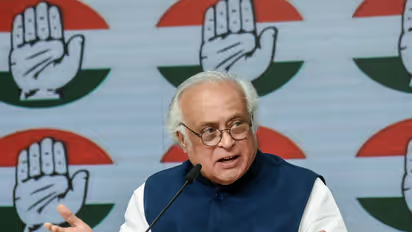
Congress MP Jairam Ramesh on Friday urged NDA-ruled states, particularly Andhra Pradesh, to oppose the proposed Viksit Bharat Shiksha Adhishthan (VBSA) Bill, 2025, during the upcoming Monsoon Session of Parliament, alleging that the legislation violates the federal structure of the Constitution, undermines the autonomy of higher educational institutions and centralises powers with the Union government.
In a post on X, Ramesh said states governed by the NDA should register dissent if they believed in protecting the constitutional rights of states. "If NDA-ruled states, especially Andhra Pradesh, have the courage of their convictions they must submit dissent notes and oppose the VBSA Bill, 2025 when it is taken up in the forthcoming Monsoon Session of Parliament. The VBSA will actually be a Very Bad Shiksha Act," Ramesh said.
Jairam Ramesh's Four Objections
The Congress leader outlined four major objections to the proposed legislation, beginning with what he described as a constitutional overreach.
Constitutional Overreach
He argued that the Bill had been introduced under Entry 66 of the Union List, which empowers Parliament only to coordinate and determine standards in institutions of higher education and research. According to Ramesh, "Constitutional Overreach: The proposed Bill, as stated in its Statement of Objects and Reasons, was introduced for passing in Parliament under Entry 66 of Union List in the Seventh Schedule of the Constitution. However, Entry 66 of Union List gives limited and specific legislative powers to Parliament that is only for "Co- ordination and determination of standards in institutions for higher education or research and scientific and technical institutions." The VBSA Bill gives the VBSA powers far beyond this scope, and specifically encroaches on State Government powers. Entry 44 of List I-Union List expressly prohibits the Parliament for law-making on matters of Incorporation, Regulation and Winding up of Universities, and Entry 32 of List II-State List expressly gives this law-making power to State Legislatures. The Bill is therefore violative of the federal structure of the Constitution." If NDA-ruled states, especially Andhra Pradesh, have the courage of their convictions they must submit dissent notes and oppose the VBSA Bill, 2025 when it is taken up in the forthcoming Monsoon Session of Parliament. The VBSA will actually be a Very Bad Shiksha Act for the… pic.twitter.com/k6yXKqwK7e — Jairam Ramesh (@Jairam_Ramesh) July 10, 2026
Absence of Grants Council
Ramesh also criticised the absence of a dedicated grants council in the proposed regulatory framework, stating, "Absence of Grants Council: The National Education Policy 2020 (NEP) expressly envisioned a Higher Education Council of India with four verticals. The current bill envisions only three Councils, with the exception of a council for grant-giving. Effectively, grant-giving powers will be returned from autonomous bodies (the UGC and AICTE) governed by academics to the Ministry that is run by politicians. This centralisation of power is a departure from current practice, a violation of the NEP, and a threat to the autonomy of our universities."
Impact on Institutions of National Importance
The Congress MP further alleged that the Bill could adversely affect the autonomy of Institutions of National Importance (INIs), including the Indian Institutes of Technology (IITs), Indian Institutes of Management (IIMs), National Institutes of Technology (NITs), Indian Institutes of Information Technology (IIITs) and Indian Institutes of Science Education and Research (IISERs). Referring to Clause 49 of the draft legislation, Ramesh said, "Impact on Institutions of National Importance: The VBSA includes the INIs-- Institutes of National Importance (IITs, IIMs, NITs, IIITs, and IISERs) --which have historically had autonomy. For instance, as per the IIT Act 1961, IITs are empowered to create their own academic programs and need no further approvals for the grant of the same. However, clause 49 of the draft Bill grants the Bill an overriding effect over all other laws currently in force. Although it says that the autonomy of INIs cannot be compromised, it is not clear on the details. Therefore, with this bill, IITs and other INIs may also be expected to fall under the Commission's regulatory powers. This has never been the case before and may compromise their academic and institutional autonomy."
Dilution of UGC's Consultative Requirements
Ramesh also claimed that the Bill dilutes the consultative mechanism currently available under the University Grants Commission (UGC) Act. He argued, "Dilution of UGC's Consultative Requirements: Under the Existing UGC Act, there is mandate for UGC to perform all its functions of determination and maintenance of standards in universities, specify regulations, and even to conduct inspection in consultation with the Universities. The proposed Bill, in contrast, gives sole discretionary powers to the Councils to determine standards, conduct inspection, and exercise/perform other unlimited and unspecified powers and functions." "The regulator is now statutorily siloed off from the institutions," he said.
Challenge to Chandrababu Naidu
Taking a swipe at Andhra Pradesh Chief Minister and Telugu Desam Party (TDP) president N Chandrababu Naidu, Ramesh alleged that the TDP had earlier been compelled to support the Centre on issues such as delimitation and questioned whether it would now oppose the education legislation if it believed it undermined states' rights. "Chandrababu Naidu garu was opposed to the Delimitation Bills but was forced to support them. Now the picture is different. The TDP is no longer essential for the survival of Mr. Modi since it has been displaced in the 2nd position in the NDA by the three-year old, obscure, and fishy Nationalist Citizens Party of India. So, if he believes that the VBSA is not in the interests of states he must stand up boldly and be counted.," he said.
Background of the VBSA Bill
The Viksit Bharat Shiksha Adhishthan Bill, 2025, seeks to overhaul India's higher education regulatory framework by replacing existing bodies with a new institutional structure. Introduced in the Lok Sabha on December 15, 2025, the legislation is currently under examination by a Joint Parliamentary Committee, which has been consulting domain experts, including representatives from IIT Bombay, SASTRA Deemed University, Shiv Nadar University and IITDM. The proposed legislation has faced criticism from sections of the opposition and some academic circles, while the Centre has maintained that the Bill aims to streamline governance, improve standards and align higher education with the objectives of the National Education Policy 2020. (ANI)
(Except for the headline, this story has not been edited by Asianet Newsable English staff and is published from a syndicated feed.)
Stay updated with the Breaking News Today and Latest News from across India and around the world. Get real-time updates, in-depth analysis, and comprehensive coverage of India News, World News, Indian Defence News, Kerala News, and Karnataka News. From politics to current affairs, follow every major story as it unfolds. IMD cities weather forecastsRain Cyclone Asianet News Official App