Indian Navy Seeks High-Speed Unmanned Targets To Sharpen Air Defence Training
Synopsis
The Defence Ministry has sought next-gen expendable aerial target drones to boost Navy anti-missile defence. These will simulate high-speed, sea-skimming anti-ship missiles for realistic live-fire training.
The Ministry of Defence has issued a request for information (RFI) for next-generation expendable aerial target (EAT NG) drones designed to simulate high-speed anti-ship missiles, as the Indian Navy moves to strengthen its at-sea anti-missile defence capabilities.
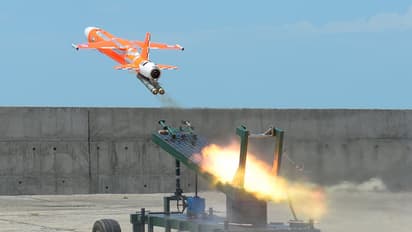
It may be recalled that following a series of successful developmental and user trials, the DRDO-developed next-generation expendable aerial target ‘Abhyas’ has now entered the mass production phase.
Formally designated EAT (NG), or expendable aerial targets (next generation), the system would be destroyed during live-fire exercises, giving warship crews realistic training against threats resembling modern sea-skimming missiles.
Demanding specifications
The target drone must reach speeds of at least 300 metres per second at low altitude roughly Mach 0.87 sustain flight for 60 minutes, operate as low as five metres above sea level, and climb at no less than 20 metres per second.
It must execute 2G sustained turns, mimicking the agility of contemporary anti-ship threats.
Radio control must function up to 100 kilometres from the ground station, with full autonomous flight capability along pre-programmed paths including mid-course speed and altitude changes. The ground control station must simultaneously manage at least six targets.
In case of data-link failure, the system must be recoverable as per user programme.
The drone requires a low radar cross-section by default but must accommodate augmentation via transponders or corner reflectors when a larger signature is needed.
An acoustic miss-distance indicator capable of detecting rounds from 20mm cannon to surface-to-air missiles within a 10-metre radius, is mandatory for post-engagement assessment.
Launch must be possible from ship or shore via rocket-assisted takeoff, in conditions up to sea state 3 and winds of 30 knots.
After ditching, the drone must float long enough for recovery by boat or helicopter. Expected service life is 15 years.
Indigenization push
The RFI reflects India's broader defence self-reliance drive. The ministry has asked vendors whether they can supply under the “buy Indian-IDDM” category, requiring over 50 per cent indigenous content, or “buy Indian” at over 60 per cent, both under defence acquisition procedure 2020.
Why it matters
The Indian Navy’s warships carry several surface-to-air missile systems, including the Israeli Barak series that require periodic live-fire evaluation against realistic targets.
With INS Vikrant and INS Vikramaditya both now operational and naval expansion accelerating, maintaining crew proficiency in anti-missile defence has become an urgent priority.
Stay updated with the Breaking News Today and Latest News from across India and around the world. Get real-time updates, in-depth analysis, and comprehensive coverage of India News, World News, Indian Defence News, Kerala News, and Karnataka News. From politics to current affairs, follow every major story as it unfolds. IMD cities weather forecastsRain Cyclone Asianet News Official App