Indian Navy Expands Anti-Submarine Warfare Fleet to Counter Growing China-Pakistan Naval Threat
Synopsis
Amid growing China-Pakistan naval ties, India is boosting its anti-submarine warfare capabilities with new warships, aircraft, sonar systems, and partnerships to counter threats and secure maritime interests in the Indian Ocean Region.
New Delhi: The Indian Navy is enhancing its anti-submarine warfare (ASW) capabilities to counter the growing naval presence of China and Pakistan in the Indian Ocean Region (IOR).
The growing Sino-Pak military collaboration at sea, marked by Pakistan's acquisition of Chinese-built submarines and the increasing forays of the Chinese PLA Navy (PLAN) into the IOR, has prompted a strategic shift in India's maritime doctrine.
At the core of this shift is the rapid expansion of India's ASW fleet, encompassing warships, maritime patrol aircraft, and underwater sensors.
Pakistan's Chinese Submarines Spark Regional Alarm
Pakistan is set to receive eight Type 039A/041 Yuan-class submarines from China by 2028, with four of these being built in Karachi under a technology transfer agreement.
These diesel-electric submarines equipped with Air Independent Propulsion (AIP) systems offer extended underwater endurance and enhanced stealth, making them formidable assets for undersea warfare.
Coupled with China's submarine patrols in the IOR and naval bases like Djibouti and Gwadar, India faces a dual-front maritime challenge.
This growing collaboration between China and Pakistan is meant as a challenge to India's sea-based deterrence, the security of SLOCs (Sea Lines of Communication), which are vital maritime routes for trade and military movement, and India's influence across the IOR.
In response, India is pursuing a layered ASW strategy focused on early detection, agile tracking, and rapid neutralization of enemy submarines.
Indian Navy's Expanding ASW Capabilities
India has adopted a multi-pronged strategy to strengthen its anti-submarine muscle. This includes the induction of dedicated ASW platforms, sonar-equipped surface ships, advanced underwater detection systems, and unmanned vehicles.
India's Kamorta-class ASW corvettes, built under Project 28, are indigenously designed stealth ships equipped with hull-mounted sonars, torpedoes, and rocket launchers. The upcoming P-17A stealth frigates and the next-generation ASW corvettes under construction will further strengthen India's undersea detection and engagement capabilities.
Additionally, the Indian Navy is bolstering its fleet of specialised Anti-Submarine Warfare Shallow Water Crafts (ASW-SWC), including recent vessels such as INS Arnala and the newly launched INS Ajay. These crafts feature advanced hull-mounted sonars, variable-depth sonars, lightweight torpedoes, and anti-submarine rockets, significantly enhancing coastal anti-submarine defence capabilities.
The Indian Navy's Boeing P-8I Poseidon fleet, currently numbering 12 aircraft, is a game-changer in undersea surveillance. Fitted with state-of-the-art radar, sonar buoys, torpedoes, and electronic warfare tools, the P-8Is extend India's reach deep into the Arabian Sea and Bay of Bengal.
Plans are in place to procure additional P-8Is or a similar maritime surveillance aircraft under the Medium Range Maritime Reconnaissance (MRMR) programme.
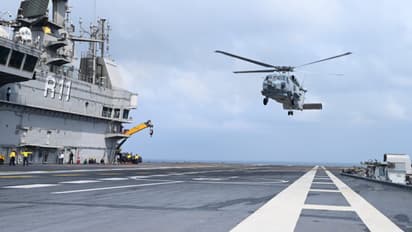
To bolster ship-based ASW, India is inducting the MH-60R Seahawk helicopters from the United States. These helicopters come with advanced dipping sonars, torpedoes, and multi-mode radar systems. They will supplement the ageing Sea Kings and enhance the fleet's ability to track submarines at greater ranges.
India is investing in seabed-based sonar arrays, autonomous underwater vehicles (AUVs), and unmanned surface vessels (USVs) to monitor choke points and strategic maritime zones. The deployment of Integrated Underwater Harbour Defence and Surveillance Systems (IUHDSS) at naval bases such as Mumbai, Kochi, and Visakhapatnam serves as a force multiplier.
Strategic Maritime Posture and Indo-Pacific Focus
The Indian Navy's shift toward ASW dominance is not merely reactive, but rather part of a broader Indo-Pacific strategy. India's partnerships with the Quad nations — the US, Australia, and Japan — have included regular anti-submarine exercises, such as Exercise Sea Dragon and MALABAR.
These drills enhance interoperability and signal intent to counteract Chinese maritime assertiveness.
India is also deepening its naval partnerships with littoral states, such as Mauritius, the Seychelles, and Sri Lanka, by providing them with coastal radar systems and maritime patrol aircraft. These initiatives help establish a regional ASW surveillance network, thereby creating maritime domain awareness that counters Chinese submarines operating far from their home bases.
Indigenous Push and Long-Term Plans
India's Defence Research and Development Organisation (DRDO) is developing indigenous AIP systems to retrofit current submarines and has been working on next-generation sonar and acoustic tracking systems.
Additionally, the 30-year submarine-building plan is set to enter a new phase with Project 75(I), which will involve submarines with advanced stealth and ASW evasion technologies.
Looking ahead, the Indian Navy aims to field over 175 warships by 2035, many of which will have integral ASW capabilities. Indigenous defence manufacturing under "Aatmanirbhar Bharat" will ensure sustained capability development, reduce dependence on foreign suppliers, and boost strategic autonomy.
India's Eye On The Future
As China and Pakistan deepen their naval alliance, the Indian Navy's proactive expansion of its anti-submarine warfare fleet reflects both strategic foresight and regional leadership.
With an eye on the future, India is not only safeguarding its maritime interests but also reinforcing stability in the Indo-Pacific region through credible deterrence and enhanced maritime domain awareness.
Stay updated with the Breaking News Today and Latest News from across India and around the world. Get real-time updates, in-depth analysis, and comprehensive coverage of India News, World News, Indian Defence News, Kerala News, and Karnataka News. From politics to current affairs, follow every major story as it unfolds. IMD cities weather forecastsRain Cyclone Asianet News Official App