India Must Shift Disaster Spending Toward Prevention As Climate Risks Intensify Across Regions Nationwide
Synopsis
India has made major gains in protecting lives from disasters, but a growing challenge remains. Experts say the next phase of preparedness will depend on where resources and planning are directed.
India has made remarkable progress in reducing disaster-related deaths over the past two decades, but experts argue that the country's next challenge lies in protecting livelihoods, infrastructure and local economies from increasingly severe climate-related events.
The debate has gained urgency as floods, cyclones, heatwaves, landslides and wildfires become more frequent and destructive. While emergency response systems have improved significantly, the economic and social costs of disasters continue to rise, prompting calls for greater investment in prevention and resilience.
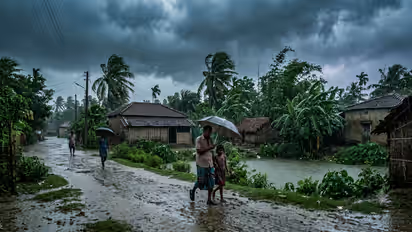
Few examples illustrate that progress more clearly than Odisha. In 1999, a super cyclone claimed nearly 10,000 lives in the state. Twenty years later, when Cyclone Fani struck, authorities evacuated a record 1.2 million people within less than 48 hours. The official death toll stood at 64, demonstrating how disaster preparedness and early response systems can dramatically reduce loss of life.
Yet Fani also exposed a broader challenge. The cyclone damaged more than 350,000 homes, destroyed power infrastructure and flattened large numbers of coastal trees. Although many lives were saved, the destruction of homes, livelihoods and public assets highlighted vulnerabilities that emergency evacuations alone cannot address.
The need for stronger resilience is becoming increasingly apparent across the country. This year alone, floods in Assam killed around 100 people, landslides hit Kerala, cloudbursts in Jammu and Kashmir claimed about 31 lives and lightning strikes killed 14 people in Jharkhand, most of them agricultural workers.
The economic consequences are also substantial. According to the Organisation for Economic Co-operation and Development, disasters cost India approximately 0.4 per cent of its gross domestic product each year.
Why Prevention Is Emerging As The Next Big Priority

Public investment in disaster management is growing. The Sixteenth Finance Commission has allocated around Rs 2.84 lakh crore for disaster management between 2026 and 2031. It has also recommended adding heatwaves and lightning to the national list of notified disasters.
However, the distribution of that funding reveals a significant imbalance. Of the total allocation, about Rs 1.64 lakh crore has been designated for relief and response measures, while Rs 40,880 crore has been earmarked for mitigation. In practical terms, roughly four rupees are being allocated to response for every rupee directed toward prevention.
Supporters of increased mitigation spending argue that this ratio deserves closer examination because investments made before disasters occur can reduce the future costs of recovery and reconstruction.
One area where progress is already visible is early warning technology. India has issued more than 134 billion SMS alerts in over 19 languages, while nationwide cell-broadcast warning systems continue to expand. The next challenge is ensuring forecasts translate directly into action. Decisions on when farmers should harvest crops, when fishing vessels should return to shore, when cooling centres should open or when emergency resources should be pre-positioned can all reduce risks before conditions worsen.
Another priority involves designing infrastructure for future climate conditions rather than historical ones. Roads, embankments, power networks, water systems and housing built to older standards may face greater risks as weather extremes intensify. India's Coalition for Disaster Resilient Infrastructure reflects this broader push toward climate-resilient development.
Experts also stress that disaster planning must be adapted to local realities. A cyclone along Odisha's coast, a Himalayan cloudburst, a Brahmaputra flood, a northern heatwave and a forest fire in central India each require different preparedness strategies. District-level plans based on local hazards are therefore considered more effective than a standardised national template.
Community involvement is equally important. Research following the 1999 Odisha cyclone found a steep decline in mangrove cover in parts of Kendrapara district. Natural ecosystems such as mangroves, wetlands, forests and grazing lands can absorb floodwaters, reduce erosion and lessen disaster impacts. Supporting local institutions to restore and manage these resources is increasingly viewed as a cost-effective resilience strategy.
India has already shown it can save lives through coordinated preparedness and rapid evacuation systems. The next phase of disaster management will focus on ensuring that communities not only survive disasters but also retain the homes, infrastructure, livelihoods and ecosystems needed for long-term recovery.
Stay updated with the Breaking News Today and Latest News from across India and around the world. Get real-time updates, in-depth analysis, and comprehensive coverage of India News, World News, Indian Defence News, Kerala News, and Karnataka News. From politics to current affairs, follow every major story as it unfolds. IMD cities weather forecastsRain Cyclone Asianet News Official App