AMCA Fighter Programme: India’s Answer To American F-35, China’s J-35 Moves Closer To Reality
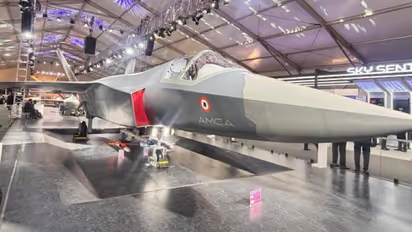
Synopsis
MoD on Wednesday issued a landmark request for proposals seeking a private industry partner to manufacture prototypes of the Advanced Medium Combat Aircraft (AMCA), the country’s most ambitious homegrown military aviation programme.
New Delhi: Taking a significant step toward indigenizing its combat aviation industry, the Ministry of Defence on Tuesday issued a request for proposal (RFP), inviting private companies to manufacture prototypes of the Advanced Medium Combat Aircraft (AMCA), the country’s first attempt at a fifth-generation stealth fighter jet.
The Aeronautical Development Agency (ADA), operating under the ministry of defence, has called on pre-qualified bidders to build five flying prototypes and one structural test specimen of the AMCA, a twin-engine, medium-weight, multi-role, low-observable aircraft being developed to meet Indian Air Force (IAF) requirements.
As per the RFP, the winning bidder will be required to set up manufacturing infrastructure, integrate advanced systems, support flight testing, and ultimately position itself as the backbone of the country’s future combat aircraft production.
What Is the AMCA?
The AMCA is India’s answer to fifth-generation fighters such as the American F-35 Raptor, the Chinese J-35, and Russia’s Su-57.
Designed to incorporate stealth characteristics through radar-absorbing materials and structures, the aircraft is envisaged as a twin-engine platform capable of carrying weapons internally — a hallmark of low-observable design — while performing multiple roles across air superiority and ground attack missions.
Development of the AMCA has been led by ADA, the same Bengaluru-based agency that designed the Tejas light combat aircraft. While the Tejas was built primarily by Hindustan Aeronautics Limited (HAL), a state-owned company, the AMCA programme marks a departure: the government is seeking a private sector partner to manufacture the prototypes, signalling a broader policy shift toward opening defence production to Indian private industry.
Scope of Work
The selected industry partner will be responsible for an end-to-end realization of the prototypes, including manufacturing aerostructures, assembling and integrating avionics, propulsion, hydraulic, fuel, electrical, and flight control systems, and establishing test facilities and ground support infrastructure.
Timeline and Milestones
The AMCA programme is structured around 14 mandatory and indicative contractual milestones spanning 84 months — seven years — from the date of the purchase order.
The last date for submission of the bid is July 27, 2026.
As per the RFP, the delivery of the first prototype’s structural modules and first flight should be done by 30 months while all the five prototypes flying by 64 months from date of purchase order.
The completion of 1,800 flight test sorties should be by 84 months.
Notably, the winning bidder will be required to incorporate an entirely new company within three months of being declared the winner.
Strategic Context
The AMCA programme carries considerable strategic weight. The IAF currently operates a mix of ageing Soviet-era MiG-29s — alongside Sukhoi Su-30MKIs, Rafales, Mirage 2000s, and the indigenous Tejas Mk1A.
The service has long flagged a declining squadron strength, with the sanctioned number of 42 squadrons having shrunk to roughly 30.
A fifth-generation aircraft of AMCA’s intended capability would place India in a small club of nations able to design and produce such platforms. However, the programme has faced years of delays in funding approvals and design maturation.
Stay updated with the Breaking News Today and Latest News from across India and around the world. Get real-time updates, in-depth analysis, and comprehensive coverage of India News, World News, Indian Defence News, Kerala News, and Karnataka News. From politics to current affairs, follow every major story as it unfolds. IMD cities weather forecastsRain Cyclone Asianet News Official App