India, Africa Enter A New Strategic Phase With Focus On Innovation, Trade And Growth
Synopsis
India and Africa are preparing for 4th India-Africa Forum Summit in New Delhi from May 28-31, 2026. The meeting aims to speed up cooperation in digital technology, trade, health, agriculture, space, and skills. The partnership focuses on shared development goals, innovation, climate action, and stronger people-to-people ties for inclusive growth.
As geopolitical shifts reshape global alliances, the partnership between India and Africa is entering a transformative new chapter. Driven by shared developmental goals, South-South solidarity and a mutual drive for self-reliance, this relationship has expanded well beyond diplomacy into the realms of technology, trade, health, and capacity building.
In this conversation, Indian Ambassador to Ethiopia Anil Kumar Rai reflects on the evolving partnership, Ethiopia’s role as Africa’s diplomatic capital, and why deeper India-Africa engagement matters more than ever.
Ques: How is India redesigning its approach for the 4th India-Africa Forum Summit to ensure faster execution of commitments?
Ans: India will host the 4th India-Africa Forum Summit (IAFS-IV) from May 28-31, 2026 in New Delhi, in collaboration with the African Union Commission. The summit will bring together leaders from across the continent, regional economic communities, specialized organizations, and the African diaspora to lay out a practical roadmap for deepening cooperation across diverse sectors.
In the lead-up to the event, preparatory meetings, think tank dialogues, and cultural events are planned, and Delhi will be adorned with Indian and African murals to celebrate the occasion.
The summit’s theme – “IA SPIRIT: India Africa Strategic Partnership for Innovation, Resilience, and Inclusive Transformation” – captures the comprehensive ambition of the partnership.
India’s approach is guided by Agenda 2063: The Africa We Want, and is closely aligned with India's own Viksit Bharat 2047 vision of becoming a developed nation by its centenary of independence. Since both regions share similar developmental challenges and opportunities, India aims to offer population-scale solutions that African nations can examine, adapt, and build upon in line with local conditions.
Ques: What mechanisms will ensure measurable, transparent outcomes on the ground?
Ans: Discussions are underway to establish a Joint Monitoring and Implementation Mechanism with clearly defined, measurable targets. Both sides are expected to convene periodically to review progress on summit decisions, ensuring that commitments translate into concrete outcomes rather than remaining aspirational statements.
Ques: How does India differentiate its partnership model from other global actors on the continent?
Ans: India and Africa share deep-rooted ties grounded in anti-colonial solidarity, people-to-people bonds, and a tradition of South–South cooperation. Unlike transactional models, India's partnership has consistently focused on demand-driven, results-oriented engagement – prioritizing capacity building, affordable technology, healthcare, education, agriculture, and institution building.
The IAFS-IV provides a pivotal opportunity to align this approach with Agenda 2063's implementation priorities, reinforcing what makes India's model genuinely distinct: it is built around Africa's own goals, not externally defined interests.
Ques: How can the summit translate India's digital infrastructure experience into scalable solutions for Africa?
Ans: India’s implementation of Digital Public Infrastructure (DPI) at population scale – spanning digital identity, banking, social services, health, education, and transportation has dramatically improved efficiency and reduced redundancy across public systems. These best practices are openly available for African countries to study and adopt.
Crucially, India's DPI stack is open source, ensuring that nations retain full data sovereignty and the freedom to innovate on top of the platform. India stands ready to support African governments in deploying these systems at scale.
Ques: What was the key message at the launch of the IAFS-IV website and logo on 23 April?
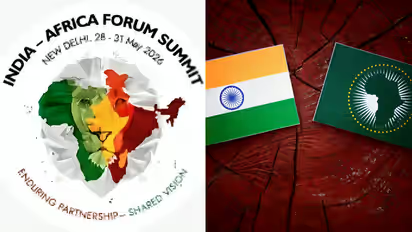
Ans: External Affairs Minister Dr S Jaishankar officially launched the logo, theme, and website for IAFS-IV on 23 April in New Delhi, with all African ambassadors accredited to India in attendance. Describing the summit as a “season of renewal,” he emphasized that it is not merely a diplomatic event but a platform to shape more ambitious, inclusive, and future-oriented cooperation.
In a world marked by volatility, he noted, the steady growth of the India-Africa relationship signals stability and reliability.
He highlighted India's long-standing support for Africa's place in global governance, pointing to the permanent inclusion of the African Union in the G20 during India's 2023 presidency as a landmark achievement.
He also referenced the establishment of 17 new Indian diplomatic missions across Africa in recent years as evidence of deepening commitment. The summit's newly launched logo – featuring the lion, native to both regions – was described as a symbol of courage, shared pride, and common identity.
Ques: What are the key areas of cooperation identified for the summit?
Ans: The IAFS-IV has identified several convergence areas between India's development experience and Agenda 2063 priorities: Digital Infrastructure and Technology: India's expertise in digital identity, interoperable payments, and e-governance offers scalable models for Africa. Collaboration in AI, fintech, cybersecurity, and digital governance can transform public services and create youth employment.
Trade, Connectivity, and Industrialization: India can support the African Continental Free Trade Area through customs digitization, logistics efficiency, and value chain development, drawing on expertise in pharmaceuticals, agro-processing, and renewable energy.
Agriculture and Green Development: Cooperation in climate-resilient farming, nano-fertilizers, millets, and organic agriculture can boost food security. India-led platforms like the International Solar Alliance and Global Biofuels Alliance offer pathways to green growth.
Health, Education, and Skills: Deeper engagement with Africa CDC on vaccines, telemedicine, and digital health, alongside expansion of technical and vocational education through institutions like IIT Zanzibar, can drive long-term human capital development.
Space and Science: ISRO collaboration can advance satellite applications, GIS mapping, weather forecasting, and disaster management across the continent.
Culture, Tourism, and Heritage: Cultural exchanges, heritage conservation, and partnerships in film and digital creative industries can deepen people-to-people ties and generate new economic opportunities.
Stay updated with the Breaking News Today and Latest News from across India and around the world. Get real-time updates, in-depth analysis, and comprehensive coverage of India News, World News, Indian Defence News, Kerala News, and Karnataka News. From politics to current affairs, follow every major story as it unfolds. IMD cities weather forecastsRain Cyclone Asianet News Official App