India Untold: The Forgotten Hero Pingali Venkayya Who Gave Us the National Flag
Synopsis
Pingali Venkayya designed India’s national flag but remained unknown for years. His vision united the country, yet he died in poverty. His inspiring story reminds us to remember the forgotten heroes behind India’s freedom.
Every Independence Day, the Indian tricolour flies high, waving in the wind with pride. It reminds us of the country's freedom, unity and sacrifice. But do we remember the person who designed it? The man behind India's first flag is one most of us have never heard of. A freedom fighter, teacher and visionary, Pingali Venkayya created the first version of India's national flag. His story is rarely told in textbooks, but it is one that every Indian should know.
Born with big dreams in a small village
Pingali Venkayya was born on 2 August 1879 in Pedakallipalli, a village in Andhra Pradesh's Krishna district. Even as a young boy, he was curious and loved to learn. His thirst for knowledge led him to Cambridge University, where he studied languages, science and more.
A soldier with a patriotic spark
At the age of 19, Pingali joined the British Indian Army and went to South Africa during the Second Boer War, as reported in The Better India. There, he met Mahatma Gandhi. Their meeting had a big impact on him.
One day, at a Congress session, Pingali saw Indian soldiers salute the British Union Jack. It made him ask, "Why are we saluting a foreign flag?"
That question never left him. It gave him a new goal: India needed its own flag.
Studying flags and designing a new one
From 1916 to 1921, Pingali studied the flags of 30 countries. He wanted to learn what made a flag special and meaningful. Then, he wrote a book called 'A National Flag for India', where he shared his ideas for a flag that truly represented India.
A meeting with Gandhi that changed everything
In 1921, during a visit to Vijayawada, Pingali presented his flag design to Mahatma Gandhi. It had red for Hindus, green for Muslims and later, on Gandhi’s suggestion, a white stripe was added for other communities. A spinning wheel (Charkha) was placed in the centre, a symbol of self-reliance and unity.
Though not official at first, this flag began to appear at Congress meetings, becoming a symbol of hope and resistance.
The flag takes shape, but credit disappears
In 1931, the Congress Party adopted a version of Pingali's design, with saffron, white and green stripes.
Finally, on 22 July 1947, just weeks before independence, the Constituent Assembly approved the national flag, based on Pingali's design but with the Ashoka Chakra (Dharma Chakra) in place of the Charkha.
A hero who faded into silence
Despite giving India one of its most powerful symbols, Pingali Venkayya's life after independence was full of struggle. He lived in poverty and died in 1963, almost forgotten.
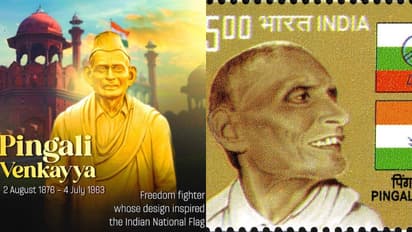
It wasn't until 2009 that India honoured him with a postage stamp. A statue was later built in his village. In 2012, there was even a proposal to award him the Bharat Ratna, but no action was taken.
Pingali Venkayya didn’t just design a flag, he gave India a symbol of hope, strength and freedom. Let this Independence Day be a tribute to him!
Stay updated with the Breaking News Today and Latest News from across India and around the world. Get real-time updates, in-depth analysis, and comprehensive coverage of India News, World News, Indian Defence News, Kerala News, and Karnataka News. From politics to current affairs, follow every major story as it unfolds. IMD cities weather forecastsRain Cyclone Asianet News Official App