'How Much Longer Will You Dry Up Sukhna Lake?': SC to Builder-Mafia
Synopsis
The Supreme Court has harshly criticized the builder-mafia and officials for the near-destruction of Chandigarh's Sukhna Lake, citing a connivance between them. CJI Surya Kant questioned the ongoing ecological damage and the role of bureaucrats.
SC Slams Builder-Mafia, Official Nexus Over Sukhna Lake's Deterioration
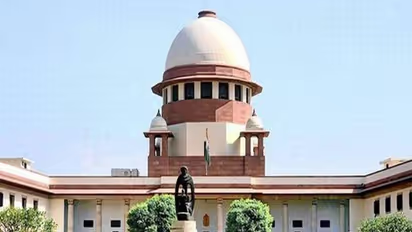
Taking serious exception to the destruction and drying up of Sukhna Lake in Chandigarh, the Supreme Court on Wednesday came down heavily on the builder-mafia and state officials, opining that they had acted in connivance that led to the severe ecological damage to the lake.
The bench, led by the Chief Justice of India (CJI) Surya Kant, remarked that the lake is at the verge of destruction and attributed this to a nexus between bureaucrats and the builder mafia. "Sukhna Lake, aur Kitna Sukhaogey Sukhna lake ko? (How much longer will you dry up Sukhna Lake?) It is on the verge of destruction. Builder mafia is working with political backing from bureaucrats. Who are the builder mafia operating?" the CJI said.
Background of the Hearing
The remarks came from the bench during the hearing of its suo moto case regarding the Aravalli definition issue, in which it had stayed its earlier decision to accept the Centre's definition of the Aravalli range. A lawyer appearing for an applicant, Anuj Kaushal, raised the issue of Sukhna Lake before the bench. The CJI immediately responded to the counsels' mentioning and expressed its displeasure over the lake's deteriorating condition.
Previous Rulings and Legal Challenges
The ongoing litigation concerning Sukhna Lake primarily focuses on protecting its catchment area. In 2020, the Supreme Court ordered the demolition of illegal structures to prevent further encroachment.
In November 2024, the Supreme Court issued notices to the Punjab government, the Chandigarh Administration, and the Union government on a plea filed by Tarsem Lal, a resident of Nada village. The plea faced challenges due to a 1998 notification declaring the Sukhna Wildlife Sanctuary, which claimed the land belonged to the state of Punjab.
Punjab Govt's Proposed Action
On Wednesday, the Punjab government filed a compliance affidavit, referring to the Supreme Court's order dated 24 July 2024, which had held that the proposed 100-metre Eco-Sensitive Zone (ESZ) was inadequate and required upward revision. The Punjab government informed the Court that it has decided to recommend an ESZ ranging from 1 km to 3 km, subject to approval by the Council of Ministers. The proposal has been approved in principle by the Chief Minister.
Construction Regulations
The affidavit stated, "As per existing Supreme Court directives. No permanent structures can be constructed within the ESZ for any purpose. No commercial construction is permitted within a 0.5 km radius outside the ESZ. Between 0.5 km and 1.25 km, only low-density, low-rise buildings up to 15 feet are allowed. Beyond 1.25 km, construction of new buildings, including residential houses, is permissible." (ANI)
Stay updated with the Breaking News Today and Latest News from across India and around the world. Get real-time updates, in-depth analysis, and comprehensive coverage of India News, World News, Indian Defence News, Kerala News, and Karnataka News. From politics to current affairs, follow every major story as it unfolds. IMD cities weather forecastsRain Cyclone Asianet News Official App