'Hindi imposition' a facade to hide failures: Pradhan slams TN CM
Synopsis
Union Minister Dharmendra Pradhan slammed TN CM M.K. Stalin, calling the 'Hindi imposition' narrative a facade to hide administrative failures. Pradhan defended the NEP and accused the DMK of stalling central schemes like PM SHRI schools.
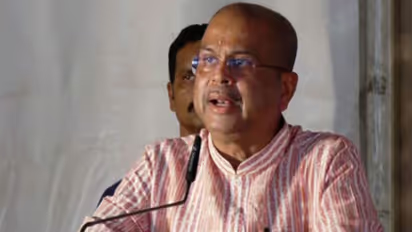
Union Education Minister Dharmendra Pradhan on Saturday launched a sharp attack on Tamil Nadu Chief Minister M.K. Stalin, accusing the DMK government of using the "Hindi imposition" narrative as a "facade" to mask administrative failures and deprive students of educational equity.
NEP a 'Manifesto for Linguistic Liberation'
In a detailed post on X, Pradhan asserted that the National Education Policy (NEP) 2020 is a "manifesto for linguistic liberation" rather than an imposition, emphasising that it prioritises the mother tongue. "Chief Minister of Tamil Nadu, Thiru @mkstalin, your narrative of 'imposition' is a tired attempt to mask political failures. The National Education Policy 2020 is, in fact, a manifesto for linguistic liberation. It prioritises the mother tongue so every Tamil child can excel in their own glorious language," Pradhan stated.
The Union Minister alleged that by misrepresenting the policy as "compulsory Hindi," the state government is creating barriers for the youth that deny them the opportunity to become multilingual global leaders. "Tamil is not weakened by the learning of additional languages; it is enriched when its speakers are multilingual, confident and linguistically empowered. Portraying multilingualism as a threat is misplaced," he added.
Pradhan said the NEP upholds constitutional principles by promoting all languages equally and also addresses the limitations of the existing two-language system. It further focuses on implementation through initiatives such as Samagra Shiksha, teacher training, and strengthening institutions, like DIETs, along with national frameworks, such as NPST and NMM.
Pradhan Accuses DMK of Stalling Central Schemes
Pradhan further highlighted that the Union Government, under Prime Minister Narendra Modi, has celebrated Tamil as a "national treasure" through initiatives like the Kashi Tamil Sangamam. He countered Stalin's questions on "reciprocity" by stating that the DMK government continues to deprive students of opportunities for a "divisive vote bank narrative."
Specifically addressing the stalling of central schemes, the Education Minister accused the Tamil Nadu government of obstructing the establishment of PM SHRI schools and Navodaya Vidyalayas. "The talk of resources is merely a facade. It is the DMK government that has stalled the establishment of PM SHRI schools in Tamil Nadu by refusing to sign the MoU after giving an undertaking for the same. Despite the directions of the Supreme Court of India to establish Navodaya Vidyalayas in Tamil Nadu, your government continues to obstruct their implementation, prioritising political narratives over educational equity," Pradhan said.
He described this resistance as a "direct disservice" to lakhs of underprivileged students who could benefit from merit-based residential education. "This deliberate resistance is not merely administrative defiance; it is a direct disservice to lakhs of underprivileged students. The Union Government remains fully committed to funding and teacher training but progress is being held back by your 'dishonest' politics," the Minister remarked.
Pradhan concluded by urging the Chief Minister to stop using the "Hindi imposition" argument to hide administrative gaps and to join the national mission of empowering Indian languages. "Mischaracterising a progressive, inclusive reform as 'linguistic imposition' is aimed at creating unnecessary apprehension and confusion. The real concern, perhaps, is not the policy's clarity, but the Chief Minister's unwillingness to acknowledge it. In doing so, he disregards the constitutional spirit that safeguards India's linguistic diversity. Stop using the "Hindi imposition" argument to hide administrative failures and join the national mission of empowering every Indian language," he concluded.
Stalin's Criticism of CBSE Framework
These remarks come after Chief Minister Stalin on Saturday criticised the Central Board of Secondary Education's (CBSE) new curriculum framework, calling it a "calculated attempt at linguistic imposition" that prioritises Hindi over regional languages.
CM Stalin said the policy undermines federalism, marginalises non-Hindi-speaking states and places an undue burden on students and teachers, urging the Union government to respect India's linguistic diversity and protect the rights of students across states.
CBSE is set to introduce a phased three-language policy from the 2026-27 academic year, beginning with Class 6. The policy requires students to learn an additional language, with at least two of the three being Indian languages.
Tamil Nadu is scheduled to go to the polls for its 234-member Legislative Assembly in a single phase on April 23, with the counting of votes set to take place on May 4. (ANI)
(Except for the headline, this story has not been edited by Asianet Newsable English staff and is published from a syndicated feed.)Stay updated with the Breaking News Today and Latest News from across India and around the world. Get real-time updates, in-depth analysis, and comprehensive coverage of India News, World News, Indian Defence News, Kerala News, and Karnataka News. From politics to current affairs, follow every major story as it unfolds. IMD cities weather forecastsRain Cyclone Asianet News Official App