Himalay Unnati Mission to study disasters after Nepal glacier collapse
Synopsis
After a deadly Nepal glacier collapse, The Art of Living's Himalay Unnati Mission announced a scientific study on Himalayan disasters. It also called for a central Himalayan Authority to coordinate resilience and sustainable development efforts.
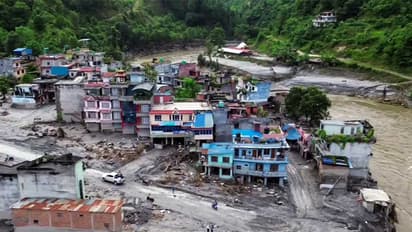
Days after the collapse of ice and underlying bedrock in Nepal’s Langtang region sent a wall of ice, rock and water down the Trishuli River, killing more than 1,000 people and leaving over 4,400 missing across Nepal and China as per official figures, the Himalay Unnati Mission (HUM), a coalition of 134 partner organisations led by The Art of Living, on Wednesday announced a scientific study into cloudbursts, landslides, glacier collapse and other recurring Himalayan disasters. The Mission has also called for the creation of a Himalayan Authority at the Centre to coordinate disaster resilience across the Himalayan states and the Northeast.
Scientific Study to Enhance Resilience
According to the release, the study will be led by scientists, ecologists, research institutions and disaster-management experts. Volunteers from The Art of Living and HUM’s partner organisations will support field data collection and community engagement across India, Bhutan and Nepal. HUM said it will seek the cooperation of the Central Government and Himalayan state governments to turn the findings into hazard maps, stronger monitoring and early-warning systems, and preparedness plans at the community level.
A Call for a Unified Himalayan Authority
Behind the announcement lies a simple conviction that has guided the Mission since its inception: the people of the Himalayas cannot be left to face these disasters alone, and no single agency can solve them. Inspired by Gurudev Sri Sri Ravi Shankar’s vision, “The Himalayas are a source of pride for the world and a lifeline for over 1.9 billion inhabitants. There is a need for regional cooperation to promote more consistent, holistic and integrated solutions for preserving its sacredness,” this mission came to life in 2021.
Pressing for a Himalayan Authority at the Centre, HUM said such a body could serve as an institutional anchor for inter-ministerial and inter-state coordination on conservation, sustainable development, climate resilience and disaster risk reduction, as per the release. “For the Indian Himalayan Region, sustainable development cannot wait for fragmented efforts to converge. It requires one-window visioning, integrated planning and swift implementation, bringing scientists, planners, policymakers, think tanks, practitioners and local communities together,” said Dr Eklabya Sharma, Padma Shri awardee, mountain ecologist, former Deputy Director General of the International Centre for Integrated Mountain Development (ICIMOD), and Advisor to the Himalay Unnati Mission.
Five Years of Groundwork and Community Impact
The study builds on five years of sustained fieldwork. Since 2021, HUM has planted 22,22,554 trees across more than 20 landscapes in Himachal Pradesh, Uttarakhand, North Bengal, Sikkim and Arunachal Pradesh under Mission Green Himalayas. It has installed 613 solar microgrids and solar-powered digital classrooms in 356 border schools, taking clean electricity to more than 1,95,000 people. Through its Samvedana disaster relief initiative, over 1,000 volunteers have reached 7,248 families and more than 45,000 people affected by floods and landslides in Himachal Pradesh, Sikkim, North Bengal and Uttarakhand, as stated in the release. The Mission has also trained more than 5,450 young people at 43-plus skill development centres in India and Nepal, certified over 5,600 farmers in natural farming and supported free education for more than 9,386 students. The aim of this livelihoods work is to ensure that economic hardship does not force mountain families to migrate.
Drawing on Global Disaster Relief Experience
HUM’s approach also draws upon The Art of Living’s wider experience in disaster relief and post-disaster rehabilitation across the world. Following the 2004 Indian Ocean tsunami, Gurudev visited affected communities while Art of Living volunteers provided immediate relief, rehabilitation and trauma care. More than 35,000 survivors benefited from trauma-relief programmes, complementing the food, shelter and material assistance delivered during the emergency.
After Hurricane Katrina in 2005, volunteers conducted trauma-relief and stress-reduction programmes for displaced adults and children across several affected American cities. The support continued through community programmes, youth initiatives and follow-up trauma care.
During the 2015 Nepal earthquake, more than 8,000 Art of Living volunteers worked across 12 of the 13 major affected districts. Relief materials reached approximately 1,50,000 people, while more than 225 trauma-relief workshops supported around 30,000 survivors.
These experiences have shaped an approach that goes beyond immediate relief to include emotional recovery, rehabilitation, livelihood restoration and long-term community resilience.
Himalayan disasters cannot be addressed through fragmented or isolated interventions, the Mission said, inviting governments, scientific institutions, businesses, civil society and citizens to join the effort. We stand together. We solve together. (ANI)
(Except for the headline, this story has not been edited by Asianetnews Editorial staff and is published from a syndicated feed.)Stay updated with the Breaking News Today and Latest News from across India and around the world. Get real-time updates, in-depth analysis, and comprehensive coverage of India News, World News, Indian Defence News, Kerala News, and Karnataka News. From politics to current affairs, follow every major story as it unfolds. IMD cities weather forecastsRain Cyclone Asianet News Official App