From Migration To Prosperity: Solar Pumps Transform Tulyachapada Farmers’ Lives With Steady Incomes
Synopsis
In Palghar’s Tulyachapada, solar-powered irrigation has enabled year-round farming, reduced migration by 90% and lifted farmer incomes, showing how sustainable innovation can reshape rural livelihoods.
Farmer Pandurang Lahare, 38, no longer makes the daily two-kilometre trek to fetch water in Tulyachapada, a hamlet in Maharashtra’s Palghar district. “Now the water comes to me,” he says, pointing to his two-acre farm where groundnut, mango and cashew thrive.
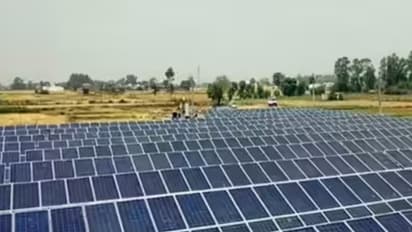
The change is driven by solar-powered pumps shared by farmer groups. Ten such pumps now serve 108 households, making irrigation possible beyond the monsoon and reducing dependence on rain.
For years, farmers grew only paddy and millets, leaving them jobless after the kharif season. Many migrated to cities like Nashik and Mumbai for daily wage work. “Life in the city wasn’t easy. We earned Rs 300-500 a day lifting bricks, but we are farmers. It was very tough,” recalls Ramdas Jadhav.
Introduced in 2019, solar-powered drip irrigation allowed year-round farming, addressing one of the roots of migration. Families no longer had to split between city and village, easing social pressures.
Expanding Cultivation
The model, ten pumps serving 100 acres, was supported by Pragati Pratishthan and Gram Oorja Pvt Solutions, with CSR backing. A 10-kilometre pipeline enabled farmers to grow groundnut and later vegetables like onions, cucumbers and chillies.
Cultivated land rose from five acres before 2019 to nearly 96 acres by 2025. Vegetable farming expanded from zero to 38 acres. Farmers produced nearly 20 tonnes of vegetables and fruits in 2024.

Groundnut cultivation grew from five acres to 57 acres.
Income from farming rose steadily, from Rs 18.3 lakh in 2021 to Rs 31 lakh in 2024. Multi-cropping added Rs 8 lakh in vegetable and fruit sales. Building Trust In New Crops
Initially, farmers hesitated to grow groundnut. “Paddy was our safety net. Groundnut was a risk,” recalls Pandurang Chaudhary. Today, his seasonal income has more than doubled, sometimes touching Rs 1 lakh.
Training in organic farming, bio-fertiliser preparation and marketing helped farmers adapt. Lahare says the additional income enabled him to fund his daughter’s college education.
Community-Led Innovation
Pragati Pratishthan’s one-to-one engagement built trust. Agricultural experts identified suitable crops, while farmers were trained in irrigation and marketing. Sarpanch Devidas Nisal says the system benefits multiple villages, enabling irrigation even when water was hard to access.
Gram Oorja’s model grouped farmers to share costs. Each farmer’s share of the system was around Rs 80,000, funded through CSR. Once operational, each generated an additional Rs 50,000 annually, making the model self-sustaining.
Gram Oorja, founded in 2008, has implemented 1,200 energy-access projects across 700 villages. In Palghar, migration has reduced by 90%. Farmers now grow second and third crops on previously unirrigated land.
The Tulyachapada project shows how solar-powered irrigation can transform rural economies, reduce distress migration and create sustainable livelihoods.
Stay updated with the Breaking News Today and Latest News from across India and around the world. Get real-time updates, in-depth analysis, and comprehensive coverage of India News, World News, Indian Defence News, Kerala News, and Karnataka News. From politics to current affairs, follow every major story as it unfolds. IMD cities weather forecastsRain Cyclone Asianet News Official App