Delhi's AQI in 'very poor' category; haze blankets national capital
Synopsis
Delhi's air quality remains in the 'very poor' category with an average AQI of 337. A thick layer of haze blankets the city despite GRAP-III being in effect. An environmentalist noted that ash clouds from an Ethiopian volcano will not immediately impact it.
Delhi's Air Quality Remains 'Very Poor'
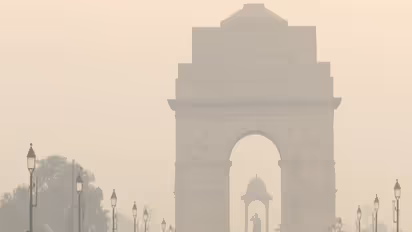
A layer of haze engulfed the national capital on Wednesday morning as the average Air Quality Index (AQI) stood at 337 at 7 am, falling under the 'very poor' category despite the Graded Response Action Plan (GRAP)-III in effect across Delhi and the National Capital Region (NCR), according to the Central Pollution Control Board (CPCB). AQI around the India Gate was recorded at 358, while AQI near the Ghazipur area stood at 363. AQI around the All India Institute of Medical Sciences (AIIMS) stood at 348. Visuals near the South Extension showed a layer of toxic smog blanketing the area. AQI around the area was recorded at 348 at 7 am. Bawana recorded the AQI level of 377 at 7 am, falling under the 'very poor' category.
In contrast, NSIT Dwarka recorded an AQI of 296, according to data from the Central Pollution Control Board (CPCB).
Expert on Volcanic Ash and Local Pollution
Meanwhile, with the ash clouds from Ethiopia's Hayli Gubbi Volcano reaching India, environmentalist Vimlendu Jha said that the ash clouds will not "immediately impact" Delhi's AQI.
He said, "The eruption of Ethopia's volcano is enormous, and if you see it in the last 24 hours, whether we talk about Gujarat, Rajasthan or even in the last 12 hours, we can even see the ashes floating around Delhi. The overall impact of the eruption will be in the form of ash clouds and will not immediately affect the AQI in Delhi. The clouds are made of sulphur dioxide (SO2) and glass particles. Though it will not immediately affect the AQI, we need to monitor it, as the clouds are in the very upper atmosphere. "The impact of these clouds might be seen in the Himalayas, the Tarai region (a lowland region of flat, alluvial soil that forms a belt along the Nepal-India border) and even parts of China.", he said.
On Delhi air pollution, he said, " In Delhi, more than half of the air quality monitoring stations are showing a rating of 400 plus of AQI, which is of the 'severe' category and in some areas, the AQI is even reaching 450 plus, which is basically 'hazardous', and this is if we take into account government monitoring stations. But if I factor in the private monitoring stations, the situation is worse, with my own device showing an AQI of 397 in my home."
Understanding AQI Categories
According to AQI categorisation, 0-50 is 'good', 51-100 'satisfactory', 101-200 'moderate', 201-300 'poor', 301-400 'very poor', and 401-500 'severe'. (ANI)
Stay updated with the Breaking News Today and Latest News from across India and around the world. Get real-time updates, in-depth analysis, and comprehensive coverage of India News, World News, Indian Defence News, Kerala News, and Karnataka News. From politics to current affairs, follow every major story as it unfolds. IMD cities weather forecastsRain Cyclone Asianet News Official App