Work From Home Back in Delhi: Govt Orders 50% Office Attendance | Full List of Exemptions Under GRAP Stage III

Synopsis
Delhi has ordered all government and private offices to operate with only 50% staff on-site under GRAP Stage III due to worsening pollution. The remaining employees must work from home. Essential services are exempt, and violations will be penalised.
Delhi has brought back strict work-from-home rules as air quality continues to touch dangerous levels. The Delhi government on Thursday ordered all government and private offices in the Capital to function with no more than 50% staff physically present, while the remaining employees must work from home. The direction has been issued under Graded Response Action Plan (GRAP) Stage III.
The order was released by the Department of Environment and Forests under Section 5 of the Environment (Protection) Act, 1986. Officials said the step is necessary as PM2.5 and PM10 levels across Delhi have crossed safe limits again during the winter period.
Why the work-from-home order was issued
Delhi’s air pollution has been rising sharply since mid-October. The city has been an officially notified 'air pollution control area'’ since 1987. Following directions from the Commission for Air Quality Management (CAQM), authorities activated different stages of GRAP as pollution increased day by day.
Under GRAP Stage III, strong measures must be taken before air reaches emergency levels. This includes reducing road traffic, cutting dust, and lowering emissions from offices and industries. Since office travel adds heavily to peak-hour traffic, the government has now shifted work-from-home rules to Stage III to act faster.
This change was made after the Supreme Court hearings on November 17 and 19 in the M.C. Mehta air pollution case. After discussions with departments on November 20, CAQM moved the earlier Stage IV “50% office attendance rule” into Stage III.

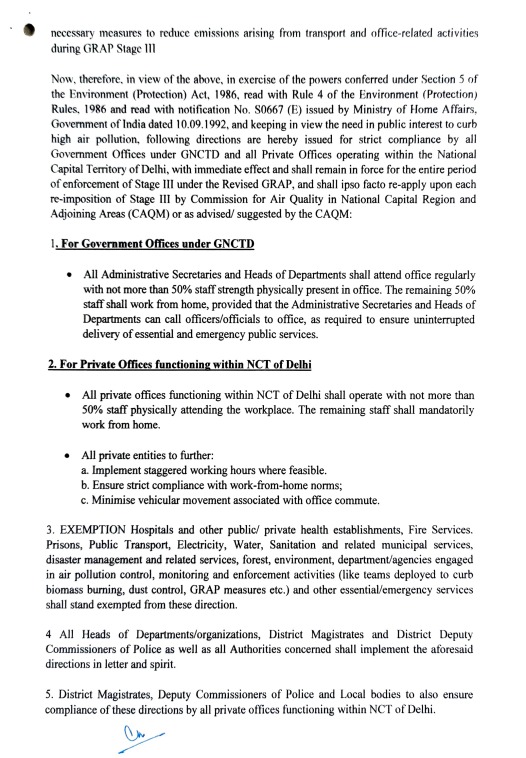
50% cap for government offices
All GNCTD government offices must operate with half their staff attending physically. Administrative Secretaries and Heads of Departments must attend office daily, but they may call extra staff only when it is essential for public services or emergency work.
Officials said the goal is to reduce the number of vehicles on the road during working hours. Traffic is one of Delhi’s biggest sources of emissions during winter pollution peaks.
50% cap for private offices and mandatory WFH
Private offices across Delhi must also follow the 50% attendance limit, and the remaining staff must 'mandatorily work from home'. Companies have been advised to:
- Introduce staggered office hours
- Strengthen work-from-home systems
- Reduce office-related vehicular movement
- Avoid calling extra staff unless absolutely necessary
The government has said that private offices play a major role in daily traffic patterns, and their cooperation is important to bring down emissions.
Staggered timings approved
Just days before these rules, Delhi Lieutenant Governor V. K. Saxena approved staggered office timings for government and Municipal Corporation of Delhi offices. The idea is to break the morning and evening rush-hour crowd and reduce vehicle pollution. These new timings will run along with the work-from-home rule.
Essential services will continue normally
Essential services do not fall under the 50% attendance rule. The following departments are exempt:
- Hospitals and health facilities
- Fire services
- Prisons
- Public transport departments
- Water and electricity utilities
- Sanitation services
- Disaster management units
- Pollution control and enforcement bodies
Officials in these departments must continue reporting for duty as normal.
Strict enforcement and penalties
The order is effective immediately and will stay in force for the entire period of GRAP Stage III. District Magistrates, DCPs and local bodies have been instructed to ensure that all offices follow the rule. Any violations will lead to penalties under Sections 15 and 16 of the Environment (Protection) Act, 1986, along with other applicable laws.
The Environment Department has also asked the IT Department to display the complete order clearly on the Delhi government’s website.
Delhi continues to struggle with winter pollution every year. Authorities say that cutting traffic is one of the quickest ways to reduce emissions. They expect that large-scale work-from-home adoption across government and private offices will help control air quality to some extent.
Officials added that more measures may be activated if pollution continues to rise.
(With inputs from agencies)
Stay updated with the Breaking News Today and Latest News from across India and around the world. Get real-time updates, in-depth analysis, and comprehensive coverage of India News, World News, Indian Defence News, Kerala News, and Karnataka News. From politics to current affairs, follow every major story as it unfolds. IMD cities weather forecastsRain Cyclone Asianet News Official App