Delhi HC dismisses Nayan Raheja's bail plea in money laundering case
Synopsis
The Delhi High Court dismissed real estate businessman Nayan N Raheja’s anticipatory bail plea in a money laundering case, citing his failure to cooperate with the ED and to meet the twin conditions required under the PMLA.
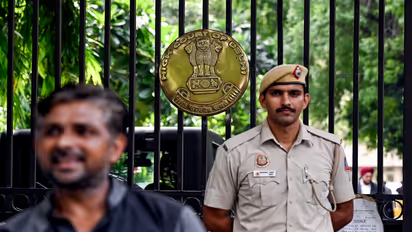
The Delhi High Court on Thursday dismissed real estate businessman Nayan N Raheja’s anticipatory bail plea in a money laundering case, observing that he had failed to satisfy the twin conditions under the Prevention of Money Laundering Act (PMLA) and that his failure to appear before the Enforcement Directorate (ED) despite repeated summons weighed against granting him protection from arrest.
Justice Amit Bansal held that, in view of the material on record, it could not be said that Raheja was not guilty of the alleged money laundering offence or that he would not be involved in such activity if granted bail. The court noted that the investigation was ongoing and that his role was still being examined.
Court Cites Non-Cooperation with Investigation
The court further observed that Raheja had failed to cooperate with the investigation despite undertakings given before the court. It held that the reasons furnished by him for not appearing in person before the ED in response to summons were not justified. The ED was represented by advocates Rajat Nair, Sarthak Sehgal, Devashish Dixit, Alok Dubey, Ashirwad and Priyanshu.
The anticipatory bail application was filed under Section 482 of the Bharatiya Nagarik Suraksha Sanhita, 2023, read with Sections 45 and 65 of the PMLA, in connection with an ECIR registered by the ED in March 2022. Raheja’s anticipatory bail plea had earlier been dismissed by the sessions court on September 19, 2026. The High Court noted that the ED had issued nine summons to Raheja between April and August 2026. According to the order, Raheja responded to some of the summons by stating that he was out of station or seeking permission to appear through video conferencing.
The court observed that Raheja had not appeared before the ED since the seizure of an iPad in April 2026. According to the ED, the device contained project-wise details concerning costs, expenses and unsold inventory of Raheja Development Limited (RDL). The court also took note of an undertaking given by Raheja in a separate writ petition that he would fully cooperate with the investigation. It observed that despite the undertaking and an earlier order recording his willingness to cooperate, he did not appear in response to subsequent summons issued in August 2026.
Referring to its earlier decision in Amanatullah Khan v. Directorate of Enforcement, the High Court reiterated that a person summoned under Section 50 of the PMLA is required to appear in person. It also noted that an investigating agency could summon a person again in light of new facts, even if the person had appeared earlier.
Arguments on PMLA Offence and Proceeds of Crime
The court rejected Raheja’s contention that the ED could not quantify the alleged proceeds of crime beyond the amounts mentioned in chargesheets relating to the predicate offences. It observed that money laundering under the PMLA is a standalone offence and that the ED’s investigation is separate from the investigation into the scheduled offences. According to the ED, ₹1,601.63 crore had been diverted from funds received from homebuyers. Raheja disputed the allegations and contended that the funds collected by RDL had been used for legitimate purposes.
The High Court observed that, at the stage of deciding an anticipatory bail application, it was not required to conduct a mini-trial to determine the precise quantum of funds allegedly diverted or whether the transactions constituted legitimate business transfers or diversion of funds. It said these issues remained under investigation and could not be accepted at face value at this stage.
Contrasting Stances of ED and Raheja
The ED had opposed the bail plea, alleging systematic diversion and utilisation of homebuyers’ funds and asserting that Raheja was involved in the affairs of RDL and its associated entities. The agency also argued that custodial interrogation was necessary to confront him with the material collected during the investigation and ascertain the ultimate utilisation of the alleged proceeds of crime.
Raheja, on the other hand, contended that he was not involved in the day-to-day management or financial affairs of RDL, had ceased to be a director of the company in November 2010 and held only a 0.81 per cent shareholding. He also relied on the status of criminal proceedings arising from the predicate offences and disputed the ED’s allegations concerning the company’s projects and financial transactions.
High Court's Conclusion
The High Court found no infirmity in the sessions court’s order rejecting anticipatory bail and concluded that Raheja had failed to meet the twin conditions prescribed under Section 45 of the PMLA. The court clarified that its observations would not be treated as an expression of opinion on the merits of the case. (ANI)
(Except for the headline, this story has not been edited by Asianet Newsable English staff and is published from a syndicated feed.)Stay updated with the Breaking News Today and Latest News from across India and around the world. Get real-time updates, in-depth analysis, and comprehensive coverage of India News, World News, Indian Defence News, Kerala News, and Karnataka News. From politics to current affairs, follow every major story as it unfolds. IMD cities weather forecastsRain Cyclone Asianet News Official App