CSIR labs' visibility enhanced under PM Modi, says Jitendra Singh
Synopsis
Union Minister Jitendra Singh inaugurated new facilities at CSIR-IICT Hyderabad, including an Effluent Treatment Plant. He praised PM Modi for boosting the visibility of CSIR labs and called for stronger industry-innovation ties for agri-startups.
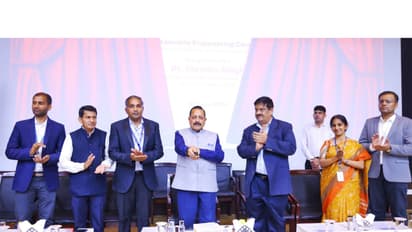
Union Minister Jitendra Singh on Tuesday congratulated the faculty and students of the CSIR-Indian Institute of Chemical Technology (CSIR-IICT) in Hyderabad on the inauguration of an Effluent Treatment Plant for textile wastewater, a Facility for Continuous Processing Technologies, and a Sustainable Engineering Complex.
Speaking to the media, Singh highlighted the efforts of Prime Minister Narendra Modi in enhancing the visibility and public outreach of the Council of Scientific and Industrial Research (CSIR) laboratories. He said several advanced technological interventions are taking place across the country's research institutions. "I congratulate the team at IICT in Hyderabad for launching these new facilities and linking them with the industry. In the last 10-12 years, after Prime Minister Modi took over, the CSIR labs have significantly enhanced their visibility and public outreach," Singh said. He added that every CSIR laboratory is contributing in its own way to scientific advancement. "Each of the labs today is qualifying in one way or the other. There are a lot of advanced technological interventions happening at different levels," he said.
Focus on Agri-Innovation and Circular Economy
Addressing faculty members and students, the Union Minister stressed the need to strengthen partnerships between agricultural innovation and industry to drive India's next phase of economic growth through a new generation of agri-startups and agri-entrepreneurs.
In a post on X, Singh said that India's agriculture sector continues to hold enormous untapped potential and that, under the leadership of Prime Minister Narendra Modi, the country's priorities have expanded beyond crop improvement to developing technologies that convert agricultural waste into reusable value-added products, creating new opportunities for farmers, industry and overall economic growth.
He said recent CSIR technologies, including the production of compressed biogas from food and agricultural waste and the conversion of captured carbon dioxide into Dimethyl Ether, demonstrate India's growing commitment to clean energy, the circular economy and the conversion of waste into valuable national resources.
Call for Industry Collaboration
Singh also called on innovators to work closely with industry, startups, MSMEs and technology partners to accelerate commercialisation and ensure the sustainability of new technologies.
About CSIR-IICT
CSIR-IICT is a premier national research institute based in Hyderabad, focusing on basic and applied chemistry, biochemistry, bioinformatics and chemical engineering. The institute provides key technological inputs to the pharmaceutical, agrochemical and biotechnology sectors.
(ANI)
Stay updated with the Breaking News Today and Latest News from across India and around the world. Get real-time updates, in-depth analysis, and comprehensive coverage of India News, World News, Indian Defence News, Kerala News, and Karnataka News. From politics to current affairs, follow every major story as it unfolds. IMD cities weather forecastsRain Cyclone Asianet News Official App