Chandrayaan-3 marks giant leap, lander 'Vikram' successfully separates from propulsion module
Synopsis
The spacecraft was launched on August 5 using a GSLV Mark 3 (LVM 3) heavy-lift launch vehicle. Following its launch, a series of orbital manoeuvres were carried out to progressively lower the spacecraft closer to the moon's surface.
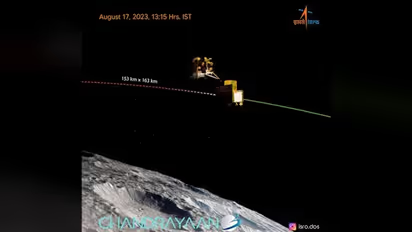
Continuing its remarkable journey in lunar exploration, India's Chandrayaan-3 mission on Thursdau (August 17) achieved a significant milestone by successfully executing the separation of the 'Vikram' lander module from the propulsion module. This achievement represents a noteworthy step forward in the Chandrayaan-3 mission, with the lander module named in honor of Vikram Sarabhai, the visionary figure often hailed as the architect of India's space program.
A significant step towards India's lunar exploration ambition was taken on Wednesday, as the Chandrayaan-3 spacecraft successfully executed its final lunar-bound orbit reduction manoeuvre. This achievement comes a week ahead of the scheduled landing on the moon's south pole, set to occur on August 23.
Noida man performs stunt on car roof, owner fined Rs 26,000 | WATCH
The spacecraft was launched on August 5 using a GSLV Mark 3 (LVM 3) heavy-lift launch vehicle. Following its launch, a series of orbital manoeuvres were carried out to progressively lower the spacecraft closer to the moon's surface. The Chandrayaan-3 mission, initiated by the Indian Space Research Organisation (ISRO) on July 14, has seen its components meticulously prepared and launched from the Satish Dhawan Space Centre in Sriharikota, Andhra Pradesh.
ISRO's aspiration for a successful soft landing on the moon is set to make India the fourth nation in the world to achieve this feat, following the United States, Russia, and China.
The Chandrayaan-3 mission includes a variety of essential electronic and mechanical subsystems designed to ensure a secure and gentle lunar landing. These subsystems encompass navigation sensors, propulsion systems, guidance and control systems, among others. The mission's primary objectives are to achieve a safe and gentle landing, enable rover mobility on the moon's surface, and carry out in-situ scientific experiments.
Odisha horror: Massive crocodile devours woman taking bath riverside | WATCH
In a determined response to previous challenges, ISRO has undertaken Chandrayaan-3 as a subsequent endeavor after the Chandrayaan-2 mission encountered difficulties during its attempted soft landing on the moon's surface in 2019. Regrettably, the Chandrayaan-2 mission was eventually categorized as having fallen short of its primary mission objectives.
Despite these challenges, the Chandrayaan-2 mission yielded significant scientific achievements. These accomplishments encompassed the creation of the first-ever comprehensive global map for lunar sodium distribution, the advancement of insights into the distribution of crater sizes on the moon, and the definitive identification of lunar surface water ice through the IIRS instrument, among other noteworthy findings.
Stay updated with the Breaking News Today and Latest News from across India and around the world. Get real-time updates, in-depth analysis, and comprehensive coverage of India News, World News, Indian Defence News, Kerala News, and Karnataka News. From politics to current affairs, follow every major story as it unfolds. IMD cities weather forecastsRain Cyclone Asianet News Official App