Census 2027 to feature caste enumeration for first time since 1947
Synopsis
The Centre notified 40 questions for Census 2027, which for the first time since Independence, will include caste enumeration for all communities. The digital census will be conducted in two phases, with population enumeration in February 2027.
The Centre on Friday notified a set of 40 questions to be asked during the exercise of the population enumeration phase of Census 2027, with specific mention of "caste enumeration" for all communities for the first time since Independence, marking a major departure from previous decennial censuses.
Caste Enumeration: A Historic First Since Independence
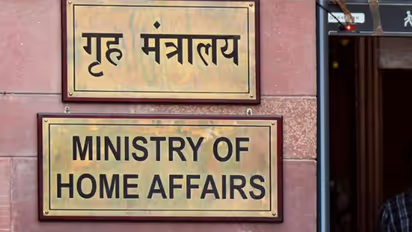
The notification issued by the Ministry of Home Affairs through the Office of the Registrar General, India, on Friday lists the information to be collected from every person through the Household Schedule. It includes details on caste, religion, education, employment, migration, family and other demographic parameters.
Caste enumeration has emerged as a major feature of the Indian Census 2027. The inclusion of caste at question number 10 assumes particular significance as Census 2027 will be the first census since Independence to undertake comprehensive caste enumeration. Until the 2011 Census, the exercise included the systematic enumeration of only Scheduled Castes (SCs) and Scheduled Tribes (STs), while caste enumeration for other communities was not part of the post-Independence Census.
The decision to include caste enumeration in Census 2027 was taken by the Cabinet Committee on Political Affairs (CCPA) on April 30, 2025. The latest notification specifically lists question number 10 as "Scheduled Caste (SC)/Scheduled Tribe (ST)/Caste" among other questions to be asked during population enumeration.
Comprehensive Data Collection: The 40 Questions
The notification comes as preparations for Census 2027 are underway. The Census is being conducted in two phases, with the first phase covering House Listing and Housing Census, followed by Population Enumeration, during which comprehensive demographic, socio-economic and caste-related information will be collected.
According to the notification, census officials will collect basic demographic information including the name of the person, relationship with the head of household, sex, date of birth and age, marital status, age at marriage and spouse's name. The schedule will also seek information on nationality, religion, caste, parents' particulars, disability, mother tongue and other languages known, literacy and digital literacy, educational attendance and highest educational level attained.
The questionnaire contains a detailed set of employment-related questions, including whether a person worked during the last year, category of economic activity, occupation, nature of industry, trade or service, class of worker and non-economic activity. It will also ask whether a person is seeking or available for work and about travel to the place of work.
Migration-related information will include birthplace, place of last residence, reason for migration, duration of stay at the present village or town since the last migration and permanent residential address. The schedule will also collect information on the number of children surviving, number of children ever born alive, and children born alive during the last year for women in specified categories.
Among other details, the 40 questions include place of COVID-19 vaccination, total number of bank accounts, mobile number, Aadhaar number, voter ID number, passport number for Indian passport holders and availability of a driving licence. Census 2027 is also India's first digital census, with data collection being carried out through digital tools and an optional self-enumeration facility.
Legal Framework and Data Confidentiality
"In exercise of the powers conferred by sub-section (1) of section 8 of the Census Act, 1948 (37 of 1948), the Central Government hereby instructs and directs that the census officers may, within the limits of the local area for which they have been respectively appointed, ask all such questions of all persons residing within such limits, about the items enumerated below, for collecting information through the Household Schedule in connection with the Census of India 2027," reads the notification.
The Census 2027 is anchored in a robust institutional and administrative framework that ensures consistency, credibility, and nationwide uniformity in data collection. Post-independence, the Census is governed by the Census Act, 1948, and the Census Rules, 1990, ensuring a strong legal and institutional framework.
The Census is a Union subject under the Seventh Schedule (listed at serial number 69) of the Constitution. As a Union subject, the exercise is centrally coordinated while implemented in close collaboration with State and Union Territory governments, enabling seamless execution across diverse regions.
As per the MHA, the framework guarantees strict confidentiality of individual data, reinforcing public trust and participation. The Census Act contains a significant provision - Section 15, under which personal information provided by people is treated as strictly confidential. It cannot be made public under the RTI Act, used as evidence in any court of law, or shared with any institution.
Phases and Timeline of Census 2027
The intent of the government to conduct the Population Census 2027 was notified in the Gazette of India on June 16, 2025. The Union Cabinet approved a financial outlay of Rs 11,718.24 crore for its implementation.
The Phase I (House listing and Housing) Census is scheduled between April and September 2026. It will be held in a period of 30 days in each state and UT, as per the convenience of the state and the UT governments. There will also be an option of self-enumeration during 15 days just before the 30-day period of house-to-house HLO work. This phase gathers detailed information on housing conditions, availability of amenities, and assets possessed by households, while also creating the essential frame for the subsequent phase.
However, Phase II (Population Enumeration) is scheduled for February 2027 and will focus on capturing detailed demographic, socio-economic, cultural, migration, and fertility-related information of individuals across households. As decided by the CCPA, enumeration of Castes will also be done during the second phase of the Census. For Ladakh and snow-bound non-synchronous areas of Jammu and Kashmir and states of Uttarakhand and Himachal Pradesh, Phase II will be conducted during September 2026. (ANI)
(Except for the headline, this story has not been edited by Asianet Newsable English staff and is published from a syndicated feed.)Stay updated with the Breaking News Today and Latest News from across India and around the world. Get real-time updates, in-depth analysis, and comprehensive coverage of India News, World News, Indian Defence News, Kerala News, and Karnataka News. From politics to current affairs, follow every major story as it unfolds. IMD cities weather forecastsRain Cyclone Asianet News Official App