SC allows Bihar voter list revision, tells ECI to consider Aadhaar, voter ID and ration card as valid proof
Synopsis
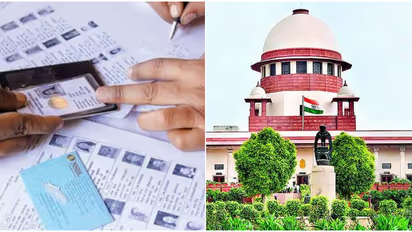
The Supreme Court has allowed the Election Commission’s special revision of Bihar's voter list but questioned its timing. It urged the poll body to accept Aadhaar, EPIC and ration card as valid documents for identity verification.
Supreme Court on Thursday allowed the Election Commission of India (ECI) to carry out its Special Intensive Revision (SIR) of electoral rolls in Bihar, but raised serious concerns over the timing and document requirements in the process.
SIR not stayed, but court flags timing
The bench, led by Justices Sudhanshu Dhulia and Joymalya Bagchi, refused to stop the exercise. However, the judges questioned why the revision was being held just months before the Bihar Assembly elections, due in November 2025.
“The exercise is not the problem, the timing is,” Justice Dhulia observed. “Why link the SIR to elections? Once the electoral roll is finalised, there’s no way to challenge exclusion. That’s a real concern,” he said.
The bench also stressed that the Election Commission must ensure the process does not lead to the removal of genuine voters, particularly when many won’t have access to detailed documents.
Aadhaar, EPIC and ration card should be considered, says SC
A major issue raised by the petitioners was the non-inclusion of Aadhaar, voter ID (EPIC) and ration cards among the 11 documents listed for the verification process.
The court said the ECI's list was not final and directed the Commission to consider including these commonly held documents.
"Aadhaar has been accepted for various government purposes. Why not here?" the bench asked.
"If the Commission doesn’t accept them, it must give clear reasons," the court added.
ECI explains its stand, asked to reply by July 21
The Election Commission, represented by senior advocate Rakesh Dwivedi, said it was following legal provisions and was 'not discriminating'. The court accepted that the ECI had constitutional powers but said the procedure and timing must also be just. The bench framed three questions for consideration:
- Does the ECI have the powers to conduct the SIR?
- Is the current procedure lawful and fair?
- Is the timeline too short ahead of elections?
The ECI has been asked to file a detailed response by July 21, and the matter will be heard again on July 28.
Voter document rules challenged as unfair
The SIR guidelines, issued by the ECI on June 24, require people not on the 2003 electoral roll to submit documents proving citizenship. Those born after December 2004 must also submit citizenship documents of both parents. If a parent is a foreign national, the passport and visa from the time of birth are also required.
The Association for Democratic Reforms (ADR) and several opposition leaders called these rules unrealistic, especially in Bihar where many poor voters lack formal documentation.
They argued that this would disenfranchise lakhs of voters, violating their constitutional rights.
Over three crore voters may be affected, say petitioners
According to ADR, over three crore voters in Bihar could fail to meet these new document criteria and risk being removed from the voter list.
Petitioners argued that the ECI had not even provided valid reasons for ordering such a large-scale revision. Under Section 21(3) of the Representation of the People Act, 1950, special revisions can only be done with a recorded justification.
Opposition slams move, says it targets poor and marginalised
The petitions were supported by a long list of opposition leaders and parties including Mahua Moitra, Manoj Jha, KC Venugopal, Supriya Sule, Yogendra Yadav, D Raja, DMK, and others. They warned that the new rules would mainly impact rural voters, daily-wage earners, and marginalised groups who often don’t have access to full documentation.
Some leaders also questioned why Aadhaar and voter IDs, issued by the same or related government bodies, were now being excluded as identity proof.
Court leaves final decision to ECI, but wants fairness
The court clearly stated that the ECI has the right to revise the rolls but must act fairly, reasonably, and with transparency. While it did not stop the SIR, it asked the poll panel to act in a manner that does not unfairly disenfranchise any eligible voter.
“We’re not doubting the EC, but this is about the right to vote. The process matters,” the court said.
(With ANI inputs)
Stay updated with the Breaking News Today and Latest News from across India and around the world. Get real-time updates, in-depth analysis, and comprehensive coverage of India News, World News, Indian Defence News, Kerala News, and Karnataka News. From politics to current affairs, follow every major story as it unfolds. IMD cities weather forecastsRain Cyclone Asianet News Official App