Bihar's Record Turnout Decoded: Experts Credit Women, Jan Suraaj Buzz, PM's Push and Gen Z Energy
Synopsis
Bihar’s first phase of elections saw a record 64.66% voter turnout — the highest in state history. Experts credit Modi’s rallies, women’s cash benefits, Chhath migration, and Prashant Kishor’s Jan Suraaj for energizing Bihar’s voters.
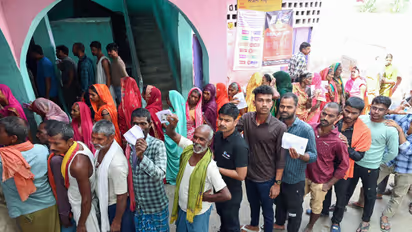
Patna: The first phase of voting in Bihar Assembly Election 2025, covering 121 constituencies across 18 of the state’s 38 districts, concluded on Thursday with a record-breaking voter turnout. According to data released by the Election Commission of India, the first phase saw a festive and peaceful polling process, marking Bihar’s highest-ever turnout at 64.66%.
To understand what drove this unprecedented participation and what it signals for the state’s political landscape, Asianet Newsable English spoke to several political experts and observers.
Experts See Jan Suraaj as a Rising Force
While Bihar’s politics has long been dominated by a bipolar contest between the NDA and the INDIA alliance, this election has taken a new turn with the entry of Prashant Kishor’s Jan Suraaj. The fledgling party, focusing its campaign on migration, employment, and development, has added a third dimension to the race.
Experts say the one-year-old outfit, though unlikely to win more than 4–5 seats, could still make a significant mark by securing 12–15% of the vote share — a remarkable achievement for a new political force that isn’t rooted in caste or religious mobilization.
‘Women and PM’s Rallies Drove Turnout’: JNU Professor
Himanshu Roy, a Professor of Political Science at Delhi-based Jawaharlal Nehru University (JNU) said: “There are majorly two reasons for increase in the voting percentage either for pro-incumbency or for anti-incumbency. In Bihar, I think it was for pro-incumbency. The women voters have got Rs 10,000 in their bank accounts. Also, the prime minister held several rallies and roadshow in the state. These have led to rise in voting percentage.”
‘Nothing Extraordinary,’ Counters Psephologist
However, Shashi Shankar Singh, a psephologist, JNU alumnus, and head of Ground Zero Research, offered a different perspective on the turnout. According to him, it is natural rise in the percentage since 2005.
“Since 2005, voter turnout has consistently risen by about 3–4% in each election, except in 2020, which was held during the Covid-19 pandemic.”
“This year, the polling dates almost coincided with Chhath Puja (Bihar’s biggest festival) and the wedding season. Many migrant workers returned home for the festival celebrations, delayed their departure, and ended up casting their votes.”
“So, the rise in voting percentage isn’t extraordinary or suspicious — it’s a natural and predictable trend.”
When asked about the huge turnout of women voters, Shashi Shankar Singh said: “In each villages you will find men are out of Bihar to earn livelihood and women are managing everything at home here in the state. So it is obvious that the women would be seen in large numbers. Rs 10,000 in their accounts is definitely played a role.”
Voters Energized by Decisive Issues
Indra Deo Singh, a retired government official who was also involved in conducting election in the state, said: “This election is seen as a decisive one for the state’s future. Issues such as unemployment, education, infrastructure, and law and order have stirred intense debate, pushing voters to the booths in greater numbers.”
“The competitive campaigns run by NDA, INDIA and Jan Suraaj have energized the electorate, making this one of the most closely watched elections in recent years,” Indra Deo Singh said.
Gen Z and Migrants Add New Energy to Polls
Educator Rohit Sir, who runs a coaching centre in Patna, attributed the surge in voter turnout to Gen Z voters and migrant labourers. He noted that over 21 lakh first-time voters were enrolled in this election, significantly influencing the first phase’s participation.
“The first time voters are mostly unemployed. There are jobless under the NDA government led by Nitish Kumar. So they will not go for NDA this time. They have also not seen the Lalu-Rabri regime, which is famously known as ‘Jungle Raj’ but have heard of it either from their parents or known one. So they will also not vote for RJD-led INDIA alliance. So I think they all will go for the third option — Jan Suraaj.”
He added that the same sentiment was visible among migrant labourers, many of whom chose to stay back in Bihar specifically to cast their votes. They believe Jan Suraaj offers a chance for real change and could help create employment opportunities within the state.
The second phase of polling, covering 122 assembly constituencies, is scheduled for November 11, while vote counting will take place on November 14.
Stay updated with the Breaking News Today and Latest News from across India and around the world. Get real-time updates, in-depth analysis, and comprehensive coverage of India News, World News, Indian Defence News, Kerala News, and Karnataka News. From politics to current affairs, follow every major story as it unfolds. IMD cities weather forecastsRain Cyclone Asianet News Official App