Allahabad HC orders UP gram panchayat polls within 3 months with OBC quota
Synopsis
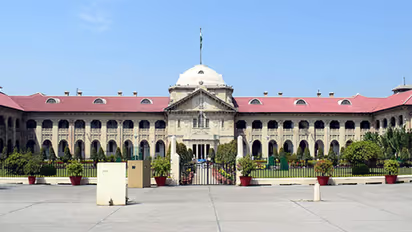
The Allahabad High Court has ordered the Uttar Pradesh government to hold gram panchayat elections within three months. The court ruled that the polls must be held under the existing reservation framework, including the 27% OBC quota.
The Allahabad High Court has directed the Uttar Pradesh government and the State Election Commission to complete gram panchayat elections within three months, making it clear that the polls will be held under the existing reservation framework, including a 27% quota for Other Backward Classes (OBCs).
A division bench of Justice Ajit Kumar and Justice Garima Prasad ruled that elections cannot be postponed pending the report of the state’s dedicated commission on OBC reservation. OBC-reserved seats cannot be treated as general seats merely because the inquiry is incomplete. Reservation for Scheduled Castes (SCs), Scheduled Tribes (STs) and women will continue as prescribed by law, subject to the 50% ceiling on total vertical reservation.
Court Scrutinizes OBC Commission's Work
Referring to Article 243-E of the Constitution and the Supreme Court’s judgment in Suresh Mahajan v. State of Madhya Pradesh, the bench said panchayat elections must be completed before the expiry of the five-year term. Even if the triple-test exercise for determining OBC reservation remains incomplete, elections cannot be deferred, it held.
The state government constituted a five-member dedicated commission under former judge Ram Avtar Singh on May 18, 2026. The commission told the court that around 60% of its work had been completed, with surveys conducted in 40 districts.
However, the court noted shortcomings in the material presented. In Agra, which has a rural population exceeding 25 lakh, only 175 people attended a survey meeting and 29 forms were submitted. Some forms were filled out by non-OBC respondents, while several contained only brief yes-or-no answers.
The criteria for assessing political backwardness and the methodology for framing recommendations also remained unclear. The commission’s advisory committee had questioned the government for failing to specify criteria to identify the “more backward among the backward”.
The bench said the material did not establish that the empirical inquiry required by the Supreme Court had been completed, while leaving open the possibility of a valid report in the future. It suggested a framework involving local body-wise data registers, comparisons of population and representation, and an assessment of socio-economic indicators linked to political participation.
Ruling on Administrator Appointments
The court also upheld the May 25, 2026, government order appointing outgoing gram pradhans as administrators after their terms expired. It said such appointments were not inherently unlawful and could not be set aside merely on apprehensions.
However, the arrangement must remain temporary, administrators’ tenure cannot be extended beyond the election timeline, and the government may act on serious complaints against them. The bench rejected challenges to Sections 12(3-A) and 12-BB(3) of the Uttar Pradesh Panchayat Raj Act, 1947, holding that Section 12(3-A) did not confer arbitrary or uncontrolled powers. It stressed that temporary administration cannot indefinitely replace elected bodies.
Final Directives and Election Readiness
The state government was directed to provide the Election Commission with the necessary personnel, funds, security and other resources to conduct the polls. The dedicated commission must continue its inquiry and submit its report within the stipulated period, subject to any extension granted by the government. The government must then examine its recommendations and take the necessary legislative and statutory steps.
The State Election Commission informed the court that the electoral roll was published on June 10, 2026, and that it could conduct the elections with adequate time and resources.
The previous gram panchayat elections were held in 2020, and the panchayats’ terms ended in May 2026, prompting petitioners to approach the High Court.
Amicus curiae Sameer Sharma, senior advocate Ashish Kumar Singh and other lawyers appeared for the petitioners. Additional Advocate General Manish Goyal represented the state. (ANI)
(Except for the headline, this story has not been edited by Asianet Newsable English staff and is published from a syndicated feed.)Stay updated with the Breaking News Today and Latest News from across India and around the world. Get real-time updates, in-depth analysis, and comprehensive coverage of India News, World News, Indian Defence News, Kerala News, and Karnataka News. From politics to current affairs, follow every major story as it unfolds. IMD cities weather forecastsRain Cyclone Asianet News Official App