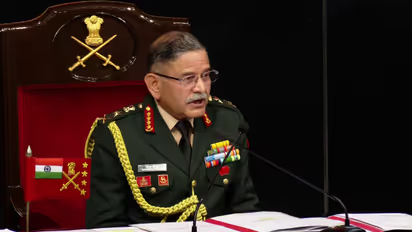
Why Army Chief General Upendra Dwivedi Is Being Called India's 'Drone General'
Synopsis
As Army Chief General Upendra Dwivedi prepares to retire on June 30, 2026, he leaves behind a transformed Indian Army built for modern warfare. His tenure saw the deployment of 50,000 drones, creation of specialised combat units, expansion of domestic drone production, and new military doctrines. Operation Sindoor validated these reforms.
New Delhi: When General Upendra Dwivedi retires as Chief of Army Staff on June 30, 2026, he will leave behind an army that looks very different from the one he inherited. The numbers tell part of the story — 50,000 drones deployed, more than 25 hubs built across the country, a reach of 500 kilometres, nearly 25 policy documents written, and 32 nations brought together at a single military conclave. That is why many now call him the “Drone General.”
But the numbers alone don’t explain what actually happened. They show the result. They don’t show the thinking behind it. The key was a choice General Dwivedi made early on: he treated modernisation not as something to plan for gradually, but as an urgent problem that needed solving now. He didn’t need to look far for reasons.
Wars in Ukraine and Gaza were showing the world, in real time, what future battlefields would look like — fast, transparent, and dominated by drones, electronic warfare, and precision weapons.
An army built around large numbers of soldiers and traditional equipment was simply not built for that kind of war. General Dwivedi saw the gap and decided to close it quickly.
What followed was not a superficial upgrade. New units were built from scratch — Bhairav Battalions, Ashni Platoons, Divyastra Batteries, and Rudra All Arms Brigades — designed specifically for modern, multi-domain warfare.
The drone and counter-drone hubs that now dot the country were not showpieces. They were built to actually sustain operations. And because an army that relies on foreign suppliers for its most critical equipment is an army with a serious weakness, domestic drone production was pushed hard.
The doctrinal side was just as important. Nearly 25 policy and strategy documents gave the transformation a clear direction and intellectual backbone. The goal set out in them was ambitious: every soldier should understand and be able to work with drone technology. That kind of change cannot happen if only a few specialist units are trained. It requires the whole institution to shift.
Operation Sindoor
Operation Sindoor showed that a significant part of the institution had. In a live campaign, the Indian Army used drones, loitering munitions, electronic warfare, and real-time intelligence in a coordinated and effective way. What had been a plan on paper became a proven method of fighting. Strategic observers have since described Sindoor as a blueprint for India’s future approach to warfare — which is really just another way of saying that what General Dwivedi built actually worked when it mattered. He also worked to strengthen India’s position internationally.
Thirty-two nations came together through the UNTCC Chiefs Conclave. A platform called “Friends for Life” connected nearly 100,000 alumni of Indian military training institutions around the world. Infrastructure projects along border regions served both military and civilian purposes. None of this was a distraction from the core mission.
It all reflected the same understanding: a strong modern military is connected to the world around it, and draws strength from those connections.
Stay updated with the Breaking News Today and Latest News from across India and around the world. Get real-time updates, in-depth analysis, and comprehensive coverage of India News, World News, Indian Defence News, Kerala News, and Karnataka News. From politics to current affairs, follow every major story as it unfolds. IMD cities weather forecastsRain Cyclone Asianet News Official App