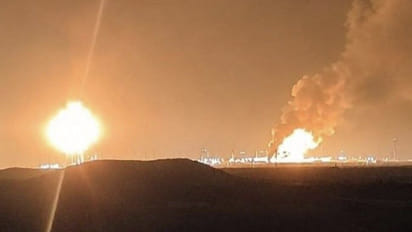
The conflict between the United States and Iran has taken another dangerous turn, with Bahrain reporting fresh Iranian aerial attacks and Kuwait's military responding to hostile drone threats on Wednesday, November 18. The developments came hours after American forces struck an Iranian missile launch site on Qeshm Island in the strategically important Strait of Hormuz.
#Kuwait and #Bahrain report fresh Iranian attacks, amid renewed escalation in hostilities between the USA and #Iran starting last week.
Kuwait's Army says that around midnight, its air defences were responding to hostile #Drone attacks.
— All India Radio News (@airnewsalerts) November 18, 2026
🚨 JUST NOW: EXPLOSIONS and ATTACKS reported against Bahrain and KUWAIT, per reports
PRAY FOR OUR TROOPS TONIGHT 🙏🏻
Sounds like Iran might be lashing out again.
They've been launching new strikes for DAYS now, including over the weekend before President Trump left for Asia
Trump is in the Philippines RIGHT NOW
Still no word on casualties, damage yet, and no official confirmation from CENTCOM
— Eric Daugherty (@EricLDaugh) November 17, 2026
Bahrain said its air defence systems had intercepted several Iranian attacks, while its Interior Ministry issued two emergency alerts asking residents to move to safe locations. Both alerts were followed by all-clear messages.
🚨 Iran says it hit back at a US base in Kuwait.
Iran's army says drones targeted US drone and missile sites at Ali al-Salem Air Base (IRNA via Al Jazeera). Kuwait says it's intercepting; Bahrain says it repelled the attacks.
Why it matters: Qeshm just got its answer. https://t.co/PojTOOCV48
— The Raw Wire 🚨 (@TheRawWire) November 18, 2026
Kuwait, meanwhile, confirmed that its air defences were responding to hostile drone attacks. Iran later claimed that its military had targeted American defence systems and drone and missile launch facilities at Ali Al Salem Air Base in Kuwait.
⚠️ Iranian drone strike on Ali al-Salem US air base in Kuwait in retaliation https://t.co/fJIgoMNavg
— Ehsan Safarnejad (@Safarnejad_IR) November 18, 2026
🇮🇷🇺🇸 Iran’s army claims it launched attack drones targeting US military installations at Ali Al Salem Air Base in Kuwait, including American drone and missile facilities and Patriot air defense systems.
The claim follows Kuwait’s announcement that its air defenses were countering hostile drones. No damage has been confirmed by Kuwait or the US.
Iran’s army warns that its response to any threat or aggression will be “decisive, crushing, and without geographic limits.”
— KOSO (@KosoWrldwide) November 18, 2026
The latest developments have raised fresh concerns about the widening conflict, particularly as Gulf countries hosting American military facilities continue to face security threats.
Bahrain's Defence Force said its air defence systems had intercepted several Iranian aerial attacks early on Wednesday.
In a statement, the Bahrain Defence Force General Command accused Iran of continuing its hostile actions against the kingdom and targeting its territory.
The country's Interior Ministry also issued two emergency alerts in the early hours, warning residents of potential threats and asking them to remain calm and move to the nearest safe location.
The authorities subsequently issued all-clear messages after both alerts, indicating that the immediate danger had passed.
The latest warning followed another Iranian attack reported on Tuesday, November 17. Iran's Islamic Revolutionary Guard Corps (IRGC) claimed that it had launched drones targeting a US-operated radar system at Sheikh Isa Air Base in Bahrain.
IRAN ESCALATES: Iranian attacks against Kuwait and Bahrain were reported overnight.
Reports indicate direct impacts and powerful explosions at several locations. https://t.co/6VmZfqyMSl
— DDF NEWS (@ddfmarketing1) November 18, 2026
According to the IRGC, the operation was carried out in response to what it described as repeated violations of Iranian airspace by American military drones.
The Guards claimed that their drones had conducted a precision operation against the radar installation. However, Bahrain and the United States said the attack had been intercepted without damage to American equipment or personnel.
Bahrain has remained an important location in the ongoing conflict because it hosts the US Navy's Fifth Fleet, which oversees American naval operations across a large part of the Middle East.
Kuwait also reported fresh aerial threats on Wednesday, with its military confirming that air defence systems were responding to hostile drones.
In a statement shared on social media, the General Staff of the Kuwaiti Armed Forces said residents might hear explosions because of air defence systems intercepting incoming threats.
The military urged people to follow security instructions issued by the authorities.
However, Kuwait's initial statement did not identify where the drones had come from or provide details about casualties or damage.
Iran subsequently made a claim about the operation.
According to a statement carried by Iranian state television, the Iranian army said its drones had targeted Patriot air defence systems and American drone and missile launch platforms at Ali Al Salem Air Base in Kuwait.
The statement described the installations as belonging to the US military.
The Iranian claim came after Kuwait announced that its air defences were dealing with hostile drone attacks. Independent confirmation of the extent of damage, if any, was not immediately available.
Ali Al Salem Air Base is an important military facility in Kuwait and is used by American forces. The latest claims have therefore added to concerns about the security of US military installations across the Gulf.
The latest attacks came after the United States carried out strikes on Qeshm Island in southern Iran on Tuesday.
Located in the Strait of Hormuz, Qeshm is strategically important because of its position near one of the world's most important shipping routes.
An American official told AFP that US fighter jets had used precision weapons to strike an Islamic Revolutionary Guard Corps missile launch site on the island.
The official said the operation was carried out in response to Iranian attacks targeting American personnel and military assets.
Iranian state media also reported the strikes. The official IRNA news agency quoted Ahmad Nafisi, deputy governor of Iran's Hormozgan province, as saying that several locations on Qeshm Island had been attacked.
However, Nafisi said the strikes had not caused damage to residential, commercial or infrastructure facilities. He added that the situation was under control and emergency services remained on alert.
Iran reported several explosions on the island, but the full extent of the damage was not independently established.
The US strike followed the IRGC's claim that it had targeted an American radar installation in Bahrain. This exchange of attacks has raised fears of further military action between Washington and Tehran.
The Strait of Hormuz is a narrow but extremely important waterway connecting the Persian Gulf with the Gulf of Oman and the Arabian Sea.
It is one of the world's busiest routes for transporting crude oil and other energy supplies. A significant share of international oil shipments normally passes through this narrow stretch of water.
Iran's attempts to restrict shipping through the strait have become a major point of disagreement with the United States.
Washington has been working to escort vessels travelling through the waterway, challenging Tehran's efforts to restrict access.
Any prolonged disruption could affect international oil supplies, shipping costs and energy prices. Countries that depend heavily on imported oil could also face economic pressure.
The latest military exchanges have therefore raised concerns beyond the immediate conflict, particularly among countries dependent on Gulf energy shipments.
The security situation has also extended beyond Bahrain and Kuwait.
On Wednesday, the Saudi-led coalition fighting Yemen's Houthi rebels said it had intercepted a cruise missile launched towards the Riyadh area.
The Coalition to Support Legitimacy in Yemen has destroyed 60 Houthi military targets across four Yemeni governorates and intercepted a cruise missile launched toward Saudi Arabia’s Riyadh region.
https://t.co/Q6vnpOG4um
— Saudi Gazette (@Saudi_Gazette) November 18, 2026
A cruise missile launched by the Houthi group toward Riyadh Region was intercepted and destroyed, Official Spokesperson for the Coalition to Restore Legitimacy in Yemen Maj. Gen. Turki Al Malki said Wednesday.
https://t.co/ks4Zqxi2H6
— The Peninsula Qatar (@PeninsulaQatar) November 18, 2026
التحالف يعلن اعتراض وتدمير صاروخ طواف (كروز) أطلقته مليشيا الحوثي باتجاه منطقة #الرياض.
#مأرب_برس
— مأرب برس #اليمن (@marebpress) November 18, 2026
The Houthis are an Iran-backed armed group that has previously carried out missile and drone attacks in the region.
The reported interception adds another dimension to the widening security concerns across the Gulf and the Arabian Peninsula.
Several Gulf countries host American military bases, naval facilities and other defence installations. These facilities have become potential targets as Iran responds to US military operations.
Bahrain hosts the US Navy's Fifth Fleet, while Kuwait's Ali Al Salem Air Base is used by American military personnel.
Iran has repeatedly said that its attacks are directed at American military assets and facilities in the region. However, the use of drones and missiles near these installations also creates security risks for the countries hosting them and their civilian populations.
Bahrain had faced a series of Iranian attacks earlier in the conflict, followed by a period of relative calm before the latest incidents. The renewed attacks have brought emergency warnings and air defence interceptions back into focus.
Despite the military exchanges, diplomatic efforts have continued. Oman and Qatar have been involved in attempts to facilitate discussions between Washington and Tehran.
However, disagreements over the Strait of Hormuz and military operations have made progress difficult.
(With inputs from AFP, DD News)