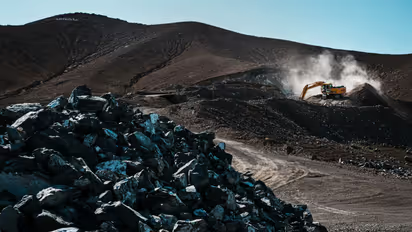
Rare earth elements which remain vital to everything from smartphones and EVs to missile systems like Akash and Astra, have emerged as a geopolitical flashpoint. While found across the globe, they are difficult to extract and process, which gives power to nations that dominate the value chain.
Currently, that nation is China. With 44 million tonnes in reserves and control of over 90% of global processing capacity, Beijing’s grip on rare earths is nearly absolute. When China announced restrictions on the export of seven rare earth elements in April amid a backdrop of tariffs and tensions with the US, it sent global supply chains into a spin, including in India.
India’s electric vehicle (EV) and electronics sectors were particularly hit. Nearly 90% of India's rare earth imports come from China, and this sudden disruption sparked fears of raw material shortages and production delays.
Yet, in this crisis lies a rare opportunity.
While China didn’t get named directly, Prime Minister Narendra Modi’s statement at the 17th BRICS Summit in Brazil made India’s stance clear. He warned that critical minerals must not become tools of coercion or control. This came just weeks after China’s new export licensing requirements and end-use declarations began slowing down rare earth shipments globally, affecting not just the US, but India as well.
India’s supply chains are now facing bottlenecks. The country imported 540 tonnes of magnets from China last year. Following the curbs, major automakers like Maruti Suzuki and JSW MG Motor have experienced procurement delays, with China’s Ministry of Commerce not approving fresh shipments.
China’s dominance also has a deeper regional dimension. According to a New York Times report, Beijing has tied up with armed rebels in northern Myanmar, which supplies nearly 57% of China's rare earth imports, to extract and secure new deposits, ensuring the entire supply pipeline remains in Chinese control.
Geopolitically, it’s deja vu. Back in 2010, China imposed a rare earth ban on Japan, showing its readiness to weaponize its dominance. The current round of restrictions targeting high-performance magnet ingredients has a similar effect: it limits India’s ambitions in clean energy and defence while signalling that rare earths are firmly a strategic lever for Beijing.
India holds an estimated 6.9 million tonnes of rare earth reserves, ranked third in the world. Yet, its actual production is just about 2,900 metric tonnes a year which is less than 1% of global output, placing it far behind countries like China and the US.
The rich deposits lie in monazite-rich coastal sands of Andhra Pradesh, Odisha, Tamil Nadu, Kerala, and West Bengal. But extracting them is not straightforward. These minerals are typically mixed with radioactive elements like thorium, making them more expensive and complex to handle.
Under the Atomic Energy Act, 1962, private companies have limited access due to the association with nuclear materials. However, discussions are now underway to amend regulatory barriers and allow private participation.
India’s response has started taking shape. The National Critical Mineral Mission, launched in July, aims to build domestic mining and processing capacity. Under this, the Geological Survey of India (GSI) will undertake 1,200 exploration projects through 2030.
The Ministry of Heavy Industries has also proposed a ₹1,345 crore scheme to boost rare earth magnet manufacturing. Industry players like Mahindra & Mahindra, Uno Minda, and Sona BLW Precision Forgings have shown early interest.
Indian Rare Earths Limited (IREL), a public sector entity, is already shifting focus to support local needs over exports and exploring resources in Vietnam and Oman.
India is also strengthening international cooperation. Australia, with significant rare earth reserves, has emerged as a strategic partner in both mining and technology transfer.
Still, hurdles remain.
Experts like Abhijit Kulkarni, from EY-Parthenon, point out critical weaknesses: limited refining capability, low domestic technical expertise, and inadequate infrastructure to support mining at scale.
A Frontline magazine report noted how Indian carmakers are now looking at a 40–45 day lag in procurement due to the disruption. This directly threatens India's clean energy timeline and its ambitions to scale up EV production.
Even Amit Gupta, of Motilal Oswal Private Wealth, acknowledged that while India's reserves are promising, the current output is negligible. "Reserves are almost 250 times higher than what is being mined now," he said on ET Now, pointing to the gap between potential and delivery.
To turn the tables, India needs a decisive recalibration. It must:
These steps will take time, but the urgency is real.
China has made it clear that rare earths are a strategic tool. For India, the only viable answer is to reduce dependence and build resilience. With the third-largest reserves, it holds the cards. But to play them well, it needs rare political resolve, and not just rare minerals.
If done right, India can turn a supply shock into strategic independence.