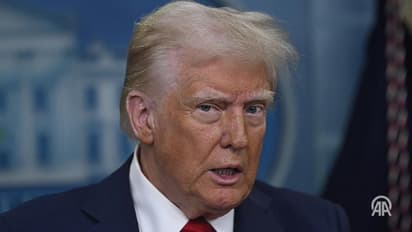
Why Oil Surged Four-Year High: Trump's Iran Blockade Threat Rattles World Markets

Published : Apr 30, 2026, 04:22 PM IST

Oil prices surged to a four-year high after Trump warned that the US blockade of Iranian ports could continue for months. Brent crude briefly crossed $126 a barrel as fears grew over prolonged disruption in Strait of Hormuz, a key global oil route.

PREV
16
Oil rockets as US-Iran tensions rise

Global oil prices jumped sharply on Thursday after US President Donald Trump warned that the American naval blockade of Iranian ports could continue for months.

Brent crude briefly surged more than seven percent, climbing above $126 a barrel, its highest level in four years. US benchmark West Texas Intermediate also jumped strongly, crossing $110 during Asian trading before easing later.

The sudden rise came as fears grew that tensions between the United States and Iran could drag on much longer than markets had expected.

26
What triggered the latest surge?

According to reports, Trump has told his national security team to prepare for a prolonged blockade aimed at forcing Iran to abandon its nuclear programme.

The Wall Street Journal reported that Trump believes Iran is not negotiating honestly, even after Tehran submitted a fresh proposal this week to reopen the Strait of Hormuz.

A White House official also said Trump had discussed ways to keep the blockade in place for months while limiting the impact on American consumers and global oil supplies.

Adding to concerns, Axios reported that Admiral Brad Cooper, the head of US Central Command, would brief Trump on possible new military strikes against Iran.

The Strait of Hormuz is one of the world's most important shipping routes. Around one-fifth of all global oil and gas passes through this narrow waterway.

Any threat to shipping in the region immediately worries traders, governments and businesses worldwide.

If the route remains blocked or heavily restricted, oil supplies could tighten quickly, pushing prices even higher.

That is exactly what markets are now fearing.

36
Trump's mixed signals

Trump has sent tough messages in public. On Truth Social, he said Iran "can't get their act together" and urged Tehran to agree to a non-nuclear deal.

He also posted an image of himself holding an assault rifle with the caption, "No More Mr. Nice Guy."

However, some analysts believe his words are harsher than his actual actions.

Michael Brown of Pepperstone said Trump's recent moves still suggest he prefers a negotiated deal rather than a major military escalation.

Still, the lack of progress in talks is making investors increasingly nervous.

46
How markets reacted

Oil was the biggest mover, but other markets also felt the shock.

Brent crude later settled around $122, still up more than three percent. West Texas Intermediate traded near $108, also sharply higher.

Stock markets across Asia mostly fell as investors moved away from risky assets.

Tokyo, Hong Kong, Seoul and Mumbai each dropped more than one percent. Sydney, Taipei, Bangkok, Manila and Jakarta also ended lower.

Shanghai managed a small gain, while Singapore and Wellington also rose.

In Europe, Paris and Frankfurt declined, while London's FTSE 100 was little changed.

56
Why investors are worried

Higher oil prices can hurt the global economy.

They increase transport costs, raise fuel prices and can push inflation higher. That often leads central banks to keep interest rates elevated for longer.

Investors are especially sensitive right now because inflation has already been a major concern in many countries.

The US dollar also strengthened, as traders moved into safer assets during the uncertainty.

AI stocks provide some support

Despite the market turbulence, technology shares have continued to attract investors.

Samsung Electronics reported a massive 750 percent jump in first-quarter operating profit, driven by strong demand for AI-related chips.

Earlier, Microsoft, Meta and Google's parent company Alphabet also delivered better-than-expected earnings.

This AI boom has helped support global markets in recent weeks, even as geopolitical risks rise.

66
Federal Reserve remains cautious

Investors are also watching the US Federal Reserve closely.

The Fed kept interest rates unchanged at its latest meeting, citing concerns that higher energy prices could fuel inflation.

Notably, four policymakers dissented from the decision, the highest number since 1992.

Three opposed signalling future rate cuts, while Stephen Miran pushed for an immediate quarter-point cut.

Jerome Powell's term as Fed Chair is ending soon, with Kevin Warsh set to take over next month.

What happens next?

Much now depends on whether Washington and Tehran can break their negotiating deadlock.

If talks improve, oil prices could fall back quickly.

But if the blockade continues or military action resumes, markets may face even more volatility.

For now, traders are preparing for a longer period of uncertainty.

That means higher oil prices, nervous stock markets and close attention to every statement coming from Washington and Tehran.

(With AFP inputs)

Check the Breaking News Today and Latest News from across India and around the world. Stay updated with the latest World News and global developments from politics to economy and current affairs. Get in-depth coverage of China News, Europe News, Pakistan News, and South Asia News, along with top headlines from the UK and US. Follow expert analysis, international trends, and breaking updates from around the globe. Download the Asianet News Official App from the Android Play Store and iPhone App Store for accurate and timely news updates anytime, anywhere.


Read more Photos on

Recommended Stories