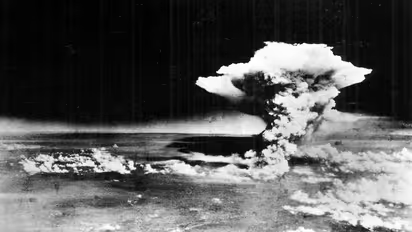
On the 80th anniversary of the Hiroshima bombing, forgotten voices of Korean survivors emerge that tell stories of loss, silence, and survival that reveal a painful legacy still carried across generations in both Japan and South Korea.
Bae Kyung-mi was just five years old when the atomic bomb "Little Boy" was dropped on Hiroshima on August 6, 1945. Like many ethnic Koreans in the city, her story was buried under silence for decades.
26
The Day the Sky Fell
Playing outside her home in Hiroshima, Bae remembers hearing the planes overhead. Moments later, the bomb hit. She was buried under rubble—unconscious, but alive. The debris protected her from the burns that killed many of her relatives.
36
A Life Lived in Silence
After returning to Korea, Bae and her family never spoke of what happened. Even her husband didn’t know. “Back then, people said you married the wrong person if they were a bombing survivor,” she said. Bae’s two sons only learned her truth in 1996, when she registered at the Hapcheon Atomic Bomb Victim Center in South Korea. By then, she had already suffered severe radiation-related health issues, including cancer surgeries.
Koreans made up over 10% of the 740,000 victims of Hiroshima and Nagasaki. Many were labourers forced to work under Japan's colonial rule. For decades, they remained largely invisible in public memorials and history. Korean survivors faced dual discrimination—in Japan as both Koreans and “hibakusha” (bombing survivors), and back home in Korea, where stigma and false beliefs about radiation exposure isolated them. Accurate records were almost impossible. The Hiroshima city office was obliterated, and Korea’s colonial-era ban on Korean names made it harder to trace victims. Some groups estimate as many as 50,000 Koreans were in the city that day.
56
Life After the Bomb
Tens of thousands of Korean survivors returned to their now-independent homeland, many battling health problems and social stigma. Today, around 1,600 South Korean survivors are believed to still be alive—82 of them at the Hapcheon center. While Korea passed a law in 2016 granting survivors a small monthly stipend (~$72), no official help exists for their children or grandchildren, many of whom suffer from congenital illnesses due to radiation exposure. Jeong Soo-won, director of the Hapcheon center, calls for laws to support second- and third-generation survivors, saying they too carry the legacy of Hiroshima in their bodies and lives.
66
80 Years Later, Lessons Still Unlearned
Despite global recognition—like the Nobel Peace Prize awarded to Japanese hibakusha groups—survivors feel the world hasn’t truly grasped the horror of nuclear war. “From politicians, there has been only talk,” says Kim Gin-ho, another Korean survivor. As the world marks 80 years since Hiroshima, the survivors hope for more than just remembrance—they want action, compassion, and global commitment to a future without nuclear weapons.