Is Indian cricket ready for the post Rohit Sharma-Virat Kohli era in Tests?

Published : May 13, 2025, 04:52 PM IST

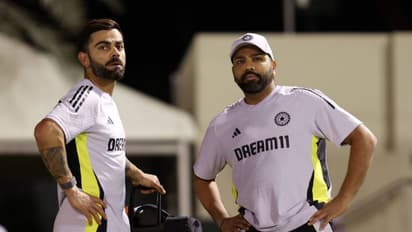
With Rohit Sharma and Virat Kohli's retirement from Tests, Indian cricket enters a transition phase. Rohit and Kohli have been backbone of India's batting in red-ball cricket over a decade, while leading the team through a golden period.
PREV
16
Indian Cricket post Ro-Ko era in Tests

Ahead of the Test tour of England, Indian cricket received a big setback as two batting stalwarts Rohit Sharma and Virat Kohli announced their retirements from the longest format of the game. Rohit was the first to take the step to call time on his red-ball career and then, Kohli followed the suit by bidding adieu to his illustrious Test career.

Rohit Sharma and Virat Kohli have left a huge void in India’s Test batting as the duo was the cornerstones of the line–up, delivering consistent performances for over a decade while taking the team through a golden era with their leadership. As the sun has set on their decorated Test careers, Indian cricket is set to undergo a transition phase post the era of Rohit Sharma and Virat Kohli in Test cricket.

Is Indian cricket ready to embrace the new era of challenges and opportunities without two batting greats in the longest format of the game?

26
Gautam Gambhir holds the fort

With the retirement of senior players like Ravichandran Ashwin, Rohit Sharma, and Virat Kohli from Test cricket, head coach Gautam Gambhir has an arduous task in hand to rebuild the red-ball squad with a fresh core, instill a winning mindset in the young generation while carrying forward the legacy of Test dominance built over the last decade. After the setbacks in the Test series against New Zealand and Australia, Gambhir will likely be under pressure to identify consistent match winners, nurture promising young talents and bring stability to a new era without its two batting giants in the longest format of the game.

Moreover, it is the beginning of Gautam Gambhir’s era as the dressing room would not be looming with larger-than-life presence of stalwarts like Virat Kohli and Rohit Sharma, enabling to have more freedom to promulgate his vision, build a team around young players, and establish a new culture with his no non-sense and aggressive cricketing philosophy.

36
Learnings from the post Dravid-Tendulkar era

As Team India goes through a transition period after Rohit Sharma and Virat Kohli’s Test retirements, management can draw crucial lessons from their own transition phase after the retirements of legends like Sourav Ganguly, VVS Laxman, Rahul Dravid, Sachin Tendulkar, and Virender Sehwag. Back then, India witnessed a dip in overseas performances and struggled to fill the void left by these batting icons. However, selectors and management’s patience with youngsters like Virat Kohli, Ajinkya Rahane, and Cheteshwar Pujara eventually paid off as they dominated the Test format.

Additionally, MS Dhoni, who was captain from 2007 to 2014 before Virat Kohli took over captaincy duties from 2014 to 2022 in Test cricket, saw a seamless leadership transition that focused on grooming and nurturing a core group of players, building a strong bench, and setting fitness and fielding standards, which have significantly contributed to India’s rise in Test cricket. Therefore, the current management must allow emerging players to settle into their roles, build experience, and grow into leaders rather than expecting instant results, especially in challenging overseas conditions.

46
Young batting core

With Rohit Sharma and Virat Kohli stepping away from Test cricket, India’s batting unit in red-ball cricket will revolve around young batters who have shown promise at domestic level and in international cricket. The likes of Shubman Gill, Yashasvi Jaiswal, Sarfaraz Khan, Rishabh Pant, Nitish Kumar Reddy, and Dhruv Jurel are expected to form a cardinal of the Indian’s batting core in Tests. While Gill and Jaiswal notched up centuries in the longest format of the game, consistency across formats remains a challenge.

The responsibility will be on the young batters to convert their potential into performances, especially in challenging tours. The senior players like KL Rahul and Shreyas Iyer are expected to act as a bridge between the outgoing stalwarts and emerging talents. With a robust domestic cricket system and India A structure in place, India cricket is expected to see many young batters making their way into the national team.

56
Bowling attack remains pillar in transition period

As India is set to go through a transition phase in batting, the bowling attack remains the pillar of strength in Test setup. With proven performers like Jasprit Bumrah, Mohammed Siraj, Mohammed Shami, Ravindra Jadeja, Axar Patel, and Kuldeep Yadav are still in the mix, and promising talents like Akash Deep, Harshit Rana, and Mukesh Kumar already showcasing their skills in the limited opportunities, India’s bowling attack looks potent and well-equipped to handle the demands in red-ball cricket.

The bowlers will have added responsibility not only to deliver their performances but also take India through a transition period in batting, by maintaining consistent pressure on opposition line-ups, and creating breakthroughs at crucial junctures while giving an opportunity to the young batting core to settle into their roles. In the past, bowlers played a pivotal role in Team India’s success in Tests and will once again expected to lead from the front during the transitional batting era.

66
Leadership takes spotlight

As Rohit Sharma moved on from Test cricket, there is a leadership vacuum that has been left by the veteran batter. The selectors and management will need to identify a long–term captain who can take the team through the transitional phase. With Jasprit Bumrah reportedly being out of the captaincy race, Shubman Gill and Rishabh Pant emerged as the strong contenders to take over red-ball captaincy. When Virat Kohli immediately took over the captaincy baton from MS Dhoni in 2014, he had already groomed into a leadership role and solid place in the team.

Some of the young players, including Gill and Pant have already been included in the leadership group, with management keeping an eye on the future. With Gautam Gambhir at the helm as the head coach, captain-coach dynamic will play a crucial role in the future of India’s Test cricket. The decision on the captaincy will not only hinge on the leadership ability but also who aligns the best with Gambhir’s long-term vision for India’s Test future.

Read more Photos on

Recommended Stories