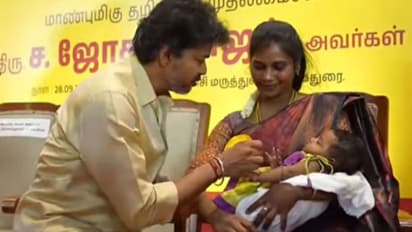
Tamil Nadu Chief Minister C Joseph Vijay on Monday launched the Thaaimaman Thanga Mothiram Thittam, or Maternal Uncle Gold Ring Scheme, for newborn babies in government healthcare facilities. The scheme provides a one-gram, 22-carat gold ring to eligible babies born in government hospitals and primary health centres across the state.
Vijay launched the scheme at the Government Rajaji Hospital in Madurai, where he personally presented gold rings to newborn babies and their mothers. The initiative is one of the key welfare promises made by Vijay ahead of the 2026 Tamil Nadu Assembly election.
The state government has allocated Rs 755.83 crore annually for the scheme. It plans to procure 4,41,667 one-gram gold rings for distribution to eligible newborns. The first batch of 1,28,499 rings has already been procured.
The name Thaaimaman Thanga Mothiram refers to a traditional Tamil custom associated with the maternal uncle presenting gifts to a newborn. Under the government scheme, the state takes on that symbolic role by presenting a gold ring to babies born in government healthcare institutions.
The Tamil Nadu government's stated objectives are to honour motherhood, celebrate childbirth, promote maternal and child health and encourage more families to choose government hospitals and primary health centres for deliveries.
The scheme is applicable retrospectively to eligible babies born from June 22, 2026, which is also Vijay's birthday. The government has said the benefit is meant for babies born alive in government hospitals and primary health centres to eligible mothers who are permanent residents of Tamil Nadu.
Each eligible newborn will receive a one-gram, 22-carat gold ring. The rings carry a unique serial number and are supplied in tamper-proof packaging to improve accountability during distribution.
The government has planned the procurement in phases because thousands of babies are born in state-run healthcare facilities every month.
For the initial rollout, 1,28,499 rings were ordered for babies born during the period beginning June 22. The wider procurement target stands at 4,41,667 rings.
The rings are not simply handed out as an open cash-equivalent benefit. Their distribution is linked to the state's maternal and child health records, allowing officials to identify eligible beneficiaries and track the rings issued under the programme.
The scheme is primarily aimed at babies born in Tamil Nadu government hospitals and primary health centres.
According to the government notification, the programme covers babies born alive in government healthcare facilities from June 22, 2026, onwards. The mother must also meet the state's eligibility requirements, including being a permanent resident of Tamil Nadu.
The scheme is linked to the state's pregnancy and infant monitoring system. The baby's details and the mother's RCH identification number are used to maintain records and ensure that the benefit reaches the intended family.
For babies born between June 22 and the formal launch, arrangements have been made through designated hub centres for distribution. From the rollout of the scheme, eligible babies born in government hospitals are expected to receive the ring before leaving the facility with their mothers.
The scheme is also intended to encourage institutional deliveries in government facilities.
Tamil Nadu records around 7.8 lakh births every year, with about 4.2 lakh, or 53 per cent, taking place in government hospitals, according to government data cited in reports on the programme. The government wants to strengthen public confidence in these facilities and encourage more families to use them for childbirth.
Health Minister K G Arunraj has pointed to the difference in childbirth costs between government and private hospitals. According to data cited by the government from the NSS 80th round survey, the average cost of childbirth in a government hospital was around Rs 1,412, compared with approximately Rs 6,914 in a private facility.
The government has argued that greater use of public healthcare could therefore reduce the financial burden on families.
Accountability is a key feature of the scheme. Each gold ring has a unique serial number and is linked to the mother's RCH identification number. The rings are also supplied in tamper-proof packaging. These measures are intended to help officials track procurement and distribution and prevent duplication or misuse.
The procurement process was handled through the Tamil Nadu Medical Services Corporation. Government documents said tenders were invited for the larger requirement, with the first batch ordered for the initial period of implementation.
The gold ring scheme was among Vijay's election promises. It was subsequently incorporated into the state government's welfare plans after he took office.
The government initially planned to launch the scheme on September 15, coinciding with the birth anniversary of former Tamil Nadu Chief Minister C N Annadurai. The launch was later postponed, with September 28 fixed as the new date.
The first statewide rollout took place in Madurai on Monday. Vijay presented rings to newborns at Government Rajaji Hospital as the scheme formally began.
At the launch event, Vijay held newborn babies and presented the gold rings to their families. He first gave the rings to 25 babies at the hospital auditorium before visiting the maternity ward, where he presented rings to another 10 newborns.
The launch was part of Vijay's first official visit to Madurai as Chief Minister.
He also inaugurated the restored Gandhi Memorial Museum at the historic Tamukkam Palace complex. The museum restoration was carried out at a cost of Rs 10.25 crore.
The gold ring programme, however, remained the central focus of the day's public event, marking the implementation of one of the government's most closely watched welfare promises.
For eligible families, the benefit is a small quantity of gold but carries a larger symbolic purpose. The government has presented the ring as a token marking the birth of a child and recognising the mother.
At the policy level, the scheme is also designed to connect welfare assistance with public healthcare. By making the benefit available to babies born in government facilities, the state hopes to encourage institutional deliveries and strengthen the use of its maternal healthcare network.
The programme therefore combines a traditional cultural symbol with a public-health objective, a one-gram gold ring for the newborn, while encouraging families to choose government healthcare for childbirth.
(With inputs from agencies)
Stay updated with the Breaking News Today and Latest News from across India and around the world. Get real-time updates, in-depth analysis, and comprehensive coverage of India News, World News, Indian Defence News, Kerala News, and Karnataka News. From politics to current affairs, follow every major story as it unfolds. IMD cities weather forecastsRain Cyclone Asianet News Official App