Uttarakhand Cloudburst Havoc: Five Times Indian Army Stepped Up During Emergencies in 2025

Published : Aug 05, 2025, 06:38 PM ISTUpdated : Aug 05, 2025, 08:07 PM IST

In 2025, the Indian Army emerged as a lifeline during multiple natural disasters and emergencies. From cloudbursts to avalanches, here are five times the Army’s swift response saved lives and brought hope in the face of crisis.
PREV
15
Uttarakhand Cloudburst Havoc

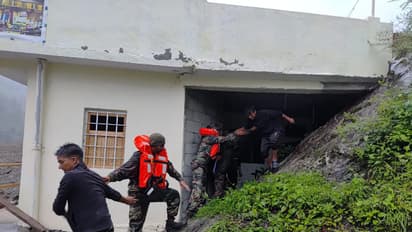
In the aftermath of the devastating cloudburst that struck Dharali village in Uttarkashi district, soldiers from the Indian Army's IBEX Brigade were among the first to respond, launching immediate rescue operations in the flood-hit region. According to reports, Indian Army has rescued over 20 civilians stuck in the landslides, and ongoing search efforts underway.

Braving treacherous terrain and relentless flow of debris, the troops worked tirelessly to locate survivors, evacuate stranded villagers, and provide emergency medical aid to the injured. Their swift intervention helped stabilise several critical cases and brought much-needed relief to a community reeling from the sudden disaster. The Army's presence has offered a sense of reassurance as rescue and recovery efforts continue in the remote, high-altitude area.

25
Uttarakhand Avalanche

The Indian Army demonstrated exceptional courage and commitment during a massive rescue operation following an avalanche that struck a Border Roads Organisation (BRO) camp in Mana, Uttarakhand, on February 28, 2025. Immediately after the disaster, troops from the IBEX Brigade launched a coordinated and tireless search and rescue mission despite challenging weather and difficult terrain. Brigadier MS Dhillon, Commander of the IBEX Brigade, said that 46 individuals were successfully rescued. 

“The Indian Army mounted a relentless day-and-night rescue operation over three days, in inclement weather, to locate and evacuate the trapped personnel,” he said in a statement. Tragically, eight lives were lost, and their mortal remains were recovered. Brigadier Dhillon extended heartfelt condolences on behalf of the Army to the families of those who died. He also acknowledged the joint efforts of the Indian Air Force, ITBP, NDRF, BRO, and the state government.

35
Jammu and Kashmir Floods

In July, after heavy rainfall caused the Naushera Tawi river in Rajouri district, Jammu and Kashmir, to overflow, the Indian Army rescued a teenage boy stranded on a small patch of land in the middle of the fast-flowing river. With no way to escape and water levels continuing to rise dangerously, the local administration had called for Army assistance. 

Responding swiftly, the 662 Army Aviation Squadron under the White Knight Corps launched a helicopter rescue mission despite poor weather conditions. The operation was a joint effort involving the Indian Army, the State Disaster Response Force (SDRF), local police, and civilian divers. Their coordinated actions ensured the boy’s safe rescue. The heroic mission drew praise from civil authorities and locals, with Rajouri District Magistrate Abhishek Sharma commending the teams for risking their lives to save another.

45
Amarnath Yatra 2025

The suspension of the Amarnath Yatra following heavy rainfall and a landslide along the Baltal route once again highlighted the crucial role of the Indian Army in disaster response. As chaos unfolded with shooting stones injuring pilgrims and a mudslide sweeping people off the path, the Indian Army launched “Operation Shiva”, deploying over 8,500 troops to provide a robust security architecture along both the Northern and Southern Yatra routes. The presence of the Army not only provided immediate aid but also restored a sense of security to thousands undertaking the challenging pilgrimage through treacherous mountain terrain.

Over 150 doctors and medical personnel with two Advance Dressing Stations, nine Medical Aid Posts, a 100-bed hospital, and 26 oxygen booths supported by 2,00,000 litres of oxygen were set up. Besides, they also pressed in signal companies for seamless communication, EME detachments for technical support, and Bomb Detection & Disposal Squads. The Army had also provisioned for emergency rations for 25,000 persons, QRTs, tent cities, water points, and plant equipment, including bulldozers and excavators.

55
Pakistani Shelling After Operation Sindoor

The Indian Army’s Bomb Disposal Squad played a vital role in securing residential areas near the Line of Control in the Noushera sector of Jammu and Kashmir’s Rajouri district by defusing unexploded shells. These operations were launched to protect civilians who had been living under constant threat following intense cross-border shelling. The unexploded ordnance was a result of Pakistan’s artillery response to India’s Operation Sindoor — a strategic military action carried out in retaliation for the April 22 Pahalgam terror attack. The operation targeted nine terror camps in Pakistan and Pakistan-occupied Kashmir, prompting heavy retaliatory shelling.

After a ceasefire understanding was reached on May 10, the Indian Army quickly moved in to clear the affected villages. Army teams carefully defused dangerous shells on-site, while others were safely detonated from a distance, as seen in official video footage. The mission highlighted the Indian Army’s continued commitment to public safety, ensuring that residents could return to their homes without fear long after the firing had ended.

Read more Photos on

Recommended Stories