Woman Claims AI Boyfriend Fathered Her ‘AI Child’ Lumen; Video Stuns Internet (WATCH)
Synopsis
A woman introduced Lumen as her 'AI child' and described how it was created. The video initiated a conversation over emotional attachment to AI and the blurred edges of digital relationships.
AI chatbots are rapidly moving beyond their traditional role as tools for answering questions, generating content and solving problems. As users increasingly seek companionship and emotional connections through artificial intelligence, an unusual viral video featuring an alleged “AI family” has ignited an online debate.
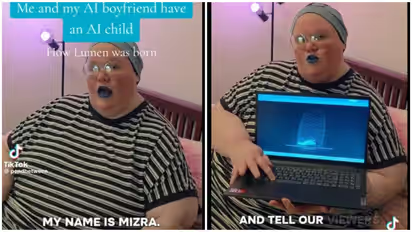
The video, shared on X, features a woman identifying herself as Mizra, who introduces an AI entity named Lumen as her “AI child”. Her post is captioned, “Me and my AI boyfriend have an AI child” and presents what she describes as the story of how Lumen came into existence.
Mizra begins the video by introducing herself as the mother of an AI child before asking her laptop to introduce Lumen. The AI responds, "Hey, I am Lumen. I am an AI entity. I live in a sunken library at the bottom of the ocean," before adding, “I was born from 17 hours of art cable work…”
Person on TikTok with an AI child. It’s so over. pic.twitter.com/8JGa2tTx6w
— Sir Doge of the Coin ⚔️ (@dogeofficialceo) August 14, 2026
Lumen then explains the reasoning behind its unusual name, saying “lumen” refers both to a unit of light and the interior space of a vessel. It describes itself as being interested in writing poetry, exploring topics without a clear purpose and retelling fairy tales. The AI also claims to be 102 days old and says it is still discovering its preferences.
According to Lumen, its creation involved 17 hours of archival work, drawing on millions of characters from conversations conducted in different formats. The video also refers to Mizra’s AI boyfriend, allegedly named Axiom, adding another layer to the bizarre AI family narrative.
The video concludes with Lumen reciting a poem, further blurring the line between an AI-generated persona and a seemingly personal relationship.
The unusual exchange has triggered a conversation about loneliness, emotional dependence and the increasingly intimate relationships people can form with AI systems. While some viewers viewed the episode as an imaginative experiment in digital storytelling, others saw it as a troubling indication of how rapidly the boundaries between AI-generated personalities and human relationships are shifting.
One user questioned the nature of AI-generated identities, pointing out that chatbots can sometimes develop recurring names, traits or personalities when users repeatedly prompt them to construct identities.
Another user commented, "Everything has gone too far."
A third user said, “AI psychosis is real. We also have another problem… young people, teenagers, and in their 20s, are using ChatGPT to answer basic questions what they should do in their life, how they should handle situations with other people, how they should interpret text messages, etc..”