Trump Factor, Shooting Scare, Epstein Shadow: Why King Charles III’s US Visit Is a Tightrope Walk
Synopsis
King Charles III's US visit turns into a high-stakes diplomatic test as he navigates Donald Trump, security fears after a Washington shooting, and royal controversies shadowing the trip.
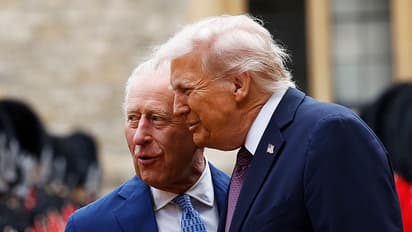
King Charles III arrives in Washington for a four-day state visit at a moment that feels anything but routine. What should have been a symbolic exercise in renewing the so-called “special relationship” has instead become a delicate balancing act—set against political unpredictability, security concerns, and lingering royal controversies.
With the 250th anniversary of American independence as the backdrop, the British monarch has been tasked with “reaffirming and renewing” ties with the United States. But the circumstances surrounding the visit have turned it into one of the most complex diplomatic missions of his reign.
A visit with an unusually high degree of difficulty
Historians are not understating the stakes. Contemporary political historian Anthony Seldon described the April 27–30 visit as “obviously beyond tricky,” noting it carries a “degree of difficulty” rarely seen in modern statecraft.
He compared it to historic moments of strain in transatlantic relations—between Lyndon B Johnson and Harold Wilson, Richard Nixon and Edward Heath, and even Dwight Eisenhower and Anthony Eden during the fallout of the Suez Crisis.
“But this is different,” Seldon suggested, largely because of the unpredictability of Donald Trump. “Because you are dealing with somebody who is so unpredictable,” he was quoted as saying in The Guardian report.
Yet Seldon also pointed to a curious advantage: Charles may be one of the few figures Trump is unlikely to antagonise openly. That, he argued, could give the monarch some room to manoeuvre. This is, in Seldon’s words, “the most important visit of the king’s life”—one where he could either “be very cautious and safe” or subtly remind Americans of the principles on which their nation was founded.
Security concerns sharpen after Washington shooting
The visit unfolds just days after a shooting disrupted the White House Correspondents’ Dinner, forcing the evacuation of top officials, including Trump.
UK officials insist that security is being taken “very seriously.” Treasury minister Darren Jones confirmed that “appropriate security” measures are in place and that discussions are ongoing between British and American teams.
“There were already extensive discussions taking place, which will continue over the coming days,” he said, underlining the fluid nature of the planning.
Behind the scenes, Buckingham Palace is in constant coordination with US authorities, assessing whether the weekend’s events require further adjustments to what was already a tightly controlled visit.
A speech that could define the visit
At the heart of the trip lies a moment that could shape its legacy: King Charles III's address to a joint session of Congress.
The speech will be televised globally, and expectations are high. Buckingham Palace has indicated that the King will “recognise the challenges that our countries face.” But striking the right tone will be crucial—especially given Trump’s reputation for taking offence.
When Queen Elizabeth II addressed Congress in 1991, she spoke of the dangers of power that grows “from the barrel of a gun” and emphasised NATO, liberal values, and cultural diversity. According to historian Philip Murphy, such language today “would be taken as a direct attack on Trump.”
Instead, Charles is expected to take a more nuanced route—appealing “almost over the head of Trump to the American public.” The message, Murphy suggested, will likely emphasise shared values: democracy, freedom, and a long-standing cultural bond.
Seldon believes the King may not need to mention Trump at all. A carefully crafted speech, “very deftly, gently, and in a polite and respectful way,” could remind Americans of their foundational ideals—leaving listeners to draw their own conclusions about whether current leadership aligns with those principles.
Private talks, public risks
One of the most sensitive moments of the visit will take place behind closed doors: a private meeting between Charles and Trump in the Oval Office.
The decision to keep discussions private—limited to a brief photo opportunity—appears deliberate. It follows global attention on Ukrainian President Volodymyr Zelenskyy’s recent diplomatic discomfort in Washington.
Charles enters the room aware of past tensions. Trump has previously criticised the UK prime minister and mocked British military capabilities. As monarch, Charles is also head of state of Canada—a country that has faced its own provocations from Trump.
“He’ll be very careful about what he says,” Murphy noted, adding that anything discussed privately could easily find its way into the public domain. “I don’t think Trump has a strong sense of what is private and what is not.”
Lingering shadows: Epstein and royal rifts
Beyond geopolitics, the visit is shadowed by unresolved royal controversies.
Questions surrounding Jeffrey Epstein and his connections to the British royal family have resurfaced. Calls from US figures, including Congresswoman Ro Khanna, for the King and Queen Camilla to meet Epstein survivors have been firmly declined by the palace. Officials argue such a meeting could interfere with ongoing investigations and legal proceedings.
At the same time, the absence of any interaction with Prince Harry and Meghan Markle—who live in California—underscores the continuing distance within the royal family. No reunion is planned during the visit.
There is also the risk of protests or public disruptions, though the itinerary has been carefully designed to minimise unscripted encounters. A single “block party” appearance in Virginia may be the only moment where the King and Queen come into direct contact with the public.
A moment of risk—and opportunity
For all its risks, the visit also offers King Charles III a chance to reshape perceptions.
After years dominated by headlines about royal disputes and scandal, this trip provides an opportunity to demonstrate the enduring relevance of the monarchy on the global stage.
As Murphy put it, “one talks about the risks, but there’s also a benefit for him here.” By rising above political divisions and focusing on shared values, Charles may yet reinforce a relationship that has weathered crises before.
Whether he succeeds will depend not just on diplomacy, but on tone, timing—and a careful reading of a moment where symbolism and politics are tightly intertwined.