Why Is Iranian Actress Laleh Marzban Facing Backlash After Her Venice Film Festival Speech?
Synopsis
An international film award has triggered fierce debate far beyond the festival stage, drawing reactions from officials, media figures and cultural institutions over comments that struck a nerve.
Iranian actress Laleh Marzban has become the focus of mounting criticism from Iranian authorities and state-linked media outlets after remarks she delivered while accepting an award at the Venice Film Festival.
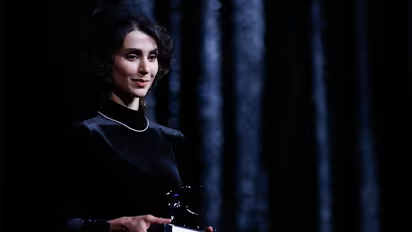
Marzban received the best actress prize in the Orizzonti section, a category dedicated to emerging talent, for her performance in director Mohsen Gharaei’s Falling House. During the awards ceremony, she used her acceptance speech to acknowledge women in Iran, dedicating the honor to those who, in her words, have paid a high price for even limited personal freedom.
Speaking in Farsi, the actress also said that many people in Iran were going through difficult times but urged them not to lose hope.
Her comments quickly drew criticism from influential voices inside Iran. On Thursday, the Supreme Council of the Cultural Revolution issued a statement condemning what it described as a distorted portrayal of Iranian society.
Without directly naming Marzban, the council referred to remarks made at the Venice Film Festival and argued that presenting Iranian women through frameworks favored by Western audiences did not align with what it called the social responsibilities of art. The statement characterized the comments as offering a one-sided perspective of the country.
The response from the council followed several days of criticism published through state-affiliated media channels, some of which called for consequences against the actress because of her remarks abroad.
Several media personalities connected to Iran’s state broadcasting network publicly attacked Marzban following the ceremony. Journalist and presenter Zahra Chekhmaghi described the actress in highly critical terms, while actress and television personality Zhila Sadeghi questioned why Marzban had not used her speech to focus instead on children killed in the February missile strike on an elementary school in Minab.
Film and Acceptance Speech Become Political Flashpoint
Coverage on Iranian state television extended beyond criticism of the speech itself. During one broadcast, a Quran commentator claimed the actress had been influenced by hostile forces and urged authorities to prevent her from continuing to work in Iran.
Elsewhere, Student News Network called on the Ministry of Culture to deny Marzban re-entry into the country.
The controversy surrounding Marzban and Falling House has unfolded against a broader backdrop of cultural disputes involving films showcased at this year’s Venice Film Festival.
At the center of the debate is Falling House, a drama that explores power dynamics within a family and examines the pressure placed on women inside a patriarchal household.
Marzban portrays Ensi, a young woman who tells her family she intends to leave Iran and pursue a modeling career in Turkey. In response, her father Rashid, played by Farhad Aslani, confines her and other female relatives to their rooms in an attempt to maintain control over the family.
The film's central themes, including authority, restriction and women’s autonomy, have attracted attention since its screening at the festival.
Following the movie’s premiere in Venice, Marzban was asked about how audiences in Iran might react to the film. Rather than focusing on controversy, she spoke about gradual change and individual responsibility.
The actress said women across many professions in Iran, including artists and doctors, could only move forward one step at a time. She described her participation in the film as her own contribution and expressed hope that others would continue making similar efforts toward shared goals.
What began as an award-winning moment on an international stage has since evolved into a wider debate inside Iran, drawing responses from government institutions, broadcasters and public figures while placing Marzban at the center of an increasingly visible cultural and political dispute.