Pakistan To Send Its First Astronaut Into Space As Zeeshan Ali Joins China's Mission
Synopsis
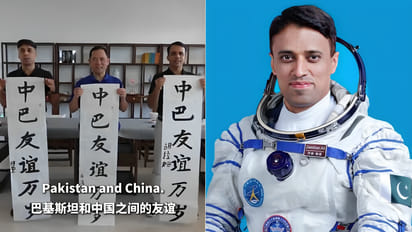
Pakistan is set to send its first astronaut into space as former Air Force pilot Muhammad Zeeshan Ali prepares to join China's Shenzhou-24 mission on November 25. He will become the first Pakistani to travel into space.
Pakistan is set to make history in space exploration, with its first astronaut, Muhammad Zeeshan Ali, preparing to travel to China's Tiangong space station aboard the Shenzhou-24 spacecraft on Wednesday, November 25. Ali, a former Pakistan Air Force pilot, will become the first Pakistani to travel into space. He will also be the first foreign astronaut to visit China's Tiangong space station, marking a new chapter in space cooperation between Pakistan and China.
The China Manned Space Agency (CMSA) announced the three-member crew on Tuesday. Ali will fly as a payload specialist alongside Chinese astronauts Tang Hongbo, who will command the mission, and flight engineer Wu Yi. The spacecraft is scheduled to lift off at 8.18 am Beijing time from the Jiuquan Satellite Launch Centre in north-western China. This is 5.18 am in Pakistan and 5.48 am in India.
Pakistani astronaut Muhammad Zeeshan Ali, who will make history as the first foreign participant in a Chinese manned spaceflight mission, has expressed his gratitude to China for helping him realize his space dream, while hailing the profound friendship between Pakistan and China which extends far beyond space cooperation.
#Shenzhou24 #ChinaSpaceLaunch
https://t.co/Dl2laLfuRj
— CCTV+ (@CCTV_Plus) November 24, 2026
Shenzhou-24 astronaut Muhammad Zeeshan Ali introduces himself. https://t.co/vyzU9z6YYP
— CNSPACE (@CNSpaceflight) November 24, 2026
Who is Muhammad Zeeshan Ali?
Ali is a Pakistan Air Force pilot who was selected for astronaut training alongside fellow pilot Khurram Daud. The two men went through a selection process that included medical, psychological and technical assessments before being sent to China for training.
China named them reserve astronauts in April 2026. They subsequently joined the Astronaut Centre of China in Beijing to prepare for the mission.
Their training covered technical skills, emergency procedures, survival exercises and crew coordination. Learning Chinese was also a major part of the preparation, as the spacecraft's controls, software and announcements operate in the language.
Speaking to reporters ahead of the launch, Ali said he was carrying the hopes of Pakistan's 250 million people.
#MegaProject "I was the last one to join the program. But now I can confidently say that from that last one to becoming the first one to be in space." Pakistani astronaut Muhammad Zeeshan Ali is preparing for the Shenzhou XXIV mission after completing a year-long training program in just seven months. Starting from scratch, he learned Chinese and can now read through the entire mission checklist. For Ali, learning Chinese is more than mastering a language — it's a way to connect with the Chinese people and understand their hearts.
#ShenzhouXXIV #Space #ChinaPakistanFriendship
— China Daily (@ChinaDaily) November 24, 2026
✨🇨🇳Chinese astronauts Tang Hongbo, Wu Yi, and Pakistani astronaut Muhammad Zeeshan Ali will carry out the Shenzhou-24 crewed spaceflight mission, with Tang serving as commander, the China Manned Space Agency announced on Tuesday.
What a great example of cooperation between China and our brothers and sisters from Global South families
— 🇨🇳XuZhenqing徐祯卿 (@XueJia24682) November 24, 2026
Planning Minister Ahsan Iqbal, who is in China for the launch, praised both Ali and Daud for their performance during training. He said that although Ali had been selected for the flight, both pilots had made Pakistan proud.
Muhammad Zeeshan Ali is set to become the first foreign national astronaut to travel aboard a Chinese spacecraft and visit China’s Tiangong space station, marking a milestone for China-Pakistan space cooperation. https://t.co/qCQ9gf9sda
— Al Jazeera English (@AJEnglish) November 24, 2026
What will Pakistan's first astronaut do in space?
Ali will serve as a payload specialist, taking part in routine crew activities while focusing mainly on joint scientific experiments between Pakistan and China.
According to the CMSA, his work will include installing experimental samples and equipment and conducting tests in orbit. The research will cover biotechnology and materials science, among other areas.
One of the experiments will involve cyanobacteria, photosynthetic microorganisms that could help researchers study biological processes in space.
Pakistan's Space and Upper Atmosphere Research Commission (SUPARCO) has said the astronaut will spend about a week aboard the station. His role will include installing the experiments and checking whether the equipment has survived the stresses of launch and is working properly in microgravity.
The experiments will continue for several months after installation, with data collected from the station.
How long will Zeeshan Ali stay in space?
Ali's stay aboard Tiangong will be short compared with the usual crew rotations at the Chinese space station.
After reaching orbit, Shenzhou-24 is expected to dock with the station's Tianhe core module following an autonomous rendezvous lasting around three and a half hours.
Ali will later return to Earth aboard the Shenzhou-23 spacecraft, which is already docked with the station. The mission will also involve a crew handover, with Chinese astronaut Zhu Yangzhu remaining in orbit for an extended stay.
Pakistan-China space cooperation
The mission follows an agreement between SUPARCO and CMSA signed in February 2025. It is part of a wider effort to expand cooperation in human spaceflight and scientific research.
Pakistan has previously taken part in China's lunar exploration programme. Its iCube-Qamar satellite travelled aboard China's Chang'e-6 mission in 2024 and entered lunar orbit. Pakistan is also working with China on a proposed lunar mission tentatively planned for 2028.
China, meanwhile, aims to send astronauts to the Moon by 2030.