What drives Pakistan-Turkey's anti-India bond? Experts decode the strategic brotherhood
Synopsis
Turkey and Pakistan's deepening strategic, military, and ideological ties, rooted in shared religion and geopolitical interests, have raised concerns for India, especially during the recent India-Pakistan conflict.
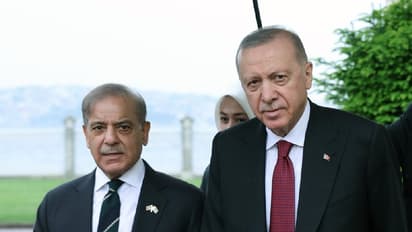
New Delhi: The diplomatic, military and ideological cooperation between Turkey and Pakistan have deepened in recent decades, raising a serious concern in India. Under the present Turkish President Recep Tayyip Erdogan leadership, the relations between New Delhi and Ankara have suffered significantly.
The two countries enjoy a strong friendship rooted in deep religious and cultural ties, a history of mutual support, and reinforced by aligned geopolitical interests.
Alongside China and Azerbaijan, Turkey was among the few nations that openly backed Pakistan during the four-day conflict with India that lasted till May 10. The clash followed the horrifying April 22 Pahalgam terror attack, prompting India to launch “Operation Sindoor” on May 7, targeting nine terror hubs inside Pakistan and Pakistan-occupied Jammu and Kashmir.
Pakistan responded with a swarm of drone attacks, which were effectively neutralised by India's strong air defence systems. During the four-day conflict, Pakistan deployed over 350 Turkish-made drones, including the YIHA and Songar models, aiming at both military and civilian targets in India.
Why Turkey Backed Pakistan?
As Pakistan and Turkey continue to flaunt their brotherhood, Asianet News English spoke to international relations experts to understand why Turkey sided with Pakistan during the four-day conflict.
Dr Aparaajita Pandey, Assistant Professor at Amity University’s Department of Defence and Strategy, explained that Turkey and Pakistan share a strong ideological alignment, particularly on the Kashmir issue.
“Turkey and Pakistan have close relations and tend to have congruent thoughts on the issue of Kashmir. One of the more easily recognisable factors is that both countries have populations that largely follow the Islamic religion," she said.
She highlighted the historical basis of their alliance, dating back to a formal agreement signed in the 1950s. “Turkey and Pakistan also signed a friendship treaty in 1954, and they have been diplomatic partners for decades.”
Pandey pointed to the regional dynamics and cultural alignment that brought Turkey and Pakistan closer, especially outside the Arab-dominated West Asia. “The Turkish and Arab identity tends to clash due to historical reasons, looking outside of West Asia dominated by the Arab identity, Pakistan presented itself as the stable Islamic republic that could be an ally to Turkey in South Asia,” she noted.
“Both Turkey and Pakistan started out as countries that were largely progressive however, have turned towards a more traditional Islamic approach at some point. They have also formed a brotherhood since 1954 where Turkey supported Pakistan in their disputes with other nations," she further stated.
According to Pandey, this brotherhood often leads to mutual silence over controversial domestic policies, particularly concerning human rights.
“Pakistan and Turkey tend to turn a blind eye when it comes to human rights abuses against minorities in each other's countries. The recent Turkish attempt to glorify Ottoman culture through TV and Social Media has been celebrated and accepted in Pakistan as well," she said.
“The Pakistan - Turkey strategic partnership has gone from strength to strength over the ages; however, the India - Turkey relations have certainly suffered under the current Turkish leadership," Pandey added.
She emphasised the depth of defence cooperation between the two countries, with Turkey emerging as a key military partner for Pakistan.
“Turkey is the second largest supplier of defence products to Pakistan right after China. They carry out training programmes for Pakistani military uniformed personnel and hold joint exercises as well. This cooperation goes back to the signing of the CENTO in 1954 and the two countries have been working together on joint projects like the MILGEM Class Corvettes," she highlighted.
Finally, Dr Pandey pointed out Pakistan’s aspirations to strengthen its economic ties with Turkey through strategic investments. “These strategic ties also give way to Pakistan's ambition to make Turkey a burgeoning economic-ally and want Turkey to invest heavily in Pakistan,” she added.
Historical and Religious Bonds Strengthen Pakistan-Turkey Alliance
Adding to the perspective, Dhananjay Tripathi, Associate Professor at South Asian University in Delhi, highlighted the historical and religious foundations of the Pakistan-Turkey alliance, noting their long-standing diplomatic warmth and evolving public engagement.
“One of the major factors for their closeness is Islam also. Since the initial days of Pakistan, the leadership of both the countries – Mohammad Ali Jinnah of Pakistan and Turkey’s Kamal Mustafa had cordial relations. There has never been a major issue so far between their relationships. During the Cold War era, they were together which is a major reason for their closeness also," he said.
Besides political and militarily, in the recent past, they have also strengthened their people to people ties, he added.