Inside Svalbard Seed Vault: How A Frozen Mountain Is Protecting The Future Of Food (WATCH)
Synopsis
The Svalbard Seed Vault in Norway stores millions of seeds, including India's, to protect global crop diversity. Here's how the Arctic facility works and why it is called the world's doomsday vault.
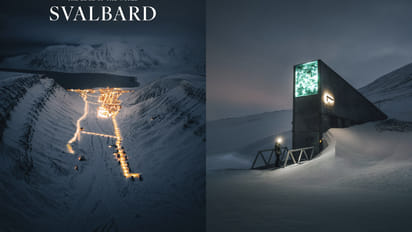
Deep inside a frozen mountain in the Arctic, far away from busy cities and human settlements, lies a facility designed to protect the future of the world's food supply. Known as the Svalbard Global Seed Vault, this extraordinary underground storage facility in Norway preserves millions of seeds collected from countries across the world, including India. Often described as the world's 'doomsday vault', it acts as a backup for global crop diversity, ensuring that important plant varieties are not lost due to natural disasters, wars, climate change, diseases or other unexpected events. Located deep inside a mountain and surrounded by permafrost, the facility is among the world's most unusual conservation centres.
Traveller Radhika Nomllers recently shared a video offering a glimpse into this remarkable facility on social media. Along with explaining how the Seed Vault works, she highlighted its unusual location and the important role it plays in protecting the world's agricultural heritage. The video also drew attention to another fascinating archive in the same Arctic region, making the area an important repository of both agricultural and historical knowledge.
Why Is The Svalbard Global Seed Vault Located Inside A Mountain?
The Seed Vault is located on the Norwegian archipelago of Svalbard, near the settlement of Longyearbyen, approximately 1,000 kilometres from the North Pole. It was officially opened on February 26, 2008, and built deep inside a mountain to provide long-term protection for the world's crop diversity.
The storage chambers are situated more than 100 metres inside the mountain, with thick layers of solid rock surrounding them. The natural permafrost helps maintain low temperatures, while an artificial cooling system keeps the seeds at the ideal storage temperature of -18°C. Even if the electricity supply fails, the surrounding frozen environment and rock structure offer additional protection.
How Does The World's Seed Bank Work?
The Svalbard Global Seed Vault works like a safety deposit box for seeds. Countries, agricultural research centres and gene banks send duplicate samples from their existing seed collections to the facility. These samples are packed in sealed boxes and stored under controlled conditions.
Importantly, the vault is not a public seed library where visitors or researchers can collect seeds whenever they want. The deposited seeds remain the property of the institutions that sent them, and only the original depositors can request their withdrawal.
The facility has a storage capacity of 4.5 million seed samples, which could hold approximately 2.5 billion individual seeds. As of June 2026, it contained more than 1.4 million seed samples from around the world.
Why Are Seeds From India Stored There?
India is among the countries represented in the Seed Vault's international collection. Seeds from different regions are important because they preserve the genetic diversity of crops, including varieties that may become difficult to find or cultivate in the future.
This collection can help protect agricultural resources against natural disasters, conflicts, climate-related challenges, diseases and the loss of traditional crop varieties. By preserving duplicate samples, the facility provides an additional layer of security for the world's food supply.
One example of why such a backup matters is the withdrawal of seeds belonging to the International Centre for Agricultural Research in the Dry Areas (ICARDA). After conflict affected its gene bank in Syria, the organisation used seeds stored in Svalbard to help rebuild its collections in Lebanon and Morocco.
Who Manages The Svalbard Seed Vault?
The Norwegian Government owns the facility through its Ministry of Agriculture and Food. NordGen, the Nordic Genetic Resource Centre, is responsible for its day-to-day operations, while the Crop Trust is an important partner supporting its work.
Although the vault protects seeds from across the world, it does not have permanent staff working inside it. Specialists visit the facility during scheduled seed deposits and for maintenance-related activities.
What Is The Arctic World Archive?
The mountain region near Longyearbyen is also home to another unusual facility called the Arctic World Archive (AWA). However, unlike the Seed Vault, it is located inside the decommissioned Mine 3, approximately 300 metres inside the former mine.
Established in 2017, the archive preserves important digital information, historical documents and cultural records from different countries. It uses a special storage medium designed to preserve data for centuries in the cold, dry and dark conditions of the Arctic.
The archive includes contributions from institutions such as the National Museum of Norway, the Vatican Library and the National Archives of Mexico and Brazil. Inspired partly by the neighbouring Seed Vault, it aims to protect the world's cultural and historical heritage.
Polar Night In Svalbard: When Does The Sun Disappear?
One of the most fascinating natural phenomena in Svalbard is the polar night, when the sun remains below the horizon for an extended period. In Longyearbyen, the polar night generally lasts from November 11 to January 30, although the wider dark season begins in late October and continues until February.
During this period, the region experiences extremely limited daylight, with some weeks receiving no civil twilight. The darkness also creates opportunities to witness the Northern Lights, provided weather conditions and solar activity are favourable.
Svalbard experiences the opposite phenomenon during summer, known as the Midnight Sun. Between approximately April 20 and August 23, the sun remains above the horizon throughout the day and night.
Best Time To Visit Svalbard
The best time to visit Svalbard depends on the kind of Arctic experience travellers want.
- November To January: Ideal for experiencing the polar night and attempting to see the Northern Lights.
- February To April: Suitable for winter adventures, including snowmobile trips, dog sledding and exploring the snow-covered landscape.
- May To September: Popular for experiencing the Midnight Sun, boat trips, wildlife watching and Arctic summer activities.
March and July are among the busier months for visitors. Travellers are advised to book accommodation and activities in advance, particularly during the popular summer season.
What Is Life Like In Svalbard?
Despite its extreme Arctic location, Svalbard has a small but established community. Longyearbyen, its largest settlement, has around 2,400 residents from nearly 53 countries.
People living there lead relatively normal daily lives, with access to grocery shops, restaurants, schools, a hospital, a university centre and recreational facilities. However, life in the region requires residents to adapt to extreme weather, prolonged darkness during winter and continuous daylight during summer.
Temperatures can fall below -30°C during winter, while summer temperatures generally remain between 0°C and 10°C. Residents also have to take precautions against polar bears when travelling outside the settlement. Healthcare facilities are limited compared with those on mainland Norway, and certain specialist treatments may require travel to the mainland.
How Did Social Media React?
Radhika Nomllers' video offered viewers a glimpse into one of the world's most unusual facilities and its role in protecting seeds for future generations. Her explanation of the underground storage system and its importance in safeguarding global food diversity caught the attention of social media users.
Several users expressed their admiration in the comments section.
One user commented: "Wow and u got to witness that lovely."
A second user commented: "Amazing."