US-India partnership turning Trump-Modi vision into concrete outcomes
Synopsis
US Ambassador Sergio Gor hailed the deepening US-India partnership, noting it's translating the Trump-Modi vision into concrete results in tech, trade, and defence, with progress on a trade deal and new frameworks like TRUST and Pax Silica.
US Ambassador to India Sergio Gor on Friday highlighted the deepening cooperation between Washington and New Delhi that has been actively translating the shared vision of US President Donald Trump and Prime Minister Narendra Modi into "concrete outcomes" across technology, trade, defence-linked innovation, and strategic supply chains, signalling what he described as a defining phase in bilateral relations.
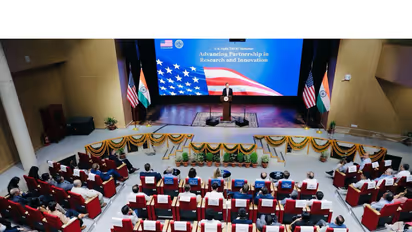
In his remarks made during the US-India TRUST Initiative event titled "Advancing Partnership in Research and Innovation" at IIT Delhi, Gor said the partnership is no longer aspirational but increasingly outcome-driven, with visible progress in critical technologies, pharmaceuticals, space cooperation, and trade negotiations.
"Under TRUST, the U.S.-India tech partnership is delivering tangible results. At IITDelhi, I highlighted our strong bilateral technology relationship and opportunities for deeper collaboration on strategic technologies. We're turning President Trump and PM Modi's shared vision into reality: making the 21st century defined by the power of the U.S.-India partnership," Gor said in a post on X.
Deepening Strategic and Economic Ties
The Ambassador's remarks come at a time when both countries are expanding cooperation under multiple new frameworks, including TRUST (Transforming the Relationship Utilising Strategic Technologies), Pax Silica, and ongoing efforts to finalise a long-pending interim trade agreement.
A central theme of Gor's address was Washington's growing reliance on India as a "trusted partner" in securing critical global supply chains, particularly in pharmaceuticals, semiconductors, artificial intelligence, space technologies, and critical minerals. Highlighting the pharmaceutical sector, Gor said India plays an indispensable role in ensuring medicine security for the United States, with nearly 40 per cent of generic medicines in the US being sourced from Indian manufacturers. "There's a reason the United States does that; it is because we trust India. These are critical, literally life-saving ingredients that are needed in the United States," he said. He added that both countries are now working to expand resilient pharmaceutical supply chains under the TRUST framework, with a focus on active pharmaceutical ingredients (APIs), critical medicines, and expanded manufacturing capacity in both countries. According to Gor, this cooperation is not limited to economics but is central to global health security and supply chain resilience, particularly in preventing shortages of essential medicines.
India's Inclusion in Pax Silica
One of the most significant announcements highlighted by the US Ambassador was India's inclusion in the Pax Silica initiative, a US-led trusted technology and supply chain framework focused on emerging and critical technologies. Under Pax Silica, countries collaborate in areas such as artificial intelligence, semiconductors, quantum computing, and advanced manufacturing, with an emphasis on trusted ecosystems and secure supply chains.
"At the summit, Under Secretary Hellberg and I officially welcomed India into Pax Silica, making India one of the first 10 trusted countries that were invited to join," Gor said. He added that India's early inclusion reflects Washington's deep confidence in India's technological capabilities, governance systems, and strategic alignment.
"As soon as that announcement happened, within two weeks, we had interest from 60 other countries that have asked us to join Pax Silica. The reason India was in the first top 10 countries around the world to join this is because we trust this place. We trust the people here, we trust the technology, we trust your government," he said. Gor further stated that Pax Silica is designed to build "trusted ecosystems and resilient supply chains" for technologies that will define the future global economy, particularly artificial intelligence and semiconductor ecosystems.
Interim Trade Agreement Nears Conclusion
On the economic front, Gor provided a strong indication that the long-awaited US-India interim trade agreement is nearing conclusion, saying negotiations have reached their final phase. "Just last week, India had sent a team to Washington DC to finalise the last 1 per cent of that trade deal. Next week we will welcome a US delegation here to continue those talks," he said.
"We fully expect that the trade deal will be signed over the next few weeks and months," he added. The Ambassador's comments signal continued momentum in bilateral trade negotiations that have been under discussion for several years, aimed at reducing barriers and expanding market access in goods and services.
Innovation and Investment Driving Economic Growth
He also emphasised that trade between India and the United States has expanded dramatically over the past two decades, growing from USD 20 billion to over USD 220 billion. "This is not just about volume; it reflects deeper, broader engagement and stronger economic integration," Gor said, noting that innovation-led sectors are now driving the next phase of growth.
These sectors include digital trade, advanced manufacturing, energy cooperation, and emerging technologies, with participation from both large corporations and start-ups. Gor highlighted significant investment commitments by US companies in India, particularly in artificial intelligence, cloud computing, and digital infrastructure. He pointed to major investments, including Amazon's USD 35 billion commitment by 2030, Microsoft's USD 17.5 billion expansion plan, and Google's subsea cable landing projects in India.
According to him, these investments reflect growing confidence in India's regulatory and technological environment and a shared vision of building secure and scalable digital infrastructure. "You have a government that is forward-leaning, that has cut and changed rules to accommodate these giant tech companies that we have appreciated in the United States," he said.
Strategic Space Cooperation
The US Ambassador also underlined the growing strategic importance of space cooperation between the two countries, calling it a key pillar of bilateral relations. He highlighted landmark missions such as the NASA-ISRO NISAR mission and the Axiom-4 mission, which enabled an Indian astronaut's return to space after decades.
Gor said these missions reflect deep institutional collaboration between NASA, ISRO, private space companies, and academic institutions. He also reiterated US support for India's participation in the Artemis Accords, aimed at future lunar exploration and sustained presence in space. "When the United States leads, we invite trusted partners. We have seen over the last year and a half that India is that trusted partner," he said.
Collaboration on Critical Minerals and Research
Gor also stressed expanding cooperation in critical minerals, noting that both countries are working together to strengthen supply chains in mining, processing, recycling, and research. He welcomed India's National Critical Minerals Mission, describing it as a key step in securing strategic resources essential for defence, energy systems, and emerging technologies.
He further highlighted joint research initiatives involving Indian and US academic institutions, including IITs, aimed at advancing artificial intelligence, quantum computing, and materials science. Through initiatives like the US-India Science and Technology Endowment Fund, more than 20 joint research teams are currently working on commercialising next-generation technologies.
A Transformational Phase
Concluding his remarks, Gor said the United States and India are still only at the early stages of fully realising the potential of their partnership. "We're only beginning to realise the full potential of this partnership. There are significant opportunities ahead to scale it into a more seamless, resilient, and transformative economic relationship," he said.
He added that the United States views India not only as a major economic partner but also as a central pillar in shaping global technological and strategic frameworks for the future. "The message that we want to send to everybody here and across the country is that the United States is paying attention. The United States is involved, and the United States comes to India with an open hand," he said.
With initiatives such as TRUST, Pax Silica, expanding trade negotiations, and deepening space and technology cooperation, Gor said the bilateral relationship is moving into what he called a "transformational phase" that could define the trajectory of global innovation and geopolitics in the 21st century. (ANI)
(Except for the headline, this story has not been edited by Asianet Newsable English staff and is published from a syndicated feed.)