US CENTCOM Establishes Task Force Iron Gate to Curb Iran Weapon Routes
Synopsis
The US Central Command has established Task Force Iron Gate to monitor and disrupt Iran's ground and Caspian Sea weapons smuggling routes. Simultaneously, Iran's IRGC claims full self-sufficiency in its domestic defense manufacturing capabilities.
CENTCOM Launches New Task Force Iron Gate
The US Central Command (CENTCOM) has announced the establishment of a new task force to disrupt Iran's alleged use of ground transit routes for transporting advanced weapons, dual-use technologies and other sanctioned materials, as Washington seeks to tighten restrictions on Tehran's military supply networks. According to a statement issued by CENTCOM, the task force, named Task Force Iron Gate, was established on Saturday under the direction of CENTCOM Commander Admiral Brad Cooper. The team will comprise approximately 20 civilian and military personnel based in Tampa, Florida.
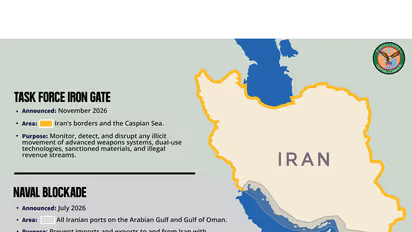
The newly established task force will coordinate with other US government agencies to prevent the movement of advanced weapons systems, dual-use technologies, sanctioned materials and illegal revenue streams across Iran's land borders and the Caspian Sea. "The establishment of Task Force Iron Gate reinforces the success of our ironclad blockade against Iran at sea," said Admiral Brad Cooper, according to the CENTCOM statement. "Strengthening CENTCOM's collaboration with U.S. interagency partners will further constrain Iran's ability to finance terrorism, rebuild weapons factories, and replenish their military," he added.
Strategic Measures Against Iranian Trade
CENTCOM further stated that the US naval blockade had prevented Iran from exporting more than USD 25 billion in crude oil in recent months. It said strict enforcement at sea continued against all ships entering or departing Iranian ports. The announcement outlined two parallel US measures targeting Iranian trade and supply routes. While Task Force Iron Gate will focus on Iran's land borders and the Caspian Sea, the existing naval blockade, announced in July, covers Iranian ports along the Arabian Gulf and the Gulf of Oman.
According to the details provided by CENTCOM, the naval blockade aims to prevent imports and exports to and from Iran, with the exception of humanitarian aid. The newly announced task force, meanwhile, will focus on monitoring, detecting and disrupting illicit movements of weapons systems, dual-use technologies and sanctioned materials.
Iran's Aerospace Force Responds
The announcement comes amid statements from Iran's Islamic Revolutionary Guard Corps (IRGC) Aerospace Force highlighting its domestic defence manufacturing capabilities, technological developments and military self-reliance. According to Iran's semi-official Mehr News Agency, the IRGC Aerospace Force spokesperson, Brigadier General Hossein Mohebbi, outlined three major pillars of the force's development during its commemorative week earlier today.
Focus on Indigenous Knowledge and Production
Mohebbi identified the development of indigenous scientific expertise and the localisation of global knowledge in the aerospace sector as the first major achievement. "The first strategic achievement of the IRGC Aerospace Force is the generation of indigenous knowledge and the localisation of global knowledge within the aerospace industry," he said, as reported by Mehr News Agency. He further claimed that these developments had transformed Iran's defence industry from one dependent on importing military equipment into an exporter of aerospace products. "This development served as the catalyst for sweeping changes within the nation's defence and offensive industry, transforming us from an importer of military weaponry into an exporter in the aerospace sector," Mohebbi added.
The second pillar, according to the IRGC spokesperson, involved translating technological advancements into domestic industrial production, with Iran manufacturing defence systems to meet domestic requirements and supply international markets. Mehr News Agency reported that Mohebbi cited the Arman missile, the 358 drone and the Khordad-3 air defence system as examples of domestically produced equipment. "Today, in addition to meeting domestic needs, we have become an exporter of defence equipment and products—a significant achievement for the country," he said.
The third pillar focused on achieving complete self-sufficiency in defence production and reducing dependence on foreign suppliers. "Today, the Aerospace Force's weaponry is produced based on indigenous knowledge and expertise; we do not rely on foreign nations to supply the arms, equipment and components we require," Mohebbi said.
The developments highlight the contrasting positions, with CENTCOM announcing measures to restrict the movement of Iranian military-related materials and the IRGC Aerospace Force publicly emphasising its domestic production capabilities and defence exports.
(Except for the headline, this story has not been edited by Asianetnews Editorial staff and is published from a syndicated feed.)