Why US Boots on Ground Won’t Tame the Iran War—But Will Hit the Global South Hard
Synopsis
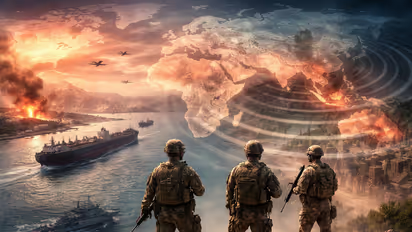
US boots in West Asia won’t control the Iran conflict, argues Dr Aparaajita Pandey, warning of a domino effect on oil, trade, and global markets that could trigger widespread economic instability.
By Dr Aparaajita Pandey: For some time now the US has clung to a not too unfamiliar strategic instinct, which is based on a notion that any escalation can be controlled, calibrated, and contained. This fundamental belief is one of the many reasons why the US essentially believes that the deploying US ground forces in West Asia would also operate on this principle of Washington’s control even as the war expands. This notion has been proven to be faulty as the conflict with Tehran has progressed and it stands to reason that putting boots on the ground would have absolutely no impact on the unpredictability of this conflict.
This assumption of control misses is not only the nature of Iran’s strategy, but also the geography of the country. This conflict is no longer defined by boundaries. It is defined by flows; of oil, trade, insurance, and risk; which extends far beyond the west Asian region.
The US deployment on the ground is not merely a modern-day military invasion but also an economic signal that is indicative of further disruption of global supply chains and more strain on an already stressed global economy.
Chokepoints and Global Shockwaves
For the US, the rationale behind such a deployment is deceptively simple; it is to secure chokepoints, deter escalation, stabilize the theatre. But the theatre of this conflict has continued to be defined and dissolved by Iran. Iran is not waiting for a land war; it is aggressively relocating it. Its strategy is not based in defeating the United States conventionally, but to make this conflict and its consequences in itself prohibitively expensive. Iran has been doing it by extending conflict across domains in such a way that the American military superiority becomes worthless.
US military on the ground would translate into a familiar but a progressively unsustainable stance. US’ heavily defended positions which have been constant low-grade attack, supply lines subjected to constant disruption, and an operational tempo dictated not by determined action but by persistent attrition. This is a complete departure from the American memories of Iraq, the American troops would be looking for their own Baghdad moment, only to be disappointed. Iran is not a regime to be toppled. It is a system to be endured.
This is precisely the reason why comparisons of this conflict to Iraq are not just flawed, but deceptive. Iraq was a war of occupation, while this is a war of circulation. Control over territory has limited significance in this case. This conflict finds its focus in control over movement; movement of energy, of goods, of capital. This shift in the nature of war is not alleviated by the presence of U.S. ground presence.
Iran’s position in this conflict is strengthened by the increased conflict around strategic choke points. By Washington’s logic, potentially taking control of the Kharg Island would be seen as a defining strategic victory, however, any attempts to neutralize Kharg, would be met with increased disruption of global flows specially from the Strait of Hormuz, and potentially through Bab – el – Mandeb through the Houthis. This would only put more pressure on global supply of oil, giving Iran greater leverage over the US and also the rest of the world.
Global South Bears the Hidden Cost
For countries in the Global South, this escalation is not in abstraction. Inflation and currency pressure are very real macro economic consequence of this war, not to mention growing energy and food insecurity, due to the eventual rise in food prices as the fertilizer industry is hit by shortage of natural gas supplies. The weaponization of energy is not contained in the Gulf; it is communicated through economies already operating with limited safeguards.
It is safe to say that much of the Western analysis remains incomplete. It calculates the escalation of a conflict through military thresholds. While it completely disregards what the rest of the world is focused on, economic survivability.
The role of Israel highlights this asymmetry. Israeli forces will continue to be an external part the conflict, through intelligence, precision strikes, and calibrated signalling. But they have denied any presence of Israeli soldiers on ground in Iran. The United States therefore would bear the burden of physical presence.
Domestic Blowback in the United States
It is not farfetched to speculate that the domestic political consequences of this deployment by the US would unfold along largely familiar lines, which is initial support by ardent Trump supporters followed by gradual erosion of support even in the MAGA voter base as the human cost of war begins to proverbially hit home. Furthermore, even this domestic cycle is going to be progressively influenced by global realities. Energy price shocks, trade disruptions, and financial volatility will impact domestic opinions about the war for the US. This in turn might further amplify the very conflict that the US is trying to manage.
The conventional debate of success and failure of battle is no longer central to the presence of the US troops on the ground. It is whether the war is going to become too costly to be won, it is now about whether this would increase the instability across markets and regions. The objectives of this conflict became fluid for the US as soon as they realised that this is not the war that they expected. The problem is that the US is stuck playing a game of chess when the game for Iran was of dominoes all along.
A single misstep by the US starts an almost unstoppable fall of global supply chains and structures. Crude oil and natural gas trade, international shipping routes, shipping insurance rate, inflation, energy and food insecurity- all of these stand to fall one after the other as this conflict goes on. The impact of all of these on Iran is limited but for the rest of the world it is potentially disastrous.
(Author is an Assistant Professor at Amity Institute of Defence and Strategy, Amity University and has a PhD in Energy Statecraft.)
Disclaimer: The opinions expressed are solely those of the author and do not reflect the views or stance of the organization. The organization assumes no responsibility for the content shared.