Ukraine Turns to Rooftop Solar Power as Constant Attacks From Russia Expose Weaknesses in National Grid
Synopsis
As energy pressures reshape daily life across Ukraine, businesses and communities are embracing new solutions. A growing trend is helping residents navigate uncertainty while reducing dependence.
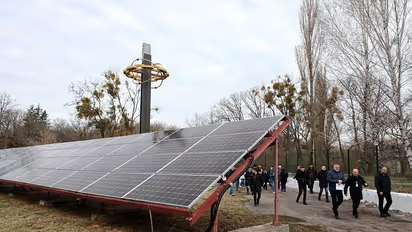
Ukraine is accelerating its shift toward solar energy as repeated attacks on its electricity infrastructure continue to disrupt power supplies across the country. Businesses, apartment buildings, and local communities are increasingly turning to rooftop solar systems and battery storage as a way to maintain electricity access and reduce dependence on a grid that has suffered extensive wartime damage.
The change is visible in Bila Tserkva, a city in central Ukraine, where a door manufacturing facility recently invested in solar power after years of power interruptions made operations increasingly difficult. Since Russia's invasion in 2022, the area has experienced recurring attacks that contributed to widespread blackouts and electricity shortages.
For the factory's owner, Yaroslav, the decision was driven by both practical and economic concerns. During winter power shortages, maintaining production became a challenge. Employees sometimes relied on a fireplace fueled with discarded wood to help warm the warehouse, while backup generators added significant operating costs.
Yaroslav said the transition to solar energy is expected to allow the facility to expand production capacity while becoming less dependent on the national grid. He also pointed to lower operating expenses and environmental benefits as motivating factors behind the move.
The installation was arranged through Yasno, a private electricity and gas supplier that has completed similar projects across Ukraine. Customers typically cover installation costs, often with assistance from government-backed financing programs. One of the key initiatives, known as Affordable Loans 5-7-9, offers businesses preferential financing for solar panels and related equipment, with loans capable of covering a substantial share of project costs.
Yasno has significantly expanded its renewable energy work since resuming operations in 2024. The company reports installing solar systems at 117 locations over the past two years, creating a combined capacity of 23 megawatts.
Distributed Energy Gains Ground as Wartime Pressures Intensify
Industry representatives say the rapid expansion of renewable energy is closely tied to the need for resilience. According to Yasno officials, decentralized systems are easier to restore and can be paired with batteries that store electricity for use during outages.
Before the war, Ukraine relied heavily on a centralized electricity network dominated by nuclear generation. More than half of the country's electricity came from four nuclear power plants, while coal and natural gas accounted for a significant portion of the remaining supply.
Although renewable energy represented a smaller share of the energy mix, solar development had already been underway through government-supported programs. The country's green tariff system encouraged households and businesses to install renewable energy technologies by guaranteeing favorable payments for electricity generation.
Those incentives helped Ukraine reach roughly 8 gigawatts of installed solar capacity by 2022. However, the war dramatically changed the energy landscape. Attacks on power plants, substations, and transmission infrastructure have repeatedly interrupted electricity service throughout the country.
A significant share of solar capacity has been lost through destruction, occupation, or uncertainty in contested areas. Most of Ukraine's wind farms in the south have also been affected. The Zaporizhzhia nuclear power plant has remained shut down and under Russian control since the invasion began.
The impact has been felt nationwide. Scheduled power restrictions continue in some areas, while electricity deficit estimates have increased amid ongoing attacks. The challenge has prompted greater investment in distributed energy systems that are less vulnerable than large centralized facilities.
The growth trend appears to be accelerating. The Solar Energy Association of Ukraine estimated that 1.5 gigawatts of new solar capacity was added during 2025, nearly double the amount installed the previous year, with similar deployment expected in 2026.
The benefits are extending beyond businesses. In Kyiv, some residential buildings are installing rooftop solar systems to help maintain essential services during blackouts, including heating equipment and elevators. Residents say government assistance programs have made such projects more accessible.
Closer to frontline regions, renewable energy is becoming increasingly important. Damage to power lines and security risks can leave communities isolated from the grid for extended periods. In response, volunteers and nonprofit organizations have worked with international partners and local donors to install solar panels and battery systems for homes and community facilities.
Supporters of these efforts argue that access to dependable electricity is increasingly linked to safety and communication. Solar-powered systems can help residents stay connected, access services, and maintain critical daily functions even when traditional power supplies are interrupted.