Turkey’s Airlift to Karachi: A Game-Changer for Pakistan’s Military? Opinion
Synopsis
A Turkish Air Force Lockheed C-130 Hercules, with the call sign TUAF509, was spotted flying over the Arabian Sea, heading towards Karachi, Pakistan.
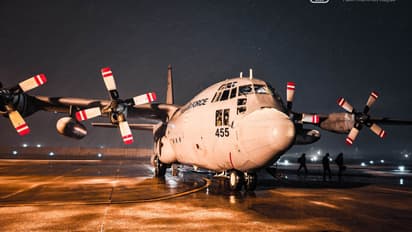
On April 28, 2025, a Turkish Air Force Lockheed C-130 Hercules, with the call sign TUAF509, was spotted flying over the Arabian Sea, heading towards Karachi, Pakistan. This unusual flight, tracked by the flight tracking service ADS-B Exchange, has sparked curiosity and speculation. Open-source intelligence (OSINT) enthusiasts suggest the aircraft was likely carrying an urgent shipment of ammunition for Pakistan’s unmanned aerial vehicle (UAV) fleet, such as the Bayraktar TB2 drones supplied by Turkey. This event is not just a routine military operation; it reflects Turkey’s growing strategic partnership with Pakistan, driven by shared geopolitical interests, military cooperation, and mutual support on global platforms like the Financial Action Task Force (FATF). But why is Turkey deepening its ties with Pakistan, and what does this mean for the region?
Turkey’s military engagement with Pakistan, as seen in this C-130 flight, is part of a broader strategy to expand its influence in South Asia and counterbalance regional powers like India. The flight’s timing and purpose suggest Turkey is responding to Pakistan’s immediate security needs, possibly linked to counterterrorism operations along its Afghan border or tensions with India. Pakistan relies heavily on drones like the Bayraktar TB2, which require specialised munitions such as laser-guided bombs and missiles. Turkey, with its advanced defence industry led by companies like Baykar and Roketsan, is a key supplier of these systems. By airlifting supplies to Karachi, Turkey is not only fulfilling a defence contract but also signalling its commitment to Pakistan’s military capabilities at a critical time.
The Turkey-Pakistan defence partnership has grown significantly in recent years. Turkey has supplied Pakistan with Bayraktar TB2 and Anka drones, which have become central to Pakistan’s reconnaissance and combat operations. These drones are affordable yet effective, making them ideal for Pakistan’s security challenges. The C-130 flight could indicate an urgent need for munitions, possibly due to heightened military activity or depleting stockpiles. This move strengthens Turkey’s position as a reliable partner, ensuring Pakistan’s UAV fleet remains operational. For Turkey, this is a chance to showcase its defence industry’s capabilities and secure long-term export deals, boosting its economy and global standing.
Beyond military ties, Turkey’s support for Pakistan extends to diplomatic and economic spheres. A notable example is Turkey’s role, alongside China, in helping Pakistan exit the FATF grey list in 2022. The FATF, a global watchdog, monitors countries for money laundering and terrorism financing. Pakistan was placed on the grey list in 2018, facing economic challenges like restricted access to international markets. Turkey, along with China, consistently backed Pakistan during FATF reviews, advocating for its removal. This support was crucial in easing Pakistan’s financial pressures and strengthening bilateral trust. Turkey’s stance was driven by its desire to align with Pakistan against common geopolitical rivals and to counter India’s influence in global forums.
Turkey’s motivations are also shaped by its ambition to be a major player in the Muslim world. By supporting Pakistan, a significant Islamic nation, Turkey enhances its image as a leader among Muslim-majority countries. This aligns with President Recep Tayyip Erdogan’s vision of projecting Turkish power beyond its borders. Pakistan, with its strategic location and nuclear capabilities, is a valuable ally in this pursuit. The C-130 flight, while a small event, fits into this larger narrative of Turkey positioning itself as a defender of Pakistan’s interests, especially in a region marked by tensions involving India, Afghanistan, and the Middle East.
The Arabian Sea, where the C-130 was spotted, is a sensitive geopolitical zone. It lies at the crossroads of South Asia and the Middle East, with ongoing conflicts and rivalries. Pakistan’s military is engaged in operations along its western border, targeting militant groups. The need for UAV munitions could signal preparations for intensified drone strikes or a response to emerging threats. Turkey’s willingness to undertake such a mission underscores its commitment to Pakistan’s security, even in a volatile region. This move also sends a message to India, Pakistan’s arch-rival, that Turkey is ready to back Islamabad militarily and diplomatically.
However, Turkey’s actions are not without risks. By aligning closely with Pakistan, Turkey may strain its relations with India, a major economic and military power. India has already expressed concerns about Turkey’s growing defence ties with Pakistan, especially after Turkey’s support during FATF discussions. The C-130 flight could further fuel tensions, particularly if it is confirmed to be carrying military supplies. Turkey must balance its strategic interests with the need to maintain stable ties with other regional players. Its defence exports to Pakistan, while lucrative, could complicate its broader foreign policy goals.
China’s role in this equation cannot be ignored. Like Turkey, China has been a steadfast supporter of Pakistan, providing military and economic aid. Both countries collaborated to help Pakistan exit the FATF grey list, reinforcing their strategic partnership with Islamabad. China’s Belt and Road Initiative (BRI) projects, such as the China-Pakistan Economic Corridor (CPEC), complement Turkey’s defence cooperation with Pakistan. Together, they form a powerful axis that challenges India’s regional dominance and strengthens Pakistan’s position. The C-130 flight, in this context, is a piece of a larger puzzle, reflecting a coordinated effort by Turkey and China to bolster Pakistan.
For India, this development is a cause for concern. The Turkey-Pakistan-China axis poses a strategic challenge, particularly in the context of India’s strained relations with Pakistan. India’s robust defence capabilities and growing global influence, however, ensure it can counter these moves. New Delhi must focus on strengthening its own alliances, particularly with the United States and European nations, to offset the Turkey-Pakistan-China partnership. Diplomacy will be key to managing tensions and preventing escalation in the region.
In conclusion, the Turkish C-130 flight to Pakistan on April 28, 2025, is more than a logistical mission; it is a symbol of Turkey’s strategic ambitions and its deepening alliance with Pakistan. By supplying UAV munitions and supporting Pakistan on platforms like the FATF, Turkey is cementing its role as a key player in South Asia. This partnership, backed by China, has significant implications for regional stability, particularly for India. As Turkey continues to flex its military and diplomatic muscle, the world will be watching how this alliance shapes the geopolitical landscape.
( The author Girish Linganna of this article is an award-winning Science Writer and a Defence, Aerospace & Political Analyst based in Bengaluru. He is also Director of ADD Engineering Components, India, Pvt. Ltd, a subsidiary of ADD Engineering GmbH, Germany. You can reach him at: girishlinganna@gmail.com )