Tsunami Hits Russia, Japan After Strongest Earthquake: What Are The Key Facts About Tsunamis?
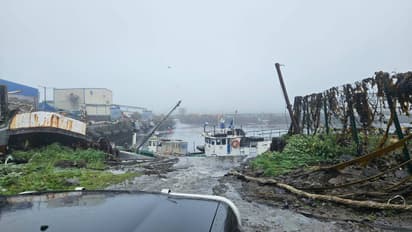
Synopsis
A massive earthquake triggered tsunamis in Russia and Japan, prompting Pacific-wide alerts. Here are key facts about how tsunamis form, why they are so destructive, and the potential damage they can cause to coastal regions worldwide.
Tokyo: Tsunami alerts were issued across much of the Pacific on Wednesday after an 8.8 magnitude earthquake off Russia's far east.
Here are key facts about tsunamis and the damage they can cause:
Shock Of Water: How Are Tsunamis Triggered?
A tsunami is a shock of water that spreads through the sea, usually triggered by a strong earthquake beneath the ocean floor.
The sudden, violent movement of the Earth's crust can thrust up or drive down a section of the seabed -- with the rift displacing vast quantities of water that move as waves.
Tsunamis radiate in all directions from their source and can cover enormous distances, sometimes at the speed of a jet plane.
They are a rare phenomenon but can create dangerously powerful currents and cause deadly flooding in coastal areas.
Other Causes Of Tsunamis Beyond Earthquakes
Large quakes are the main driver of tsunamis, but the phenomenon can also be sparked by other cataclysmic geographic events, such as volcanic eruptions and landslides.
In 1883, a volcano shattered the Pacific island of Krakatoa, causing a blast that could be heard 4,500 kilometres (2,800 miles) away, followed by a tsunami that killed around 30,000 people.
Large storms or a meteorite falling into the ocean can also be powerful enough to cause a tsunami, according to the US National Oceanic and Atmospheric Administration.
Meaning Of The Word ‘Tsunami’ Or ‘Harbour Wave
The word "tsunami" comes from the Japanese words for "harbour" and "wave".
Tsunamis are sometimes referred to as "tidal waves" but experts say this is inaccurate because they are not related to tides.
At their point of generation, tsunamis have a relatively small wave height, with peaks far apart.
As the waves approach the shore they are compressed by the shelving of the sea floor, reducing the distance between the peaks and vastly increasing the height.
When they hit the coast, tsunami waves can strike repeatedly over several hours, or even days.
Historical Accounts: Roman Historian’s Observation
To those on the shore, the first sign of something amiss can be the retreat of the sea, which is followed by the arrival of large waves.
"The sea was driven back, and its waters flowed away to such an extent that the deep seabed was laid bare and many kinds of sea creatures could be seen," wrote Roman author Ammianus Marcellinus of a tsunami that struck Alexandria in 365 AD.
"Huge masses of water flowed back when least expected, and now overwhelmed and killed many thousands of people... some great ships were hurled by the fury of the waves onto the rooftops."
Factors That Determine Tsunami Damage
Several factors determine the height and destructiveness of a tsunami.
They include the size of the quake, the volume of displaced water, the topography of the sea floor and whether there are natural obstacles that dampen the shock.
The Pacific Ocean is particularly prone to earthquakes and therefore to tsunamis, but over the millennia tsunamis have occurred in many parts of the world.
2004 Indian Ocean Tsunami’s Devastating Impact
The tsunami of December 2004 in the Indian Ocean was caused by a 9.1 magnitude earthquake off the Indonesian island of Sumatra.
It released energy equivalent to 23,000 of the atomic bombs dropped on Hiroshima, according to the US Geological Survey (USGS). Around 220,000 people in 11 nations were killed, many of them thousands of kilometres from the epicentre.