Trump's Abraham Accords plan faces pushback from Pakistan, Turkey
Synopsis
Donald Trump's effort to expand the Abraham Accords by linking it to an Iran deal faces regional pushback. Pakistan has rejected the idea, while Turkey may be open to a deal. Saudi Arabia's participation remains a major question mark.
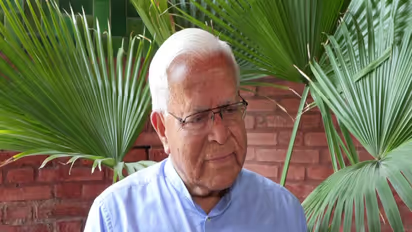
US President Donald Trump's bid to link a potential Iran peace deal to an expanded Abraham Accords has sparked immediate pushback, with key regional powers voicing scepticism or outright rejecting the proposal. Speaking with ANI, former diplomat Ashok Sajjanhar on Wednesday highlighted that Turkey could potentially be persuaded to join through a strategic "give-and-take" arrangement; he remains cautious regarding others. "We must recognise that Turkey has had relations with Israel for a long time and only recently severed them. If there is enough pressure or a "give-and-take" arrangement, Turkey might be persuaded to join the Abraham Accords," said Sajjanhar.
Regional Reactions to US Proposal
Meanwhile, Islamabad has issued a blunt rejection. Defence Minister Khawaja Muhammad Asif stated that joining the accords would clash with the country's "fundamental ideologies." In a televised interview, Asif reaffirmed Pakistan's long-standing policy: no recognition of Israel until the establishment of an independent Palestinian state. He further highlighted the symbolic nature of this resistance, noting that Pakistan remains the only country in the world that does not include Israel's name on its passports.
"For Pakistan, joining is likely more difficult. Donald Trump has insisted that countries like Saudi Arabia and Qatar join, though he has not explicitly mentioned Oman or Kuwait, which are also GCC members. The UAE and Bahrain joined in 2020," said the former diplomat.
"Saudi Arabia remains a significant question mark," Sajjanhar remarked, noting that Riyadh's participation will likely hinge on concrete security guarantees. Long considered the "crown jewel" of potential expansion, the Saudi Kingdom remains the most significant question mark. While Crown Prince Mohammed bin Salman has previously expressed openness to normalisation, Riyadh maintains that any such move must be contingent upon a "clear path" to Palestinian sovereignty. Despite Trump's insistence that the Kingdom and Qatar sign on "immediately," the Saudis appear hesitant to bypass the core requirement of a two-state solution amid heightened regional sensitivities.
Sajjanhar argued that for these nations, normalisation of ties with Israel is inextricably linked to the protection of vital maritime passages, including the Strait of Hormuz, the Bab-el-Mandeb Strait, the Red Sea, and the Suez Canal. "It might be persuaded if joining ensures its own security, specifically the ability to export oil through the Strait of Hormuz and the maintenance of open passage through the Bab-el-Mandeb Strait, the Red Sea, and the Suez Canal," Sajjanhar added.
As the US seeks to cement a broader West Asian realignment alongside efforts to end the ongoing conflict, President Trump has issued an ambitious call for nations, including Saudi Arabia, Turkey, and Pakistan, to join the US-brokered agreements that normalise relations with Israel. While Turkey has maintained formal diplomatic relations with Israel for decades, President Trump's call for them to join the Abraham Accords represents an effort to turn private, often strained, diplomatic ties into a public commitment to the US-led framework. Analysts suggest that while Turkey might be more pliable than Pakistan under the right "give-and-take" conditions, the move remains a delicate diplomatic challenge for Ankara, especially given recent tensions and domestic political dynamics.
Strait of Hormuz Closure Triggers Global Economic Crisis
Sajjanhar also issued a stark warning regarding the global economic paralysis caused by the ongoing closure of the Strait of Hormuz. Sajjanhar highlighted that even as diplomatic efforts--including a potential US-Iran memorandum of understanding--seek to de-escalate hostilities, the world faces a long road to recovery. "Tomorrow marks the three-month anniversary of the war that began on February 28th. While there has been a ceasefire for about seven weeks, there needs to be an end to the problems the world is facing, particularly regarding the Strait of Hormuz. The conflict between the US, Israel, and Iran has its own complications and implications, but the global economy is suffering primarily from the closure of the Strait," he said.
According to the diplomat, damage sustained by critical energy infrastructure in the region means that even if the shipping lanes reopen immediately, the global energy supply chain may not fully normalise until the beginning of 2027. "Hundreds of ships and oil tankers are trapped in the Persian Gulf, unable to exit a gateway that supplies 20 per cent of global gas and oil. This blockage affects not only fossil fuels but also fertilisers, helium, and sulfur. Furthermore, global exports are failing to reach Gulf and West Asian countries, resulting in a massive adverse impact on the global economy," he added.
Sajjanhar noted that the impact extends far beyond crude oil, the blockade has severely restricted the flow of fertilisers, helium, and sulfur. Sustained conflict has crippled refineries and oil fields across Qatar, the UAE, and Saudi Arabia, necessitating extensive repairs that will extend well into next year. Global exports to West Asian and Gulf nations have ground to a halt, creating a compounding effect on international trade.
"The closure of the Strait of Hormuz began in early March. While there have been occasional moments of relief for global oil importers, the damage Iran has inflicted on refineries and oil fields in Qatar, the UAE, and Saudi Arabia will take a very long time to repair. It may take until the beginning of 2027 for these facilities to come back on stream. Even if hostilities halt and shipping through the Strait is restored, it will still take quite some time for normal energy supplies to be resumed from the Persian Gulf to the rest of the world," he said.
While reports from Iranian state media suggest that a draft memorandum of understanding between the US and Iran is currently under consideration to de-escalate tensions, experts warn that the economic "ceasefire" will not be an immediate fix. Sajjanhar emphasised that the physical destruction of energy facilities, combined with the logistical backlog of stranded shipping, ensures that the global economy will continue to feel the tremors of this crisis for several months, if not the remainder of the year.
(Except for the headline, this story has not been edited by Asianet Newsable English staff and is published from a syndicated feed.)