Trump Unveils Vision for Florida Aerospace Hub Rivaling Paris Air Show
Synopsis
President Trump revealed plans for a massive 1,900-acre aerospace hub in Florida, aiming to eclipse the Paris Air Show by integrating commercial aviation and space technology, while reiterating commitments to lunar and Martian exploration.
Trump Proposes Massive Aerospace Exhibition Venue
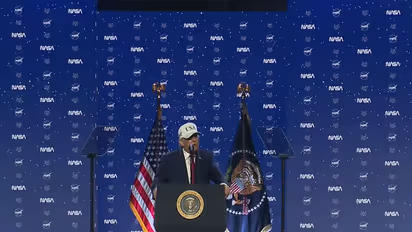
United States President Donald Trump has laid out a blueprint for a sprawling aerospace exhibition venue situated at Florida’s former space shuttle landing facility, pledging an event capable of overshadowing the Paris Air Show within roughly two years. Addressing audiences at the Kennedy Space Center during the MAX POWER aerospace technology expo, running from November 6 to 8, Trump detailed that the proposed 1,900-acre venue is designed to integrate commercial aircraft, private aviation and space technology, thereby equipping domestic manufacturers with an expanded stage to debut products and secure deals onshore.
"We're going to have a show the likes of which has never been done before," Trump asserted. Drawing comparisons to major aerospace exhibitions held in Paris, Britain and Dubai, the president contended that the United States ought to anchor the pre-eminent global showcase, given the dominant market share held by American firms. “We dominate and we should have the biggest show,” he remarked.
Economic and Logistical Impact
Estimates provided by the administration forecast hundreds of thousands of annual attendees, multi-billion-dollar economic boosts and astronomical commercial deals. Highlighting logistical benefits, Trump underscored that the local runway and surrounding land offer ideal capacity for handling heavy aircraft displays, space demonstrations and new exhibition buildings, with phased expansions scheduled over the coming years.
Strategic Goals for Space and Aviation
Lunar and Deep-Space Exploration
The proposal formed the core of his remarks at the event, where he lauded NASA Administrator Jared Isaacman and tied the exhibition project to broader strategic targets spanning American aviation, manufacturing and outer space exploration. Reaffirming domestic space milestones, Trump reiterated objectives to land American astronauts on the lunar surface before the conclusion of his current term, paving the way for a permanent lunar footprint. According to NASA’s published programme, the Artemis III mission is slated to validate integrated architectures in Earth orbit by 2027, setting the stage for an Artemis IV lunar landing targeted for 2028.
Additionally, Trump renewed commitments to deploying a nuclear-powered spacecraft bound for Mars. NASA officially unveiled the Space Reactor-1 Freedom initiative in March, scheduling lift-off before late 2028. This unmanned robotic mission aims to showcase nuclear electric propulsion across deep-space environments while deploying a swarm of small helicopters designed to map Martian terrain. Agency officials noted that this undertaking remains distinct from crewed planetary exploration horizons.
Future of Commercial Aviation
Shifting towards commercial aviation trends, Trump reflected on past experiences travelling on Concorde, expressing regret over the demise of supersonic passenger service. “This may be the only industry in the world where we've gone backwards,” he observed. Adding an optimistic note, he vowed, “But no more, no more we're going way forward.” The president championed ongoing research targeting supersonic aircraft capable of cruising without producing disruptive sonic booms, alongside advancements in unmanned aerial drones, electric vertical take-off and landing vehicles, and pilotless flight systems. Trump framed the proposed Florida exhibition as an integrated ecosystem where major commercial aircraft manufacturers and cutting-edge transport innovators can converge alongside the broader space exploration sector. (ANI)