Trump Asked for Help in Iran. Why Europe Kept Its Distance | Explained
Synopsis
European allies initially supported the US stance against Iran due to shared security concerns but soon hesitated. The primary turning point was economic, as rising fuel prices from Gulf disruptions caused significant financial strain and inflation in Europe. This led to widespread public opposition.
Why Europe Initially Backed Washington on Iran
When the United States intensified its military posture against Iran, many European allies initially appeared willing to stand beside Washington. Several governments shared longstanding concerns over Tehran’s nuclear programme, regional influence, and repeated threats to maritime security in the Gulf. At the beginning of the crisis, European capitals publicly supported efforts to contain Iran, hoping that a show of Western unity could pressure Tehran back to negotiations.
But beneath that early support, there were signs of discomfort. European leaders were uneasy about the pace of escalation and worried that military action could rapidly spill into a wider regional war. Unlike previous conflicts where NATO allies coordinated strategy from the start, many officials felt the United States was moving faster than its partners were prepared to follow.
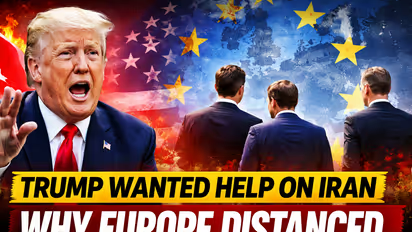
The strain became visible after US President Donald Trump reportedly sought stronger public support from European allies for a tougher campaign against Iran. Instead of deeper commitment, he encountered hesitation. According to the report, Trump later voiced frustration over the lack of solidarity from allies that had traditionally aligned with Washington during security crises.
Trump wrote on Truth Social: “NATO wasn't there when we needed them… and they won't be there if we need them again.”
That message reflected growing anger inside Washington that Europe was beginning to distance itself from a conflict the White House believed required united Western backing.
Also Read: Report Raises Questions Over China’s Role in Iran’s Tracking of US Bases
Rising Fuel Prices Changed the Political Mood
The biggest turning point was not diplomacy — it was energy.
As tensions in the Gulf disrupted shipping routes near the Strait of Hormuz, Europe began to feel the economic consequences almost immediately. The region remains heavily dependent on imported oil and natural gas, and even minor disruptions in the waterway can send prices sharply higher across the continent.
The report says the impact was severe. In just the first month of the conflict, Europe’s additional fossil fuel costs reportedly climbed to $16.2 billion, rising to nearly $25 billion by the 44th day of the crisis.
Petrol prices rose quickly in multiple countries. Transportation costs increased, electricity bills climbed, and inflation pressures returned at a time when many European economies were only beginning to stabilize after years of financial uncertainty.
The report notes that eurozone inflation moved from 1.9 percent in February to 2.5 percent in March, largely due to the sudden jump in energy prices. For governments already struggling with slow growth and voter frustration, the Iran crisis became more than a foreign policy issue — it became a domestic political problem.
European officials feared that if the conflict dragged on, energy costs could remain elevated for months, forcing governments to spend billions more on subsidies or face a wave of public anger over household expenses.
That economic reality began reshaping Europe’s position faster than any diplomatic pressure from Washington.
Also Read: UN chief Guterres calls for dialogue amid 'profound' global tensions
Public Pressure Forced Leaders to Reconsider
As fuel costs surged, public opinion shifted sharply against deeper involvement in the Iran conflict.
Across Europe, voters increasingly viewed the war as an American-led crisis that threatened European stability without offering any clear benefit. In countries already dealing with inflation fatigue, rising mortgage costs, and slower growth, many people questioned why their governments should support a confrontation that was making everyday life more expensive.
In France, polling cited in the report showed that nearly 60 percent of respondents now viewed Trump as an “enemy of Europe.” In Spain, more than 70 percent of voters opposed military involvement linked to the crisis. Similar sentiment began emerging in Germany and the United Kingdom.
That pressure pushed leaders into a difficult position. Supporting Washington risked political backlash at home, while opposing the United States could create tension within the transatlantic alliance.
Spain became one of the clearest examples of the shift. Prime Minister Pedro Sánchez strongly criticized the conflict and described it as: “Illegal, cruel, and absurd.”
His government later moved to restrict military cooperation linked to operations in the region, signalling that Madrid no longer wanted to be seen as endorsing Washington’s approach.
Italy also showed signs of hesitation. Prime Minister Giorgia Meloni, who had once maintained close ties with the US administration, reportedly grew more cautious as public concern over energy costs intensified. Other governments quietly adopted a similar stance — avoiding direct confrontation with Washington while stepping back from visible support.
The message from European voters was becoming difficult for leaders to ignore: domestic economic stability mattered more than political loyalty abroad.
Also Read: US naval blockade 'squeezing economic life' out of Iran: White House
A Wider Shift in the Transatlantic Relationship
The immediate issue may be fuel prices, but analysts say the deeper story is strategic.
The Iran crisis has exposed a growing divide between the United States and Europe over how future conflicts should be handled. For years, Washington could usually rely on its European allies during major security crises. This time, economic vulnerability changed the calculation.
Many European policymakers now believe that the continent can no longer automatically support US military decisions when the economic consequences fall disproportionately on European households. The conflict has renewed debate over Europe’s dependence on foreign energy supplies and its broader reliance on American security policy.
Some officials worry that if the war continues, the political damage could outlast the conflict itself. Energy insecurity has become one of the most sensitive issues in European politics, and governments are under increasing pressure to prioritize domestic resilience over alliance commitments.
The report suggests that Europe’s response to the Iran conflict may mark a turning point. Rather than openly breaking with Washington, European leaders are choosing a quieter strategy — keeping diplomatic ties intact while creating more distance from military decisions they do not fully control.
For Trump, that hesitation has become a sign that traditional alliances are no longer as automatic as they once were.
For Europe, the crisis has become a reminder that geopolitical wars abroad can quickly become political crises at home.
And for the wider world, the growing divide between Washington and its allies could reshape how future global conflicts are managed — especially when the price of oil becomes the price of political support.
Also Read: Trump Turmoil Sees Spain's Sanchez Emerge As Progressive Star