Schools, Villages, Rooftops: The Anatomy of Pakistan's Militarised Civilian Landscape
Synopsis
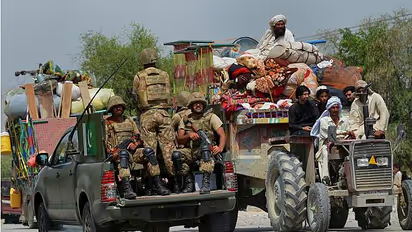
Reports surrounding the May 2025 military operations along the India-Pakistan border have emerged, with allegations that the Pakistan Army positioned military assets close to civilian populations in several towns and villages.
New Delhi: Picture a Tuesday morning in Jandrot. Girls in uniforms walk through the gate of their school, backpacks bouncing, probably arguing about homework or laughing at something one of them said on the way. Their mothers watched them leave the house and went back to their morning chores. Their fathers headed to work. Nobody in that household was thinking about war.
But somewhere near that school - near those girls, those mothers, that ordinary morning, a drone launch site was reportedly being set up by the Pakistan Army. That is not an abstraction. That is a real school, with real children inside it, being placed in the shadow of a military target.
The places named in the reports from May 2025 are not remote military zones on some strategic map. They are the kinds of places that exist in every country, in every corner of the world – Jandrot, Zafarwal, Bareela Sharif, Kotla, the area near Bunguna Sahib Singh School. Villages where the evening smells like cooking fires. Towns where shopkeepers know their customers by name. Settlements where children play in the lanes between houses and old men sit in the shade of trees they have known their whole lives.
Into these places, according to multiple reports and social media footage from the May 2025 operations, the Pakistan Army reportedly brought its weapons. Consider the family living in the house in Zafarwal.
An RBS-70 MANPADS – a man-portable air defence missile system, sophisticated enough to bring down aircraft – was reportedly placed on the roof of a civilian home in that town. Somebody lives in that house. Possibly a family with children sleeping in the rooms below. Possibly elderly parents. Possibly newlyweds who saved for years to build it.
The moment that missile system was set up on their roof, their home stopped being a protected civilian dwelling under the laws of armed conflict. It became, legally and practically, a military target. The family inside who almost certainly had no say in the matter were now living inside a potential strike zone.
Did anyone knock on their door and explain that to them?
In Bareela Sharif village, photographs and videos circulating on social media appeared to show the SH-15 Mounted Gun System, a heavy artillery platform, Chinese-origin, recently inducted by Pakistan – positioned inside what is clearly a populated residential area. Artillery of that calibre does not just sit quietly. It fires. It makes the ground shake. It announces itself across every home within earshot.
And it draws return fire.
A second SH-15 was reportedly placed near the Rawalakot Advance Landing Ground, close to civilian habitations. An air defence gun system appeared in Kotla village, Gujrat. Artillery was reportedly set up near Bunguna Sahib Singh School. The pattern, place by place and incident by incident, tells a consistent story, not of a military making difficult choices under pressure, but of a military that has made a deliberate and calculated decision to nest its weapons inside the lives of ordinary people.
There is a phrase that gets used in military and legal analysis: “incidental civilian harm.” It refers to the unavoidable, tragic reality that civilians sometimes suffer in war even when the parties are doing their best to prevent it. It is a concept designed to acknowledge human cost while maintaining the distinction between accident and intent.
What is described in these reports is not incidental. It is the opposite of incidental. It is the choice made in planning rooms, signed off by commanders to position guns in villages, launch sites near schools, and missile systems on rooftops.
The civilian population is not an unfortunate bystander to this strategy. The civilian population is the strategy.
India's conduct during Operation Sindoor is worth noting here, precisely because of the contrast it offers. Despite being aware that military assets were embedded within civilian areas, Indian forces reportedly held back from striking those locations. That restraint had a cost – military assets remained operational that might otherwise have been neutralised. But the decision reflected a clear moral priority: the lives of civilians, even civilians in territory controlled by an adversary, were not to be traded for tactical advantage.
The Pakistan Army made a different calculation. Its weapons sit in the same neighbourhoods as the children, the grandmothers, the shopkeepers. Its launch sites are adjacent to the schools. Its missile systems are on the rooftops.
The people living in these places in Jandrot and Zafarwal, in Bareela Sharif and Kotla – deserve to be seen as what they are: human beings who did not choose any of this, who were not consulted, and who are now living inside a military target because their own army decided their neighbourhood was a convenient place to put a gun. They deserve better. And the world should be asking, loudly and clearly, why they are not getting it.