Taliban Legalises Domestic Violence Without “Broken Bones”, Global Outrage Grows
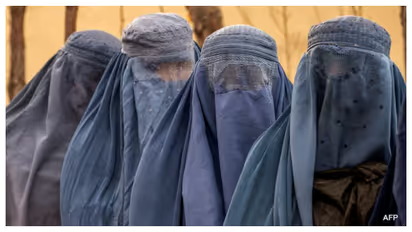
Synopsis
The Taliban has introduced a new penal code in Afghanistan that permits domestic violence against women and children, provided it does not cause visible injuries like broken bones.
The Taliban has introduced a controversial new penal code in Afghanistan that critics say effectively legalises domestic violence, provided it does not result in visible injuries such as “broken bones or open wounds.” The move has triggered widespread international concern, with human rights groups warning that it institutionalises abuse and further erodes protections for women and children.
According to reports, the 90-page penal code, approved by the Taliban’s supreme leader Hibatullah Akhundzada, allows husbands to physically punish wives and children within these limits. Even in cases where abuse crosses that threshold, the punishment is minimal, with offenders facing a maximum of just 15 days in prison.
The law marks a significant rollback of earlier legal safeguards, notably abolishing the 2009 Elimination of Violence Against Women (EVAW) law, which had provided some protection against abuse under the previous government. By removing these safeguards, the new framework leaves victims with little legal recourse and reinforces a system that critics say favours perpetrators.
Another alarming aspect of the code is its requirement that victims present visible physical evidence of abuse in court. This creates a near-impossible burden of proof, especially in a society where women’s mobility is heavily restricted and access to legal systems is limited. In many cases, women must be accompanied by a male guardian—often the abuser—making it even harder to report violence or seek justice.
The penal code also introduces discriminatory legal distinctions, with punishments varying based on social status, including categories such as “free” individuals and others. Observers say this embeds inequality into the justice system and further marginalises vulnerable groups. Additionally, the law reportedly does not explicitly address psychological or sexual violence, leaving major forms of abuse unrecognised.
Global Outrage Grows Louder
Human rights organisations and international observers have strongly condemned the development, describing it as a dangerous step backward for women’s rights in Afghanistan. Critics argue that the law normalises domestic violence and reflects a broader pattern of restrictions imposed since the Taliban regained power in 2021. These include limits on women’s education, employment, and freedom of movement, making Afghanistan one of the most restrictive environments for women globally.
The situation has also raised concerns about freedom of expression. Reports indicate that even discussing or criticising the new penal code could be considered an offence, further silencing dissent and limiting public debate.
Overall, the new law has intensified global scrutiny of the Taliban’s governance and its treatment of women, with calls growing for international intervention and accountability. Critics warn that without sustained pressure, such policies risk becoming entrenched, deepening the humanitarian and human rights crisis in Afghanistan.