SpaceX Rocket to Hit Moon at 8,700 km/h This Week; Scientists Eager for Rare Experiment
Synopsis
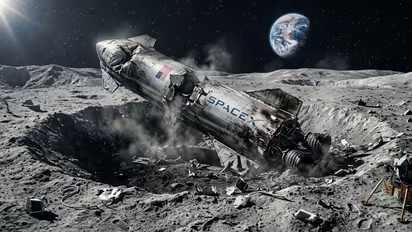
A piece of a SpaceX Falcon-9 rocket, lost in space for a year, is now set to crash into the Moon. While it's an accident, scientists are seeing it as a golden chance to study how craters are formed and how Moon dust flies.
Washington: A piece of a SpaceX rocket, which has been wandering around in space for nearly a year, is set to crash-land on the Moon this Wednesday. This isn't a planned event. But scientists aren't worried, as it poses no threat to Earth or any ongoing Moon missions. Instead, they're looking forward to using this crash for research.
The Falcon-9's Journey
The Falcon-9 rocket had a mission on January 15, 2025. It was carrying Firefly Aerospace's "Blue Ghost" lander and Japan's ispace Hakuto-R lander to the Moon. After successfully dropping off both spacecraft at their destinations, the rocket's upper stage had done its job. But it didn't have enough fuel to either come back to Earth or fly into an orbit around the Sun. So, it got stuck in a chaotic orbit, pulled by the gravity of the Earth, Moon, and Sun. Now, the Moon's strong gravitational pull has finally caught it, and it's expected to crash on Wednesday.
The Impact
The rocket part is travelling at a crazy speed of 8,700 km/h, which is more than seven times the speed of sound on Earth. It's expected to hit the Moon near a place called the Einstein crater. This impact is estimated to create a crater about 90 feet wide and 16 feet deep. Luckily, the impact area will be in sunlight, which will make it easier for scientists to watch the whole thing happen.
What's the Use?
For scientists, this natural event is a big deal. They already know the rocket's size, weight, speed, and the exact time of impact. This will help them study how craters form on the Moon. They can also see how the Moon's dust reacts to an impact, how high it gets thrown up, and what happens next.
Not the First Time
This isn't the first time a rocket is hitting the Moon. Earlier, during the Apollo missions, NASA intentionally crashed rocket parts to study 'moonquakes'. In 2009, they did something similar to look for water ice. A rocket part also crashed into the Moon in 2022. Even India's Chandrayaan-1 orbiter, back in 2008, dropped a 32 kg cube to kick up dust and debris for study. And we all remember how the Vikram lander unfortunately crashed in 2019 due to a technical problem.
Is There Any Danger?
Right now, this crash doesn't pose a threat to any active projects. However, if parts of rockets sent from Earth keep crashing on the Moon, it will increase the amount of space junk. This could definitely create problems for future missions.