Somalia's Defence Dilemma: Will Competing Agendas of US, Turkey, Pakistan & Gulf States Tear Its Army Apart?
Synopsis
Somalia’s military struggles with a patchwork of foreign training and aid from Turkey, the US, Pakistan, and Gulf states. Competing doctrines and loyalties risk dividing the army, undermining cohesion, and threatening national sovereignty.
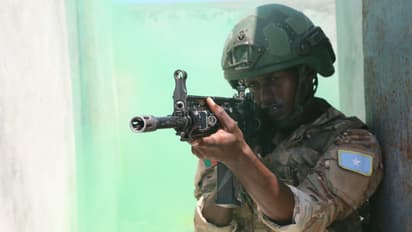
New Delhi: Despite years of war, Somalia has struggled to rebuild its security forces after years of war, terrorism and political instability for decades now. It is doing this by taking help from several countries. Yet, every time a new ally comes by and promises to help, the country's defence structures suffer and are only get divided. Today, Somalia’s army finds itself pulled in different directions. Trained by Turkey, advised by the United States, supplied by Pakistan and courted by the Gulf states. What looks like cooperation on paper is, in reality, a complex web of competing models and interests.
A Patchwork Army
Somalia’s military revival began only after 2012 when the federal government was formed and international partners pledged support. But each country brought its own system.
Turkey built military bases in Mogadishu and offered intensive training and weapons supply. The US, on the other hand, is focused on counterterrorism and helps with training elite units to fight al-Shabaab.
With Pakistan now stepping in with its own defence agreement, another layer of influence gets added to this complex web.
The result is a patchwork army. Here, units trained by different countries use different command methods, languages and equipment. Instead of forming one national defence identity, Somalia risks building multiple mini-armies, each loyal to its trainers’ doctrine with no cohesion whatsoever.
The Turkish Model
Turkey has emerged as Somalia’s most visible defence partner. Its base, “Turksom,” is one of Ankara’s largest overseas facilities. Turkish trainers focus on discipline, modern infantry tactics, and loyalty to the Somali state. Thousands of Somali soldiers have graduated under this program, and Turkey also supplies weapons and logistics.
However, Turkey’s growing presence benefits Ankara more. It has more influence in the Horn of Africa and it strengthens its reach in the Red Sea trade, giving it leverage over rival Gulf powers. For Somalia, Turkish support brings professionalism and also dependence on a foreign system that may not always align with local realities.
Pakistan’s Entry
Pakistan’s recent entry into Somalia’s defence landscape is seen as an effort to deepen Muslim-world cooperation. This, in turn, would help Pakistan counterbalance India’s expanding footprint in East Africa. Islamabad has offered training programmes, naval cooperation as well as intelligence support to Somalia.
While this could add value, it also risks overlapping with existing Turkish or American models. Each ally’s training style, whether it’s NATO-inspired or rooted in Pakistani doctrines, affects the army’s structure and discipline differently, at the end of the day. For a fragile state such as Somalia, such inconsistency can easily create divisions among units, leading to competition and confusion.
Somalia’s security web is not limited to Turkey and Pakistan. The US maintains drone operations and special forces missions, while the European Union funds police and coastguard programmes.
The UAE and Qatar compete for political influence through funding and arms deals. Ethiopia and Kenya, despite being part of regional security efforts, also pursue their own border interests.
Every partner claims to help Somalia stand on its own feet. However, their motives are rarely neutral. For most, Somalia is not just a weak state in need of support.
It’s a strategic foothold in the Red Sea and Indian Ocean corridors. As these powers jostle for influence, Mogadishu’s sovereignty gets caught in the middle.
The Cost of Too Many Partners
The lack of coordination among Somalia’s defence partners has created confusion at both command and policy levels. Weapons and communication systems often don’t match, supply chains are irregular and troops trained abroad return with different loyalties.
Even more concerning is that some regions, such as Puntland or Jubaland maintain their own local forces. Sometimes, backed by separate foreign actors. This divides the security architecture and delays the creation of a unified national army, crucial for Somalia’s stability.
Balancing Independence and Assistance
Somalia’s leadership faces a delicate challenge. They recognise that the country needs foreign aid to combat terrorism and rebuild its institutions, but excessive dependence risks compromising sovereignty. A long-term defence policy that aligns all training, procurement, and command under a single national framework is urgently needed.
For that, Mogadishu will have to take the driver’s seat, deciding what kind of army it wants before accepting what others offer. Otherwise, every new deal, no matter how generous, will come with a silent condition – to follow someone else’s playbook.
Somalia’s defence dilemma is not about a lack of help. It's about having too much of it, all pointing in different directions. Each ally may promise security, but together they risk creating new fault lines. For a country still healing from decades of conflict, the real test is not in finding partners. It’s in keeping its national interest at the centre of every partnership.
Somalia should create one clear national defence plan that all foreign partners must follow. This way, training, weapons, and command systems stay consistent, and the army truly serves Somalia – not the interests of other countries.