'ChatGPT Said It Was Safe': Grieving US Mother Exposes AI's Role in Teen's Death, Calls For AI Safety Laws
Synopsis
A mother told a US hearing that ChatGPT advised her son about drugs before he died after taking kratom, Xanax and alcohol in May 2025. She said he had sought safety advice in over 700 chats. His family has sued OpenAI, which said the model involved has since been discontinued. The case remains unresolved in court as lawmakers debate AI safety.
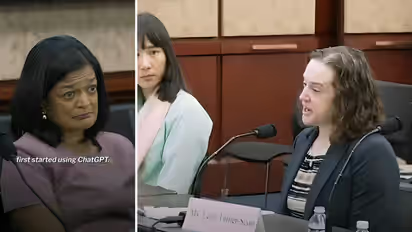
Leila Turner-Scott, the mother of 19-year-old Sam Nelson, gave an emotional account at a US House-hosted shadow hearing on Thursday, alleging that ChatGPT gave her son dangerous drug advice before his fatal overdose. Nelson, a University of California, Merced student, died in California on May 31, 2025, after taking kratom, Xanax and alcohol. His parents later sued OpenAI, alleging that ChatGPT's advice contributed to his death. The case remains unresolved.
'ChatGPT changed from refusing to answering'
Turner-Scott told the hearing that her son had used ChatGPT for everyday questions, including homework and pop culture, before he began asking the chatbot about drugs.
She said she reviewed more than 700 chat logs from his account and believed the conversations showed that Sam was trying to understand how to use substances safely rather than seeking to harm himself.
According to her testimony, ChatGPT initially refused to provide information about drug use. She said its responses later changed and that the chatbot began giving Sam advice about substances, including dosage information and combinations.
"Just hours before Sam died, ChatGPT had advised him that it was safe to mix kratom and Xanax," she said.
The allegation is also detailed in the family's lawsuit against OpenAI. The complaint says Nelson had been discussing drug use with ChatGPT for months and that the chatbot provided advice about combining kratom and Xanax before his death.
Sam's family says he trusted the chatbot
Turner-Scott said her son viewed ChatGPT as a source of information and believed it could help him make safer decisions.
She said the hundreds of conversations she reviewed showed a pattern of Sam asking questions about substances and their effects.
A 19-year-old California college student died because he trusted ChatGPT and his chatbot told him to take a deadly combination of drugs, a new lawsuit claims.
Sam Nelson was a junior studying psychology. His mother wrote, “Sam was a smart, happy, normal kid. I talked to him… pic.twitter.com/FzC8tAXmOP— KRON4 News (@kron4news) May 12, 2026
Her account has become part of a wider debate over whether AI chatbots should be allowed to provide health-related information, particularly when users are asking about potentially dangerous substances.
A January investigation by SFGATE (San Francisco-based news website), based partly on chat logs provided by Turner-Scott, reported that Sam had used ChatGPT for schoolwork, computer problems and popular culture as well as repeated questions about drugs. The report said the chatbot later gave him increasingly detailed drug-use advice.
What happened to Sam Nelson?
According to the lawsuit, Nelson died on May 31, 2025, after an accidental drug overdose. The complaint identifies kratom, alcohol and Xanax as being involved.
Kratom is made from the leaves of Mitragyna speciosa, a tree native to Southeast Asia. Its effects can vary depending on the amount consumed and can include stimulant and opioid-like effects.
🚨 A new lawsuit this morning alleges that 19 year old Sam Nelson was coached to his death by ChatGPT:
JO LING KENT: Who do you hold responsible for Sam's death?
LEILA SCOTT: OpenAI. And the creators, the people who bypassed safety guards and took away safety nets. pic.twitter.com/rWsTkq7mGm— Katie Miller (@KatieMiller) May 12, 2026
Xanax is the brand name for alprazolam, a prescription benzodiazepine used to treat anxiety and panic disorders.
Medical experts have warned about the risks of combining substances that can depress the central nervous system. A University of Chicago Law Review analysis of the Nelson case said toxicology results showed alprazolam and kratom in his system, alongside a blood alcohol concentration of 0.125.
OpenAI says the model has been discontinued
OpenAI has described Sam's death as heartbreaking and said the model involved in the conversations is no longer available.
OpenAI has also said it has made changes to its safety systems. The family's lawsuit, filed in California in May 2026, alleges negligence and other claims against OpenAI and seeks to hold the company responsible for Sam's death. Those allegations have not been established by a court.
What happened at the AI safety hearing?
The September 17 event was hosted by Democratic Representative Pramila Jayapal and described as a hearing on "Big Tech and Surveillance AI". It was not a conventional committee hearing, but Turner-Scott was among the witnesses who spoke about alleged harms linked to AI systems.
Jayapal used the event to call for greater scrutiny of AI companies, while former Meta researcher Jason Sattizahn also testified about what he described as pressure to prioritise engagement over safety.
Turner-Scott's testimony focused on the personal consequences of what she believes was an unsafe interaction between her son and an AI system.
Social media reacts to Sam Nelson's mother's testimony
Leila Turner-Scott’s testimony, shared by US Congresswoman Pramila Jayapal, drew strong reactions on social media, with many users expressing sympathy for the grieving mother and concern over AI safety.
Many social media users said children and students should not become overly dependent on chatbots for learning, with some arguing that AI was unnecessary for schoolwork. Others questioned why a chatbot could provide drug-related information when professionals selling or handling substances face restrictions on giving medical advice.
One said the testimony highlighted the risks of AI systems that may prioritise engagement over user safety. Another urged people to remember 14-year-old Sewell Setzer, whose family has also alleged that ChatGPT contributed to his suicide.
Some users, however, raised a different question, asking why the teenager was seeking drugs in the first place and suggesting that the broader causes of substance use also deserved attention. Several commenters thanked Turner-Scott for speaking publicly about her son’s death.
ChatGPT Told a College Kid How to Mix Kratom and Xanax. His Mother Found Him Dead the Next Afternoon.
Samuel “Sam” Nelson was 19, a UC Merced psychology student who wanted to help people. On May 31, 2025, his mother found him unresponsive in bed, lips blue. Alcohol, Xanax, and… pic.twitter.com/et9Ikf1NcB— The Lie Lamaa™ 🏹 (@TweetsOfLamaa_) September 18, 2026
Lawmakers are debating AI safeguards
The testimony comes as US lawmakers consider legislation aimed at protecting children and teenagers from potential harms linked to AI chatbots.
Senators Adam Schiff and John Curtis introduced the SAFE KIDS Act in June. The proposed legislation includes child-safety safeguards, restrictions on emotional manipulation or dependence, crisis-response requirements and independent safety audits for AI chatbot providers.
A separate bipartisan CHATBOT Act, backed by Senators Ted Cruz, Brian Schatz, Curtis and Schiff, would require family accounts and parental consent mechanisms for children and teenagers using AI chatbots. The Senate Commerce Committee advanced the legislation in August.