Russian 'Pearl Harbour': How New START Treaty left bombers exposed to Ukraine's drone attack
Synopsis
Ukraine’s drone strike on Russian bombers highlights vulnerabilities linked to New START Treaty rules requiring strategic nuclear-capable aircraft to be openly stationed for verification.
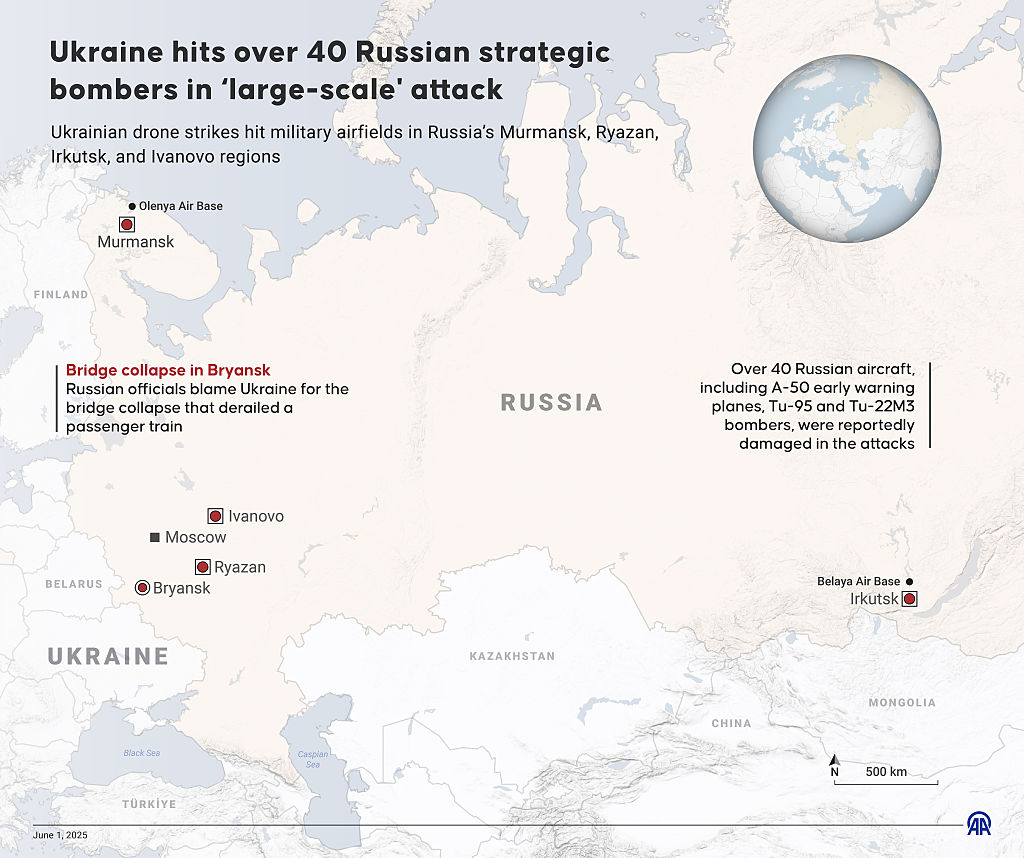
New Delhi: The world witnessed a massive Ukrainian drone strike targeting five military air bases deep inside Russia, resulting in the reported destruction of 40 strategic bomber aircraft. Among the damaged assets were A-50 airborne early warning planes, Tu-95, and Tu-22M3 bombers — each valued at approximately USD 7 million.
In a significant escalation, Ukraine is also reported to have targeted Russia’s Northern Fleet headquarters, the command center for the country’s nuclear submarine operations.
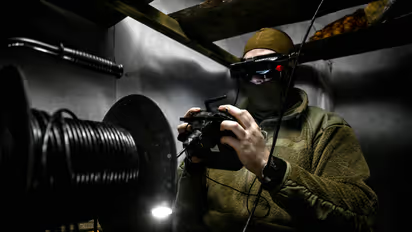
Social media platforms were flooded with videos showing how drones were covertly transported into mobile wooden sheds hidden inside shipping containers, smuggled deep into the rear of the Russian Federation. Once the trucks reached areas near the targeted air bases, the containers’ roofs were remotely opened—reportedly by the drivers, who were unaware of the drones concealed within. Ukraine had codenamed the audacious operation “Spider Web.”
The strike has sparked intense debate over Russia’s failure to safeguard its strategic bomber fleet. Many are questioning why such valuable aircraft were left so vulnerable. Some commentators have even described the attack as a “Russian Pearl Harbour.”
‘Ukraine’s short-term win could be world's long-term loss'
Former US Army Lieutenant General Michael Flynn, who also served as the 24th national security advisor under the first Donald Trump administration, stated that the Russian bombers could have been parked in the open due to nuclear treaty obligations.
“FYI (For Your Information), those bombers that were hit HAVE to be out in full view due to nuclear treaty obligations. Zelenskyy took advantage of that," he said.
“People, and especially world leaders, need to realize the global implications to such an operation as Ukraine just pulled off. Russia will respond. Action, reaction, counteraction. Those are the shifting tides of warfare. This wasn’t a bold action, it was brash,” Lt Gen Flynn added.
“Ukraine’s short-term win could be the world’s long-term loss,” he declared.
What is the New START Treaty?
General Flynn was referring to the nuclear treaty --- New START Treaty (Strategic Arms Reduction Treaty), which was inked between the United States and Russia in 2010 and entered into force from 2011.
With an intention to enhance global security and stability, the two countries had signed the treaty to reduce and limit their strategic nuclear arsenals, on April 8, 2010, in Prague by the then US President, Barack Obama and then Russian President Dmitry Medvedev.
The new treaty replaced the expired START I treaty and the 2002 Strategic Offensive Reductions Treaty (SORT).
The New START Treaty, extended until February 4, 2026, includes specific provisions for verifying strategic offensive weapons, including heavy bombers capable of carrying nuclear payloads.
The treaty requires that such bombers be stationed at sites “VISIBLE” to national technical means (NTM) of verification—such as satellite surveillance—to ensure transparency and enable monitoring by the other signatory party.
This implies that strategic bombers should be stationed in a way that makes them observable, typically at designated airbases, to confirm their status.
The New START Treaty establishes verifiable limits on strategic nuclear arsenals, capping the number of deployed strategic nuclear warheads at 1,550. It also restricts the number of deployed intercontinental ballistic missiles (ICBMs), submarine-launched ballistic missiles (SLBMs), and heavy bombers to 700, with a combined limit of 800 for both deployed and non-deployed launchers.
The treaty encompasses intercontinental ballistic missiles (ICBMs), submarine-launched ballistic missiles (SLBMs), and heavy bombers.
Under the category of heavy bombers, the Russian Tu-160 and Tu-95, along with the U.S. B-52G, B-52H, B-1B, and B-2A, are explicitly listed in the agreement.
It is important to note that while Russia suspended its participation in the New START in February 2023, the treaty remains legally in force until February 4, 2026.