Is Putin’s Poseidon Nuclear Underwater Torpedo a Doomsday Signal to the West?
Synopsis
Russia has tested its nuclear-powered Poseidon underwater drone, which President Putin claims can unleash radioactive tsunamis. Hailed as a “huge success,” the doomsday weapon could redefine global deterrence — or risk catastrophic escalation.
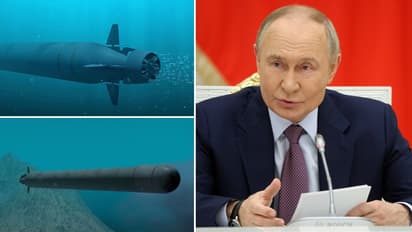
Russia has successfully tested its nuclear-capable, nuclear-powered underwater drone — the Poseidon — President Vladimir Putin announced on Wednesday. The weapon, long shrouded in secrecy and myth, is said to have the potential to unleash catastrophic radioactive tsunamis and devastate coastal cities. This is the second test of a nuclear-capable Russian weapon in a week, underscoring Moscow’s renewed focus on showcasing its strategic deterrence capabilities amid the ongoing war in Ukraine and escalating tensions with the West.
“There Is Nothing Like This”
Speaking while drinking tea with soldiers wounded in the Ukraine war at a Moscow hospital, Putin revealed that the test had taken place on Tuesday.
“For the first time, we managed not only to launch it with a launch engine from a carrier submarine, but also to launch the nuclear power unit on which this device passed a certain amount of time,” Putin said. “There is nothing like this.”
Calling it a “huge success,” he claimed that the Poseidon’s destructive power surpasses that of even Russia’s most advanced intercontinental missile.
“The Poseidon's power significantly exceeds the power of even our most promising Sarmat intercontinental range missile,” Putin said, referring to the SS-X-29, or simply Satan II.
The Return of Russia’s “Superweapons”
Putin’s comments come just days after he announced a successful test of another nuclear-capable weapon — the Burevestnik cruise missile — which he said carries a compact nuclear reactor “comparable in power to a submarine’s but 1,000 times smaller.”
He also hinted that Russia’s Sarmat ICBM, a heavy-lift nuclear missile capable of carrying multiple warheads, will soon enter combat duty.
“Yesterday, another test was conducted for another prospective system — the unmanned underwater device 'Poseidon,' also equipped with a nuclear power unit,” Putin said, adding that there was “no way to intercept” the drone.
A Weapon to Deter the West
When first unveiled in 2018, Poseidon was presented as part of Russia’s “invincible” next-generation strategic arsenal — weapons designed to bypass Western missile defence systems.
Putin has consistently framed these developments as a response to US withdrawal from the 1972 Anti-Ballistic Missile Treaty in 2001 and NATO’s eastward expansion.
What Exactly Is the Poseidon?
Also known by its NATO designation Kanyon and originally codenamed Status-6, the Poseidon is a nuclear-powered, autonomous underwater drone designed by Russia’s Rubin Design Bureau.
It is believed to function as a strategic retaliatory weapon, capable of carrying either a conventional or nuclear warhead of up to 2 megatons — about 133 times more powerful than the bomb dropped on Hiroshima.
Analysts describe it as a massive underwater torpedo — nearly 60 feet long, over 90 tons in weight, with a diameter of about 6.5 feet. It can dive to 3,280 feet (1 kilometre) and travel at speeds of up to 100 knots (115 mph).
Powered by a compact nuclear reactor, Poseidon reportedly has virtually unlimited range, allowing it to cross oceans and strike targets thousands of kilometres away — silently and undetected.
A “Radioactive Tsunami” Machine
What sets Poseidon apart from traditional nuclear weapons is its potential to cause environmental and economic devastation on an unprecedented scale.
According to Russian state media and military analysts, Poseidon could generate a radioactive tsunami up to 500 metres high, washing over entire coastal cities and rendering them uninhabitable for decades.
Russian propaganda TV expert Andrei Klintsevich once went as far as to say the weapon could “wipe out Britain under a nuclear tidal wave.”
He had said the Poseidon should be used “against Britain,” adding that it would “see the wave wash over Britain” as one Kremlin aim is to “wipe out” the UK.
A Myth or a Monster?
Despite Putin’s triumphant announcement, much about the Poseidon remains cloaked in secrecy — and even within military circles, its true capabilities are still a matter of speculation and debate.
In January 2024, Russia’s TASS reported that the first production batch of Poseidon torpedoes had been completed for deployment aboard the Belgorod nuclear submarine.
Defence analysts remain divided: some see Poseidon as a psychological weapon designed for nuclear deterrence, while others believe it represents a genuine technological leap.
Military expert HI Sutton, writing for Forbes in 2019, called Poseidon “one of the most disruptive weapons currently being developed. It is also one of the least well understood.”
An ‘Accidental’ Leak That Wasn’t?
Interestingly, Poseidon’s existence first came to light back in 2015, when two Kremlin-controlled TV channels — NTV and Channel One — appeared to accidentally broadcast a classified document showing blueprints for a weapon called Status-6.
The document described torpedoes capable of creating “zones of extensive radioactive contamination making them unsuitable for military or economic activity for a long period.”
Western observers, however, believe the “accident” was intentional — a calculated leak meant to send a chilling message to Washington and NATO.
Strategic Deterrent or Symbolic Show of Strength?
For Moscow, Poseidon is more than just a weapon — it is a statement of intent. The unveiling of these superweapons serves to reinforce Russia’s claim of technological parity with the West, even amid its costly and grinding war in Ukraine.
While the exact operational status of the Poseidon remains uncertain, Putin’s message is clear: Russia wants the world to know it possesses a doomsday device that no one can stop.
“There is nothing like this,” Putin said again, repeating his point for emphasis.
And for now, as the mystery around Poseidon deepens, the world can only watch — and wonder — whether this so-called “nuclear god of the sea” is a real superweapon or a symbol of Russia’s nuclear bravado.